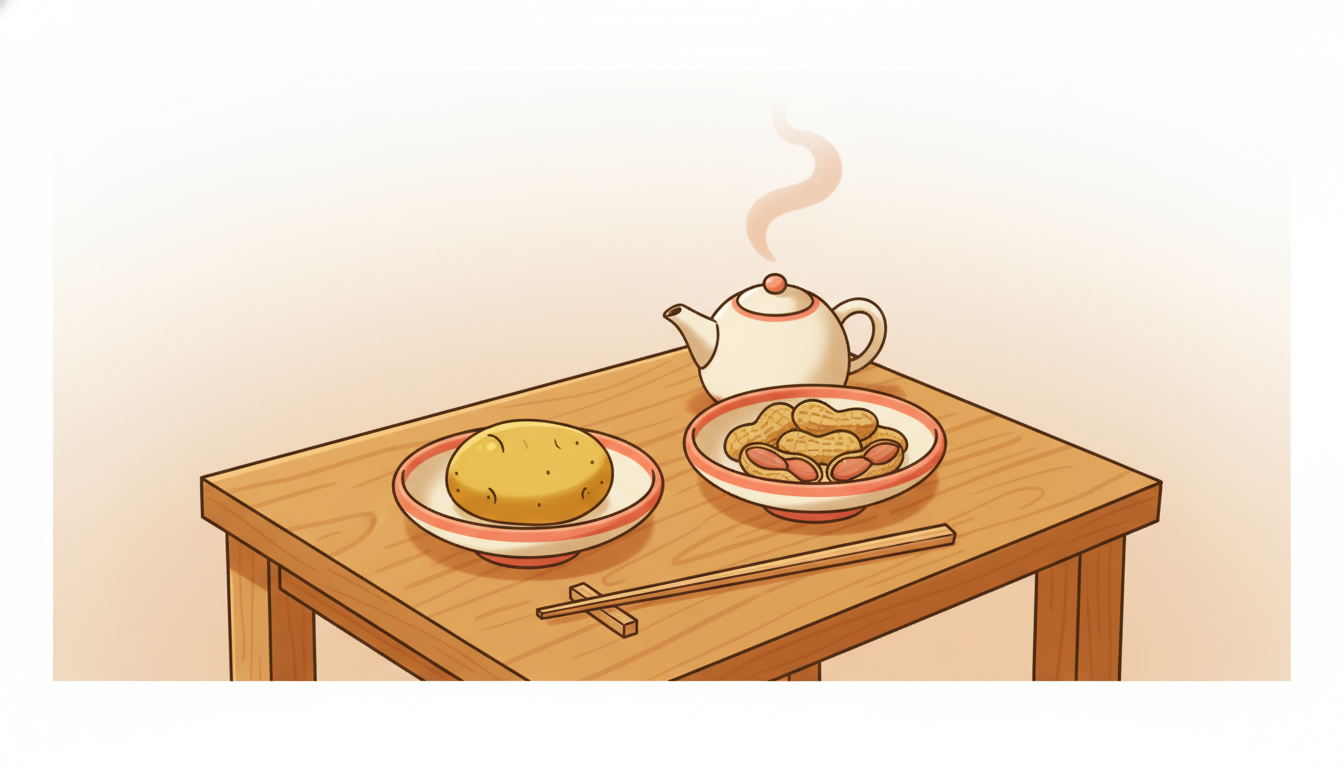
A friend of mine ordered 土豆丝 at a stall in Taipei expecting a plate of shredded potato and got a bowl of peanuts. She'd spent two years studying in Beijing where 土豆 means potato. In Taiwan, 土豆 means peanut. Potato in Taiwan is 馬鈴薯 (mǎ líng shǔ). It's the most-cited example of cross-strait vocabulary divergence for a reason. It really happens, and a 2023 textbook controversy over a Taiwan biology book using 土豆 instead of 馬鈴薯 made national news on the island.
If you've been studying Mandarin from a textbook, that textbook is almost certainly Mainland-default. Apps lean Beijing. Curricula lean Beijing. Most YouTube channels lean Beijing. Land in Taipei and you don't suddenly hit a different language. You hit a different register and a different word for half your kitchen. There are six concrete things that diverge, and the biggest one is the politeness gap that makes Taiwan Mandarin sound warm and Mainland-trained speakers sound clipped to a Taipei ear.
土豆 means peanut, and that's not the only word that flips
Ask for 出租车 (chūzūchē) at a hotel in Taipei and the front desk may need a beat to parse it. Ask for 計程車 (jìchéngchē) and you'll have a cab in three minutes. You'll always have a cab. Both words are mutually intelligible to anyone who reads news from the other side. The cross-strait vocabulary gap is mostly safe like that. Almost everything carries. A handful of words flip cleanly, and a few of them will get you the wrong thing on a plate or pointed at the wrong vehicle.
Both sides understand each other; the local word gets you the right cab and the right plate.
The word pairs that come up most often:
| English | Mainland | Taiwan |
|---|---|---|
| video | 视频 shìpín | 影片 yǐngpiàn |
| software | 软件 ruǎnjiàn | 軟體 ruǎntǐ |
| bus | 公交车 gōngjiāochē | 公車 gōngchē |
| taxi | 出租车 chūzūchē | 計程車 jìchéngchē |
| bicycle | 自行车 zìxíngchē | 腳踏車 jiǎotàchē |
| potato | 土豆 tǔdòu | 馬鈴薯 mǎlíngshǔ (土豆 means peanut) |
A few are also politeness or register shifts you'd miss. A taxi driver is 师傅 (shīfu) in Beijing and 司機 (sījī) in Taipei. "Excuse me" in casual Taipei is often 歹勢 (paiseh), a Hokkien loanword with no direct Mainland Mandarin equivalent.
The practical takeaway: if you're moving between regions, batch-relearn maybe twenty words and you've covered most of the daily vocab gap. Don't worry about the rest. People on both sides watch each other's TV shows and read each other's manga. They know.
zh, ch, sh become z, c, s in Taiwan
The "Taiwan sounds softer" thing has a name: retroflex merger. Mainland Mandarin (especially north of the Yangtze) curls the tongue back for zh, ch, sh. Taiwan Mandarin systematically softens these to alveolar z, c, s, pronounced with the tongue forward against the teeth.
Three words you'll hear the difference in immediately:
- 中 zhōng (middle) → in Taiwan, closer to zōng
- 车 chē (vehicle) → closer to cē
- 生 shēng (life, raw) → closer to sēng
This is systematic, not lazy. It's a regional feature on the same scale as a British speaker dropping the r in car. Mainland and Taiwan speakers understand each other without effort; the mouths are doing different things.
If you trained in Beijing and you're suddenly in Taipei, dialing back your retroflex by maybe 30 percent is enough to stop sounding theatrical. If you trained in Taiwan and you're heading north, expect natives to find your sh and zh slightly under-curled, which is fine. You're already speaking Mandarin and nobody will mock you for it.
Erhua (儿化音) is the Beijing tell
Walk down a street in Beijing and you'll hear an r glommed onto the end of about a third of all syllables. 哪儿 (nǎr, "where"), 一点儿 (yìdiǎnr, "a little"), 玩儿 (wánr, "play"), 好玩儿 (hǎowánr, "fun"). This is erhua, also called rhotacization, and it's a distinctly northern feature of Mandarin.
In Taiwan, it's almost entirely absent. The standard equivalents are full syllables: 哪裡 (nǎlǐ) instead of 哪兒, 一點點 (yìdiǎndiǎn) instead of 一點兒.
If you hear erhua in a conversation, you're listening to a Mainland speaker, probably from Beijing or somewhere north. If you don't hear it, you're either listening to someone from Taiwan or from southern China (Shanghai, Guangzhou, the Yangtze delta), where erhua is also rare.
For learners: Mainland-trained students should produce some erhua because their textbooks include it, but they should produce it sparingly. Mainland speakers from outside Beijing don't pile it on either. Taiwan-trained learners don't need to produce it at all.
Taiwan keeps the tones; Mainland eats them
A study cited in Wikipedia's Taiwanese Mandarin article found roughly 18% of common pronunciations differ between the two, and a big chunk of that is the neutral tone. Mainland Mandarin runs a lot of unstressed second syllables down to no tone at all. Taiwan Mandarin keeps them.
A handful of words you'll hear the difference in:
- 但是 (but): Mainland dànshi, Taiwan dànshì
- 先生 (mister, husband): Mainland xiānsheng, Taiwan xiānshēng
- 朋友 (friend): Mainland péngyou, Taiwan péngyǒu
- 喜欢 / 喜歡 (to like): Mainland xǐhuan, Taiwan xǐhuān
Most of what people mean when they say "Taiwan Mandarin sounds more singsong" or "more tonal" is this. The tones are still the same four (plus neutral). Both regions use the same system. You'll see online claims that Taiwan has five tones and Mainland has four. Skip those. Both have four tones plus a neutral tone, the difference is how often the neutral tone gets used, not the tone inventory.
If your tones are already shaky, the same shadow-and-compare loop that fixes tones for any Mandarin learner works on Taiwan-vs-Mainland prosody too. Pick a Taiwan speaker and a Mainland speaker reading the same word, record yourself, listen back. Your ears lie in real time; the recording tells the truth.
喔, 啦, 耶: Taiwan's politeness particles
你很聰明喔. Drop the 喔 and the same sentence, 你很聰明, lands flat in Taipei, faintly judgmental even. The 喔 is doing real work, and Taiwan Mandarin uses three sentence-final particles like it roughly an order of magnitude more than Mainland Mandarin uses any of its own:
- 喔 (o or ō): adds warmth, signals friendliness. 你很聰明喔 (nǐ hěn cōngmíng o) lands as "you're smart, you know?" The same sentence without 喔 reads in Taiwan as a flat statement, possibly cool.
- 啦 (la): adds emphasis, often with a touch of mild exasperation or finality. 我已經做完啦 (wǒ yǐjīng zuò wán la) is "I'm already done!" with a slight roll of the eyes.
- 耶 (ye): playful, enthusiastic, almost always positive. 太好了耶 (tài hǎo le ye) is "that's so great!" A Harvard corpus study found 耶 is used 78% more often by women than men in Taiwan Mandarin, though men use it too.
There's also 啊 (a) and 呀 (ya) as softeners and tag particles, and the Hokkien-origin 餒 / 內 (nei) as a friendly affirmation, all documented in native-speaker guides.
Without 喔 the compliment lands flat in Taipei, faintly judgmental even. With it: you're smart, you know?
The reason this matters for learners: if you're drilled on Mainland-default Mandarin and you walk into a Taipei conversation without these particles, you don't sound polite-and-neutral. You sound flat, possibly curt. Drop a 喔 onto a compliment and it becomes warm. Drop a 啦 onto a "got it" and it becomes friendly. The particles aren't decoration. They're the politeness register.
Try it in Conversa
Practice with AI characters who adapt to your level and give real-time feedback.
Try Conversa FreeSimplified vs traditional, and the Bopomofo wrinkle
学习 in Beijing. 學習 in Taipei. Same word, xuéxí "study", drawn from two different stroke registers. Mainland and Singapore use simplified characters. Taiwan, Hong Kong, and most of the overseas diaspora use traditional. Most characters are visually identical or near-identical across the two systems, which is why a Mainland-trained reader can stumble through a Taipei menu and a Taiwan-trained reader can read a Beijing newspaper.
The wrinkle most Mainland-trained learners don't know about: Taiwan teaches reading and pronunciation with a non-Latin phonetic system called Bopomofo (or Zhuyin, 注音符號), not pinyin. The 37 symbols are named after their first four: ㄅ (b), ㄆ (p), ㄇ (m), ㄈ (f). 你好 (hello) in bopomofo is ㄋㄧˇ ㄏㄠˇ.
Taiwanese keyboards default to bopomofo input. Children's books and dictionaries print it as ruby characters above the Chinese. If you're learning via pinyin and you land in Taiwan, you'll see ㄋㄧˇ ㄏㄠˇ everywhere and feel like you've stepped into a different writing system, which is half-true.
Whether you should learn bopomofo depends on what you're doing. If you're moving to Taiwan, planning to use Taiwanese textbooks, or interested in classical Chinese or Taiwanese children's media, it's a two-week investment that pays back fast. If you're a Mainland-focused learner who occasionally watches Taiwanese variety shows, pinyin is fine.
So which one should you actually learn?
If your in-laws are in Kaohsiung, learn Taiwan Mandarin. If you took a job in Shenzhen, learn Mainland. Most people fall between those, and the next four bullets cover them.
- Heritage learner with family on either side? Match the family. Your grandmother's variant is the variant that matters.
- Career oriented toward tech, business, or academia with a PRC focus? Mainland Mandarin and simplified characters. Most apps default here, and most contemporary publishing follows.
- Planning to live, study, or work in Taiwan, Hong Kong, or in any field that touches classical Chinese or calligraphy? Taiwan Mandarin and traditional characters, plus consider learning bopomofo. Traditional characters are also more common across overseas Chinese communities outside Singapore.
- No specific tie? Mainland is the easier on-ramp. There's more learner content, more native material online, more apps tuned for it. Adapting a Mainland base to Taiwan later means swapping a few dozen words and softening your retroflex. Going the other direction is harder mostly because the Taiwan-focused learner content is thinner.
If you're working on either variant and want a low-stakes way to drill the differences out loud, an AI conversation partner like Conversa lets you switch between Mainland and Taiwan context and notice in real time which 土豆 the listener thinks you mean.
Neither dialect is wrong. Neither is "Chinese with a typo." They're two living variants of the same language, shaped by 75 years of separate political and cultural development, and most of the daily friction comes down to a small vocabulary list, a softer set of consonants, and the friendly particles that make Taiwan Mandarin sound the way it does. Pick one. Get fluent. The other one is closer than it looks.