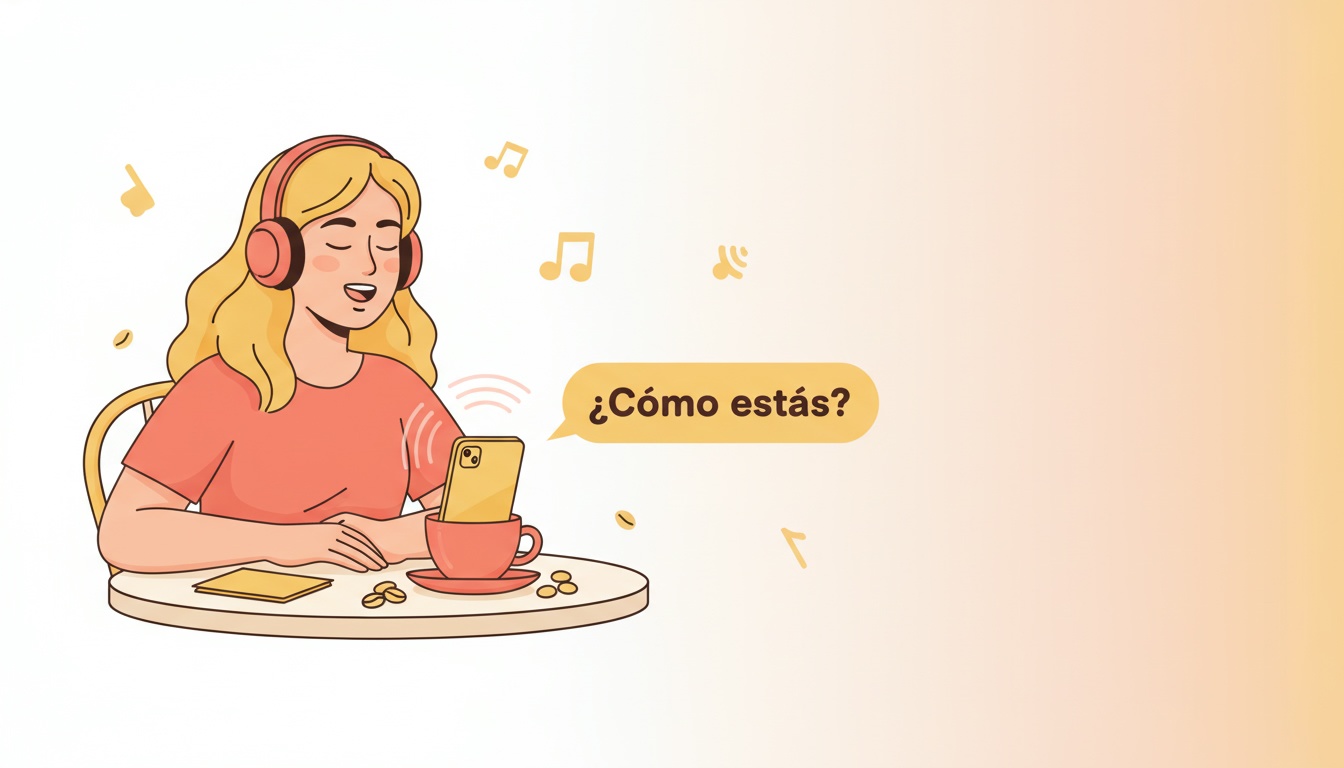
Listening comprehension is one of the hardest skills to develop when learning Spanish. Native speakers seem to talk at lightning speed, words blend together, and regional accents add another layer of complexity.
But here's the good news: with the right strategies, you can dramatically improve your listening skills. Here are five proven techniques that work at any level.
1. Start with Slow, Clear Audio
Before diving into telenovelas, begin with content designed for learners. Podcasts like "Notes in Spanish" and "SpanishPod101" offer graded content that matches your level.
The key is comprehensible input: audio where you understand roughly 80% of what's being said. If you're catching less than that, the content is too advanced. If you understand everything, it's time to level up. Once your comprehension is solid, the next thing that ambushes Spanish learners is vocabulary, specifically false cognates that sound like English but aren't.
2. Use the Shadowing Technique
Shadowing means repeating what you hear in real time, matching the speaker's rhythm and intonation as closely as possible. This trains your ear and your mouth simultaneously.
Start with short clips (30-60 seconds). Play a sentence, pause, repeat it. As you improve, try repeating without pausing, speaking along with the audio like a simultaneous interpreter.
3. Watch Content with Spanish Subtitles
Not English subtitles, Spanish ones. This bridges the gap between what you hear and what's actually being said. You'll start to recognize where words begin and end, which is half the battle with fast speech.
Netflix, YouTube, and Disney+ all offer Spanish subtitle options on most content. Start with shows you've already seen in English so the plot doesn't distract you.
4. Practice with Different Accents
Spanish sounds different in Madrid, Mexico City, Buenos Aires, and Bogotá. Don't limit yourself to one accent. Exposure to variety builds a more robust listening ability.
Try switching between Spanish content from different countries each week. You'll be surprised how quickly your ear adapts.
5. Have Real Conversations
Nothing replaces live conversation for building listening skills. The unpredictability forces your brain to process Spanish in real time, without the safety net of a pause button.
Try it in Conversa
Practice with AI characters who adapt to your level and give real-time feedback.
Try Conversa FreeThe Bottom Line
Improving your Spanish listening is a marathon, not a sprint. But with consistent practice using these five techniques, you'll notice real progress within weeks. Start with just 15 minutes a day, and build from there.
The most important thing? Stay with content you enjoy. If you're bored, you won't stick with it, and consistency is what matters most. If you're studying a tonal language alongside Spanish, the same shadow-and-compare loop does most of the heavy lifting for Mandarin tones too.