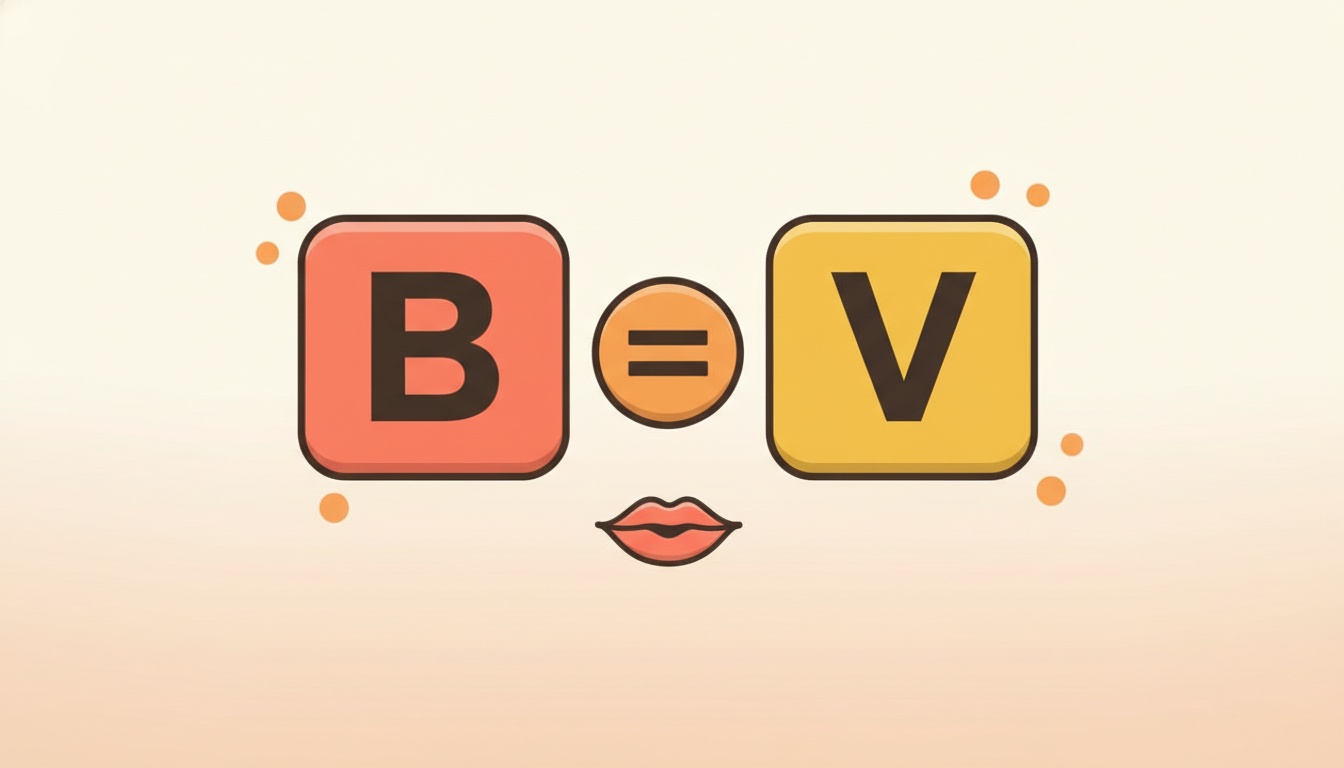
In Spanish, vaca (cow) and baca (a car's roof rack) sound exactly the same. So do votar (to vote) and botar (to throw out), and tubo (tube) and tuvo (he had). Spanish speakers can't hear a difference between the b and the v, because there isn't one. That's why, when someone spells a word out loud, they say "be de burro" or "ve de vaca" to tell you which letter they mean (Regina Coeli Language Institute). The letters are two. The sound is one.
Most guides tell you that much and stop there. "Pronounce your V like a B." That's true, and it's half the lesson. The missing half is the part that actually makes you sound native.
There is no Spanish v, so stop biting your lip
Say the English word very. Feel your top teeth press down on your bottom lip. That contact, teeth on lip, is the English /v/, and it does not exist anywhere in Spanish (Berges Institute). When an English speaker reaches for it on vino, verde, or Sevilla, it's an instant accent giveaway. Going the other way, that same missing contact is why Spanish speakers learning English say seben for seven. Spanish speakers learning English have the mirror-image job, which is the harder one: building a /v/ their language never gave them.
The fix is mechanical: keep your teeth off your lip. Vino (wine) starts with both lips pressed together, the same way bueno (good) does. Vaca opens identically to boca (mouth). If your teeth touch your lip on any Spanish word, you've found a mistake to correct.
The rule nobody finishes: it softens between vowels
Here's the word that gives the whole thing away: bebé (baby). Say it slowly. The first b, at the very start, is a hard, full-lipped B. Your lips press shut and pop apart. The second b, sitting between two vowels, is gentler. Your lips come close but never quite seal, and air slips through. One word, one letter, two different sounds.
This is the split textbooks bury. The single Spanish b/v sound has two modes depending on where it sits (SpanishDict).
The hard version, with full lip closure, shows up in two situations: after a pause, including the very start of a sentence, and after an m or n. Vamos (let's go) launching a sentence. Bueno answering the phone. Un beso (a kiss), where the n sets up a hard B with a buzz before the lips open, the cue that separates it from a Spanish p with no puff of air. Hombre (man) and también (also), where the m does the same job.
The soft version, lips barely brushing, happens almost everywhere else, and especially between vowels. La vaca (the cow). Cuba. lavar (to wash). uva (grape). nuevo (new). Spanish Academy states the rule plainly: between two vowels, b and v are always the soft sound (Spanish Academy).
Watch what this does to one word said two ways. Vino on its own, opening a sentence, is hard: a full B. But el vino (the wine) goes soft, because now the v sits between the vowel of el and the i of vino. Same word. The position flipped the sound.
English speakers who only learned "V like B" miss this completely. They harden every b and v into a crisp English B, so Cuba comes out clipped and metallic instead of soft and open. Fixing the lip-bite gets you halfway. The softening is the other half, and almost nobody teaches it.
How to make the soft Spanish b/v sound
Make a normal B, then commit to laziness. Bring your lips together as if to start the B, but stop just short of touching. Leave a sliver of a gap and let the air trickle through. It should feel like you were too tired to finish the B. That leaky, unfinished B is the soft sound (SpanishDict).
Drill it between vowels, where it lives. Say la-ba-la-ba-la-ba on a loop, lips loose, never fully closing. Then, to feel the contrast, snap to the hard version after a pause. Stop, take a breath, and bark ¡Basta! (enough) with a full, popping B. Loose, loose, loose, then hard. That switch is the entire skill.
Now take it to real words. bebé, hard then soft, the way you said it earlier. beber (to drink), hard at the start and soft in the middle. Barcelona, opening on a hard B. La Habana (Havana), where the b floats soft and airy between the vowels in the middle. Read them slowly and overdo the difference until your mouth stops defaulting to the hard English B on every one.
Try it in Conversa
Practice with AI characters who adapt to your level and give real-time feedback.
Try Conversa FreeB isn't the only letter that does this
Once you can hear the softening, you start catching it everywhere, because b and v aren't special. The same thing happens to d and g between vowels (Wikipedia). The d in cada (each) isn't a hard English D; it softens until it's close to the th in "this." The g in agua (water) isn't a hard G; it relaxes into a breathy sound with no full contact. It's one habit Spanish has, applied to three letters: between vowels, hard sounds go soft. Learn it on b and v and you've half-learned it for d and g too.
This is the same family of fixes as the vowels, which are the other giant English-speaker tell. If you haven't met that one yet, the five pure Spanish vowels deserve the same attention. And if you've been losing sleep over rolling your R, the tap and the trill are a smaller problem than they look.
Listen for it in one word
Next time you hear Spanish, stop trying to follow whole sentences. Track one word: Cuba, or nuevo, or La Habana. Listen for the soft middle, the b that never quite closes. The moment you can hear it in someone else's mouth, you'll catch yourself making the clipped English version in your own, and you'll stop. That's the whole correction, one airy, unfinished B at a time.