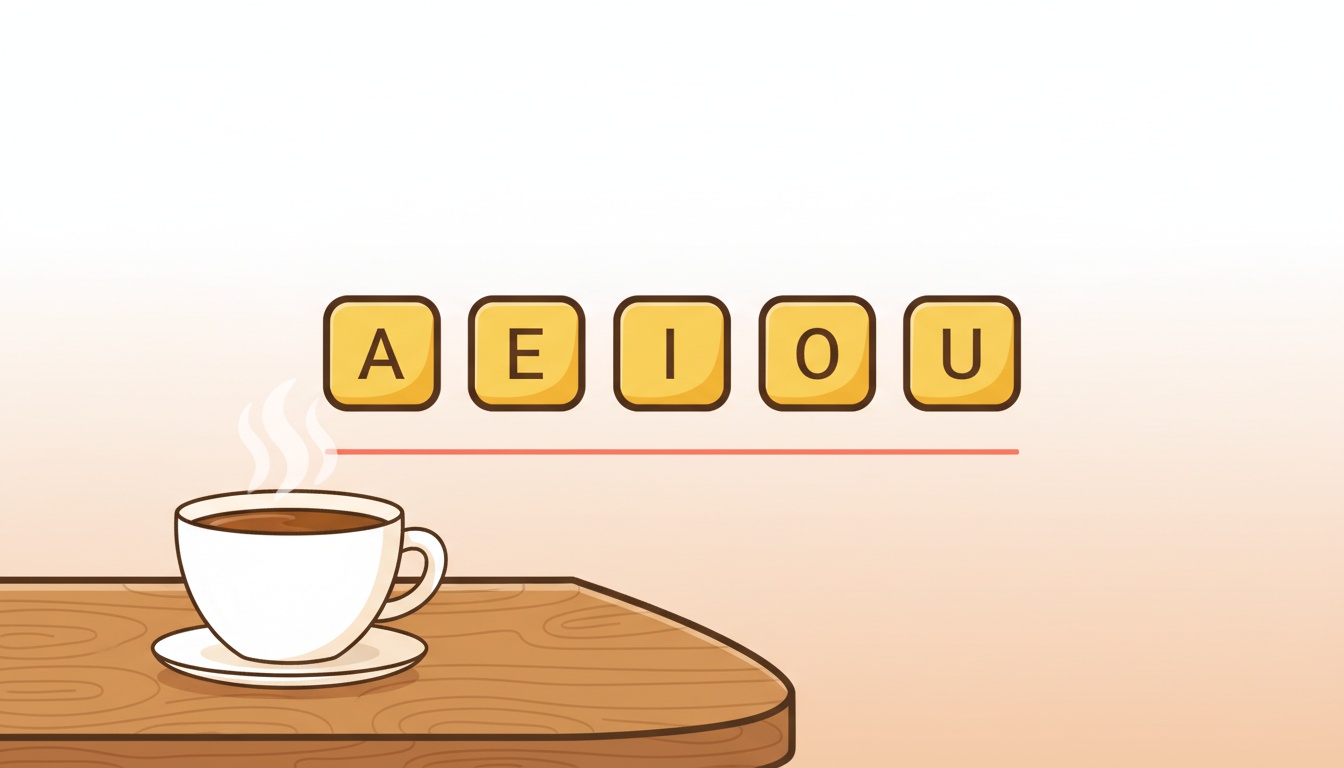
Say the word café out loud. If you're a native English speaker, the second syllable probably came out "FAY," with your mouth sliding from an "eh" toward a "y" on the way out. A Spanish speaker says it with one flat "e," held still, then stops. Same story with no. You say it and the vowel drifts toward "noʊ," a hidden little "w" tacked on at the end. In Spanish it's just no. Clipped. Motionless.
That sliding is one of the loudest things in your accent, along with the puff of air English adds to p, t and k, and almost nobody points either one out. Everyone obsesses over the rolled R instead, and most guides to Spanish vowel pronunciation just name the five sounds and stop there. But Spanish has exactly five vowel sounds, you land on one in nearly every syllable, and English speakers move all five. Two habits are doing the damage. Here's how to catch them and shut them off.
Spanish has five vowels, and they hold still
casa, peso, mi, poco, uno: one word for each of the five Spanish vowels, and the trick to all of them is the same. The vowel sound is identical from the first instant to the last. It doesn't travel anywhere.
Those five are a /a/, e /e/, i /i/, o /o/, u /u/. Each one is a monophthong, a single steady sound, start to finish (SpanishDict's vowel guide). English, by contrast, runs somewhere around 12 to 15 vowel sounds and glides most of them. That mismatch is the whole problem in one sentence: you have a mouth trained to move through vowels, pointed at a language whose vowels stay put.
This isn't quite absolute, and it's worth being honest about it. Spanish vowels do shift a little depending on what surrounds them: slightly more open in a closed syllable, a touch nasal next to an m or n (Spanish phonology). But those are millimeter adjustments a learner doesn't need to chase. The core sound holds. Your job is to stop the big, obvious slide your English mouth wants to add on top.
Mistake #1: you're gliding vowels into diphthongs
Say my, way, and no in English and feel your tongue travel. My is really "mah-ee" (/aɪ/), way is "weh-ee" (/eɪ/), no is "noh-oo" (/oʊ/). Those moving vowels are diphthongs: two vowel sounds glued into one slot (diphthong).
Spanish keeps them apart. mi (my) is just a pure "ee" that ends exactly where it began. sé (I know) is not the English say. tú (you) is not too with your lips creeping forward as you say it. SpanishDict puts the o problem plainly: English speakers tend to add an "uh" sound at the very end of an o, while the Spanish o stays rounded and steady the whole way through.
So when café comes out "ca-FAY," that final "AY" is the tell. The fix is almost stupidly physical: say the vowel, then freeze your mouth before it can wander. If your jaw, tongue, or lips move while the sound is still going, you're gliding.
Mistake #2: you're mumbling the unstressed vowels into "uh"
Say banana in English: "buh-NAN-uh." Only the middle vowel really survives. The other two collapse into "uh," the schwa, the laziest sound in the language, the one English reaches for whenever a syllable isn't stressed (vowel reduction).
Spanish refuses to do that. banana keeps all three of its a's, and every one of them is as clear and full as the stressed one in the middle. No "uh" anywhere. That refusal to swallow unstressed vowels is a big part of why Spanish sounds so even and steady to an English ear, and why English-accented Spanish sounds mushy by comparison.
One honest caveat: this is the standard, but it isn't universal. In much of Mexico, fast casual speech does squeeze unstressed vowels, especially right next to an s, so pesos can land closer to "pess" than "PE-sos." If your target accent is Mexican, you'll hear that in the wild. But reduction there is something fluent speakers do on purpose at speed, not a habit you should import from English while you're still building the basics. Keep your vowels full first. You can learn to drop them later.
The "e" and the "o" are where your accent leaks
café, qué, bebé, leche, usted: every one of those e's is a trap. English drags "e" toward "ay," so café becomes "ca-FAY" and the e in usted wants to stretch and slide. The Spanish e is short and tight, close to the e in bet, held flat and then cut off. No "y" on the end.
The o leaks the same way. poco (little), loco (crazy), bonito (pretty): English adds that "ʊ" off-glide and poco drifts into "POH-koh," two tiny "w" sounds hiding at the ends of the vowels. Round your lips, then keep them frozen there.
A quick set of near-misses to drill against, because hearing the wrong version is half of fixing it. casa, not "kassuh." peso, not "payso." poco, not "poh-kow." uno, not "yoono," with no "y" stuck on the front and no slide off the back.
Why this beats fixing your rolled R
Count the vowels in buenos días: u, e, o, then i, a. Five of the ten sounds in that phrase are vowels, and that ratio holds across the language (Blanca Quintero), so a vowel habit shows up in every single sentence, while the trilled R only turns up a few times a paragraph. Fix the thing that's everywhere first.
There's a second reason. The rolled R asks you to build a brand-new motor skill your mouth has never done. Vowels ask for the opposite: stop a movement you're already making. One is addition, the other is subtraction, and subtraction is easier to pull off. If the trill is still tripping you up, it's worth its own session, because the tap and the trill are genuinely two different sounds. It's just not where most of your accent is leaking.
The catch with vowels is that you can't hear your own slide while you're talking. You need to slow down and listen to yourself, ideally out loud with someone who'll let you repeat the same word ten times, like an AI conversation partner in Conversa that won't get bored of café.
Try it in Conversa
Practice with AI characters who adapt to your level and give real-time feedback.
Try Conversa FreeThe drill: sustain each vowel and listen for the drift
Hold a single "aaaaa" for three full seconds and record it on your phone. Play it back and listen hard to the very end: did the sound stay put, or did it slide somewhere on the way out? A pure vowel is boring. Second three sounds exactly like second one.
Run all five that way, three seconds each: a, e, i, o, u, checking every one for drift. Then read a vowel-heavy line slowly. Try mi tío toca el piano (my uncle plays the piano), and freeze any vowel that tries to travel. Watch tío especially. It has two vowels sitting right next to each other, and your English mouth will want to smear them into a single gliding sound. Keep them separate: TEE-o, two clean beats.
Then steal from the natives. Pull up casa, peso, and uno on Forvo, where real Spanish speakers have recorded them, and copy each one straight back. This is the same copy-and-compare loop that does most of the work for building your listening comprehension, aimed at your own mouth this time.
This is slow, unglamorous work, and it won't tidy up your accent in an afternoon. But it's the rare pronunciation fix where you can catch your own mistake the instant you make it, which means you can correct it without a teacher sitting in the room.
Start with one flat e
Go back to café. Hold the e flat, no slide off the end. Then no, clipped. Then banana with all three a's standing up straight. Once your vowels stop traveling, the words you already know start landing differently in a stranger's ear, and you got there without learning a single new sound. You just stopped moving the ones your mouth already makes.