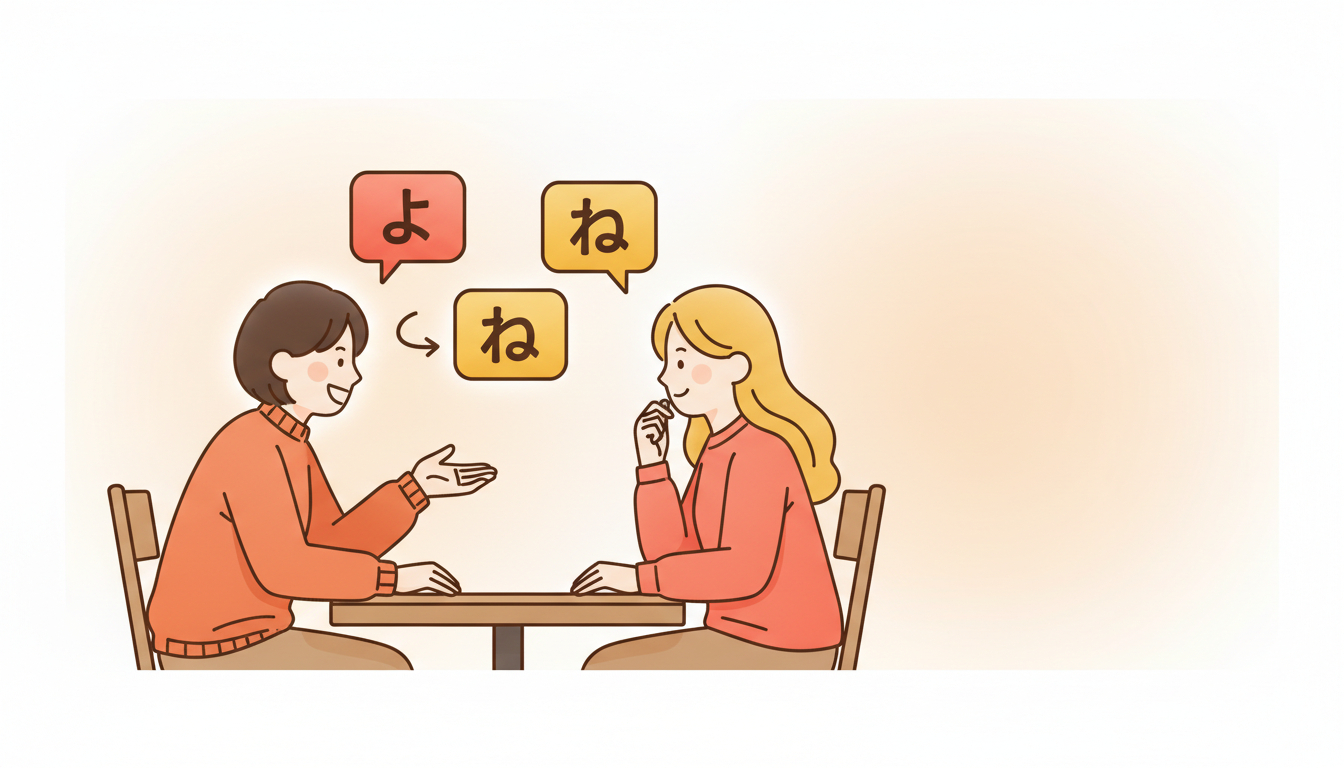
晩ごはんできたよ。 "Dinner's ready." Drop the よ and it still means dinner is ready, but now it sounds like a line from a grammar drill instead of someone calling you to the table. Add ね by mistake (晩ごはんできたね) and you've told the person they already knew dinner was ready, which is strange, because you're the one who cooked it.
That is the whole problem with よ and ね (yo and ne) in one sentence. Most learners either leave them off and sound like a robot, or scatter them around and sound pushy. Both mistakes come from the same blind spot: nobody tells you what these particles actually do. They aren't politeness decoration. They mark whose information is on the table, yours or the listener's.
You already do this in English, just with your voice
Say "It's raining" three ways out loud.
Flat, falling tone: "It's raining." You're informing someone who didn't know.
Rising tone: "It's raining?" You're checking something you're not sure about.
Stretched out, knowing: "It's raining, you know." You're pointing at something you both can see and nudging them about it.
Same three words, three completely different messages about who knows what. English carries that meaning in your pitch. Japanese pulls it out of your voice and hands it to a particle. Once you stop translating よ and ね as words and start hearing them as your own tone of voice made visible, the choice stops feeling like a coin flip.
よ: "you don't know this, so I'm telling you"
財布落としましたよ。 Saifu otoshimashita yo. "You dropped your wallet." The よ is doing real work here: it flags that this is news, information flowing from you to a person who didn't have it. Strip the よ and 財布落としました sounds oddly detached, like you're narrating their misfortune rather than alerting them.
That's the core of よ. It hands over something the listener doesn't already know. Tofugu frames it as new information moving from speaker to listener, and once you have that hook, a lot of everyday よ sentences click into place. あそこに自動販売機がありますよ (Asoko ni jidōhanbaiki ga arimasu yo, "There's a vending machine over there") is you supplying a fact they were missing.
Here's the part the internet gets wrong: よ is not rude. People hear it lands with force and conclude it's aggressive. But 大丈夫だよ (Daijōbu da yo, "It's okay, don't worry") and ご心配いりませんよ (Goshinpai irimasen yo, "There's really no need to worry") are among the kindest things you can say. The よ is reassurance. It says trust me on this, I know something that will make you feel better. Same particle, opposite of pushy.
ね: "we both know this, right?"
今日は暑いですね。 Kyō wa atsui desu ne. "Hot today, isn't it?" You're both standing in the same heat. ね reaches for the thing you already share and invites the other person to nod along. It's the particle of common ground.
字がとても綺麗ですね (Ji ga totemo kirei desu ne, "Your handwriting is really nice, isn't it") works the same way: you're both looking at the handwriting, so you mark it as shared and let them agree. 明日頑張ろうね (Ashita ganbarō ne, "Let's do our best tomorrow") pulls a shared goal into the open. Where よ pushes information out, ね pulls the two of you onto the same side.
This is also why dropping ね makes you sound cold. A whole conversation of bare です and ます sentences, with no ね anywhere, reads as someone reciting facts at you instead of talking with you. The particle is half of what makes Japanese sound like a relationship instead of a report.
The one-line rule, and where よね fits
テストは、来週の金曜日でしたよね。 Tesuto wa, raishū no kinyōbi deshita yo ne. "The test was next Friday, right?" You're fairly sure, you think the other person knows too, and you're checking. That よね is the tell for a single question you can run before any sentence leaves your mouth: does the listener already know this?
If yes, reach for ね. If no, reach for よ. And if the answer is they should know it, but I want to confirm we're on the same page, that's よね. 昨日ポテトチップス買ったよね? (Kinō potetochippusu katta yo ne?, "You bought potato chips yesterday, right?") does the same job as the test example, and crucially it leaves room for them to say no.
One honest caveat: よね is not automatically softer. Lean on it too hard and it flips into pressure, the verbal equivalent of "...right? right??" until the other person caves. Use it to confirm, not to corner.
Try it in Conversa
Practice with AI characters who adapt to your level and give real-time feedback.
Try Conversa FreeThree ways you accidentally sound wrong
The first flavor is a pushy よ. You put よ on something the listener plainly already knows. Telling a coworker who's soaked from the storm 雨が降っていますよ ("it's raining, FYI") sounds like you think they hadn't noticed. The fix is ね, because you both know it, or just no particle at all.
The second is a needy or condescending ね. You use ね to fish for agreement on something the other person can't actually confirm, like your own private feelings, or you over-ね a stranger and manufacture a closeness that isn't there. A first conversation stuffed with ね can feel like someone draping an arm around a person they just met.
The third is a presumptuous よね. You assert "we both know this" when you don't actually share the knowledge. If you say あの店、高いよね ("that shop's expensive, right?") to someone who's never been there, you've handed them a shared fact they don't have.
Intonation carries some of this too. Japonin notes that a soft, falling よ informs gently, while a sharp, insistent よ can sound like scolding. So そうじゃないよ! snapped hard can sting, while いえ、そうじゃないですよ said gently is just a friendly correction. This part is easier to feel from listening than to memorize from a chart, so treat it as a tendency, not a law.
With your boss, sometimes the move is silence
Your manager asks how much the order came to. 一万円です。 Ichiman-en desu. "Ten thousand yen." No particle. With a superior, the bare です answer is the safe one, and adding よ (一万円ですよ) can tip into sounding overly familiar or presumptuous, as if you're correcting them. This is worth knowing because the beginner instinct runs the other way: you feel the English "you know" bubbling up and want to translate it. Often the more natural Japanese is to say nothing at all. If you're still sorting out these register lines, the layers of keigo are the bigger system this fits inside.
The real shift
This was never about memorizing two vocabulary words. It's the same move you've made your whole life in English with pitch, now carried by a particle. The next time you're about to end a Japanese sentence, run the one question first: does the person I'm talking to already know this? Your answer picks the particle. It's the same instinct behind は versus が, where the "right" choice is really a question about what the listener is already tracking, and the same question that picks between the Korean endings -네요, -잖아요 and -거든요 if you ever cross over. Get よ and ね even roughly right and your Japanese stops sounding translated and starts sounding like you mean it.