Under a comeback teaser, the top reply is "ㅇㅈ ㄹㅇ ㅋㅋㅋㅋ". You know 인정. You know 리얼. The reply still won't resolve, so you open a list of fifty Korean texting slang terms, find both, close the tab, and freeze again at the next one.
Lists are the wrong tool here. Korean abbreviations in a chat are a single rule applied over and over, and once you can run the rule yourself the list is just the rule's output. Here's the rule, five forms to derive with it, and then the two things the lists never tell you: how many ㅋ make a laugh, and why ㅇㅋ is fine to a friend and a small insult to your 선배.
Why Korean texting slang is one rule, not a list
감사합니다 means "thank you". Clip it to 감사, keep only the first consonant of each syllable block, and you get ㄱㅅ. That is the whole rule.
It works because of how Hangul is built. Every syllable block has an initial consonant, a vowel, and an optional final consonant, which Korean calls 초성, 중성 and 종성. Texting slang throws away everything after the 초성. Koreans call the style 초성체 (choseong-che, "initial-consonant style"), and the linguist Seongha Rhee files these forms under syllable-initial consonantal abbreviations in his 2023 study of politeness in Korean social media.
Keep the first consonant of each syllable block. Drop the rest.
The silent ㅇ at the start of 인정 and 오케이 is a real consonant letter, so it survives: ㅇㅈ, ㅇㅋ, and ㅇㅇ for 응 (yeah) doubled. A trailing ㅇ can also stand in for the polite ending 요, so ㅅㄱ becomes ㅅㄱㅇ for 수고요, a detail the community wiki entry on 초성체 spells out and every English list skips.
Chinese texters do something close with pinyin, yyds for 永远的神. Korean does it without leaving its own script. Korean Wikipedia calls 초성체 a coinage with no direct foreign equivalent, and the reason it can exist at all is the stacked block: the first consonant of a Korean syllable is a visible, separable letter you can keep, where English letters just sit in a line and "thx" has to be invented one word at a time.
Try it: five Korean text abbreviations you may not have seen
ㅊㅋ. Say the two consonants: ch, k. Now think of a two-syllable word a fan would type under good news. 축하 (congrats) is spelled with ㅎ, but it's pronounced 추카, and Wiktionary lists ㅊㅋ as the text spelling of exactly that word. The abbreviation follows the sound, not the dictionary.
Run the same move on these:
- ㄷㄷ: d, d. 덜덜, the shivering sound. Wiktionary glosses it as "shiver"; in a thread it means "whoa" or "I'm shook".
- ㅇㄷ: vowel-carrier, d. 어디, "where?". Sent alone it means "where are you?" (Wiktionary).
- ㄱㄷ: g, d. 기다리다, "to wait", clipped to its initials and sent to mean "hold on".
- ㄹㅇ: r, vowel-carrier. 리얼, from English "real". Gyeonggi province's own news portal lists ㄹㅇ as 리얼 in a piece on generational slang gaps.
That last one shows the catch. ㄹㅇ, ㅇㅋ and ㄴㄴ (노노, "no no") derive from Konglish loanwords, so the word you're hunting for is sometimes English wearing Hangul. If you've read about Konglish words that mean something else in Korean, you already have the vocabulary to decode them.
Context does the rest. ㅇㅈ means 인정 in a fan reply and, per the wiki's list of forms, 여자 (woman) in an anonymous random-chat room. Same two letters. The thread tells you which word it is, the same way "ps" means one thing at the end of a letter and another on a game console.
Same two letters, flipped. ㄱㅅ is 감사 (thanks). ㅅㄱ is 수고 (good work), the sign-off you'll see fans send after a show.
I've watched learners send ㄱㅅ when they meant ㅅㄱ more than once. Both expansions are solid; the order is the trap. Wiktionary notes that ㅅㄱ is "often used in a sarcastic intention" in game chat, close to a snide "gg". Under a concert post it's sincere. After you lose a ranked match, it isn't.
How many ㅋ is a laugh, and why one ㅋ is "k"
"응ㅋ". A GQ Korea writer decoding KakaoTalk replies reads that single ㅋ as "our chat ends here". The 응 says yes. The lone ㅋ says I'm done.
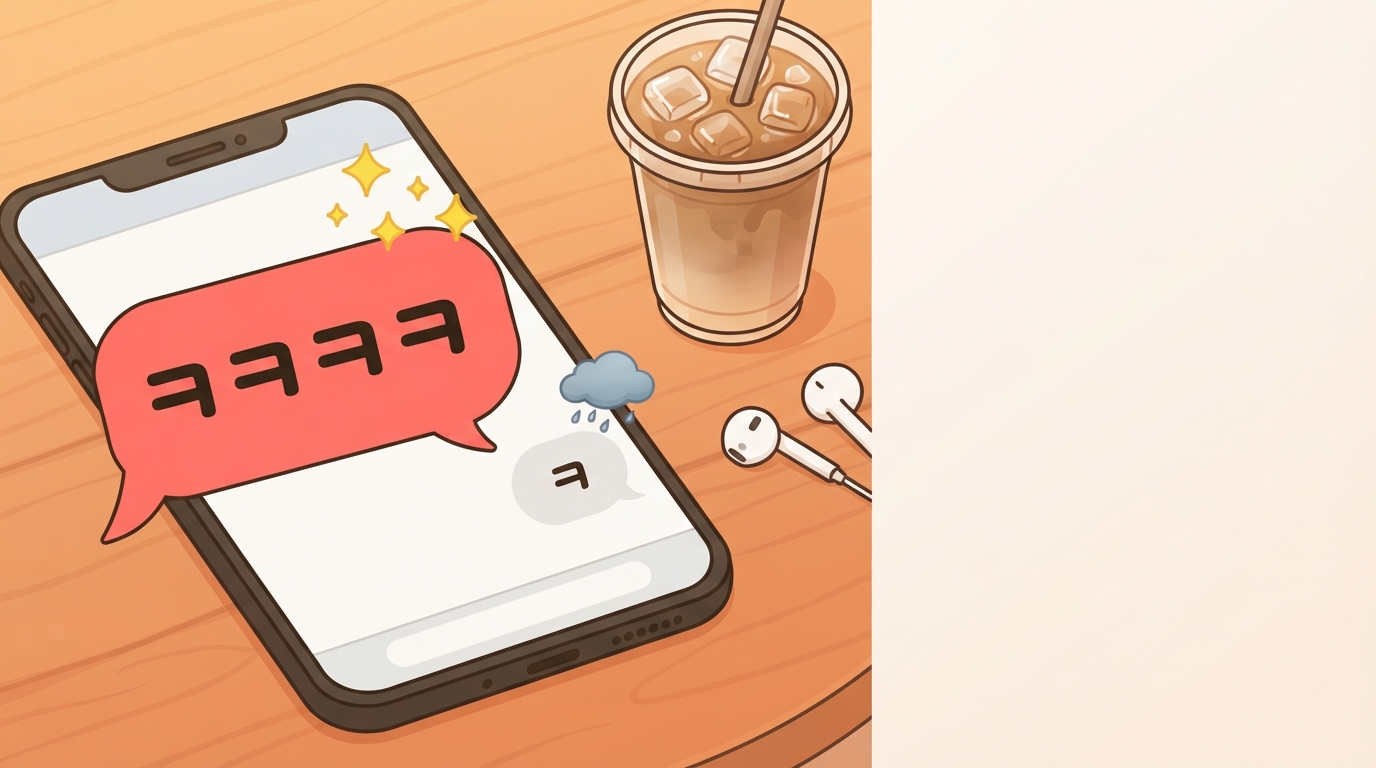
ㅋ is the consonant k, typed without a vowel to mimic a laugh, and it's the same rule as ㄱㅅ running on a sound instead of a word: ㅋㅋ is read as 크크 or 큭큭, and ㅋ is the 초성 of 크. The number of them is a dial. Rhee's study puts it in order: a single ㅋ "is considered an unenthusiastic, situationally forced agreement", ㅋㅋ is mild agreement, ㅋㅋㅋ is medium, and only four or more count as a wholehearted acknowledgment that the message was funny. The longest string in his corpus was 135 ㅋ in a row, typed by a professional in her twenties.
Wiktionary says it shorter: "A single ㅋ is usually dismissive."
A viral ladder reported by 민중의소리 in 2012 went further, calling one ㅋ a sneer and ㅋㅋㅋ "nothing to say", and the reporter added the caveat that belongs on all of this: the reading shifts with the person and the situation. Both ladders agree on the shape. ㅋㅋㅋ is the default filler, what "lol" is in English, and four is where it starts meaning you laughed. Treat that as a tendency most natives would recognise. Nobody enforces it.
If you text in English you already know this dial. "k" is not "ok". A period at the end of "sure." changes the temperature of the whole message. Korean puts the same information in the ㅋ count.
One ㅋ reads as a brush-off. Four says you actually laughed.
ㅎㅎ is the other laugh, and it's softer. Rhee calls it a letter-based ideophone for 하하, and Wiktionary draws the line: ㅋㅋㅋ "has a somewhat more blunt tone than ㅎㅎ" and is more likely to be real laughter, while ㅎㅎ is "more likely to be included just for the sake of it". That cuts both ways. ㅎㅎ is what you type when you're being pleasant rather than amused, which makes it the safer choice in a semi-formal chat and the limper choice in a funny one.
A columnist at 아시아경제 hears ㅎㅎ as 흐흐, a sly, slightly eerie laugh, and wrote about switching to ㅋㅋ himself to shed the cynicism he felt in it. Natives disagree about ㅎㅎ more than about ㅋ, so don't over-read a single one from someone you know well.
Sending no laugh at all can read as prickly, a footnote in that same wiki entry that matches what Korean friends have told me. A bare "응" lands colder than "응 ㅋㅋ".
ㅠㅠ has no word underneath
TWICE's 2016 single is called "TT", and the title is a crying face borrowed from Korean texting. ㅠ and ㅜ are vowel letters in Hangul, but in a text nobody is reading them as sounds. Victor Mair's Language Log post on the song spells out what Koreans see: the horizontal stroke is a closed eye, the vertical strokes are tears, and the more you repeat it, the greater the sadness.
So ㅠㅠ is not 초성체. There's nothing to derive. Both ㅠㅠ and ㅜㅜ are crying faces; ㅠ just has two tear strokes to ㅜ's one. Korean Wikipedia's emoticon page lists ㅠ_ㅠ, ㅜ_ㅜ, ㅠㅠ and ;ㅅ; together and notes that East Asian emoticons center on the eyes where Western ones center on the mouth. That's why :( looks wrong to a Korean texter and ㅠㅠ looks wrong to you, until it doesn't.
Use it for mild misery. "늦어서 ㅈㅅ ㅠㅠ" (sorry I'm late, crying) is right. A genuinely bad day gets words.
Who you're texting decides whether ㅇㅋ is fine or rude
"알겠습니다ㅋㅋ". In 2018 the Korean daily 머니투데이 built a whole feature around that reply, opening with a 28-year-old new hire at a trading company who agonised over every message to her manager: ㅋㅋ looked 버릇없다, rude, and bare text looked angry, so she typed and deleted ㅎㅎ and :D and finally sent ^^. 알겠습니다 is the fully formal "understood". The two ㅋ undo it.
The managers the reporter asked drew the line by topic. One said a playful ㅋㅋ on "오늘 회식하자" (team dinner tonight) is fine and on anything about actual work it isn't. A psychology professor at Chung-Ang University, 정태연, said emoticons in a work conversation can leave a 진중하지 못한 인상, an impression of not being serious.
That was the rule in the 1990s too. Korean Wikipedia notes that in the PC-communication era 초성체 was considered impolite outside close friends, and the wiki entry still frames it as something you use on a company messenger only with people close to your own age. The register logic is the one you already learned for 반말 and 존댓말: 초성체 is 반말 for your thumbs.
So what do you send a 선배, a tutor, or the admin of a fan café when you'd send ㅇㅋ to a friend? The acceptable short answer going up is 넵. A 한스경제 piece on office KakaoTalk describes workers rotating 네, 넵 and 네 알겠습니다 because answering with the same word every time looks 무성의, half-hearted. 넵 is quick without being casual.
ㅇㅋ is 반말 in two letters. 넵 is the short reply that stays polite.
Reading a senior's abbreviations is a separate skill. If your 선배 ends a message with a single ㅎ, that is probably not a sneer. On a Korean forum thread about a boss who did exactly this, some posters called one ㅎ a snort and others called it just softening a stiff message, and the ones defending it were describing someone a generation up.
Mirror them one step behind. A three-year employee in the 머니투데이 piece had settled on exactly this rule: if the boss uses them, use them too; if the boss doesn't, don't. If they open with ㅎㅎ, you may answer with ㅎㅎ, never with ㅋㅋㅋㅋ first.
None of this is official. The National Institute of Korean Language, asked in January 2026 whether "ㅎㅎ…" is correct, declined to even classify what kind of unit ㅋㅋ and ㅎㅎ are and pointed the asker at specialist literature.
The rules live in the people, and they move with age: a JobKorea survey of 2,046 adults in October 2019 found 79.4% had felt a generation gap over new slang, rising to 88.6% of those over forty. The reader on the other end of your ㅇㅋ may be in that group.
Try it in Conversa
Practice with AI characters who adapt to your level and give real-time feedback.
Try Conversa FreeDecoding a fan thread: ㅊㅋ, ㄹㅇ, ㅇㅈ, ㅂㅂㅂㄱ
A: 1위 ㅊㅋㅊㅋ ㅠㅠㅠㅠ
B: ㅇㅈ ㄹㅇ 레전드 무대였음 ㅋㅋㅋㅋ
C: ㅇㄱㄹㅇ ㅂㅂㅂㄱ
D: 다들 ㅅㄱ ㅂㅂ
That's the shape of a reply chain under a music-show win, built from forms I've met in real ones. A says congrats twice (ㅊㅋ for 축하, doubled for feeling) and cries four tears' worth, happy tears this time. B agrees (ㅇㅈ, 인정), says it's for real (ㄹㅇ, 리얼), calls the stage legendary, and laughs with four ㅋ, which Rhee would score as wholehearted. C stacks two longer forms. ㅇㄱㄹㅇ is 이거레알, "this is for real". ㅂㅂㅂㄱ is 반박불가, "no rebuttal possible", and like ㅂㅂ for 바이바이 in D's sign-off it's a form I've only found documented on community wikis, so treat it as fan usage rather than dictionary Korean. D is saying good work everyone (ㅅㄱ, 수고) and bye.
Number codes like 8282 (빨리빨리, hurry) and 1004 (천사, angel) are on every fifty-item list, and you can skip them. They are 1990s pager codes, from a device that peaked around 15 million subscribers before phones killed it. Sending 8282 today reads like signing a text "TTYL".
The cute spellings on the same lists, 고마웡 for 고마워 and 나두 for 나도, are a different layer entirely: those are aegyo sound changes, and they have their own rules.
Spoken slang is a third layer again. 헐 and 야 get typed constantly, but they are whole words, not 초성체, and whether you can say them out loud is covered in what K-drama slang is safe to say.
Korean texting slang FAQ
What does ㅋㅋㅋ mean?
Laughter, typed as the consonant ㅋ (k) with no vowel, the initial of 크 as in 크크. Three ㅋ is a medium laugh; four or more is a real one.
What's the difference between ㅋㅋ and ㅎㅎ?
ㅋㅋ is the laugh; ㅎㅎ is the smile. Reach for ㅎㅎ with someone you don't know well, and expect ㅋㅋ back only once they relax.
What does ㅠㅠ mean?
A crying face, eyes shut and tears running, used for small miseries rather than real grief.
What does ㅇㅈ mean?
인정 (injeong), "acknowledged", used like "true" or "facts". In anonymous chat rooms the same letters can mean 여자, woman, so read the room.
What does ㅅㄱ mean?
수고 (sugo), short for 수고하셨습니다, "good work". It's the sign-off after a shift, a stream, or a concert, and a sarcastic "gg" after a game. Don't flip it to ㄱㅅ, which is 감사, thanks.
Can I use ㅇㅋ with my Korean teacher?
No. ㅇㅋ is casual in both letters. Send 넵 or 네, 알겠습니다. If your teacher starts using ㅋㅋ or ㅎㅎ with you, you can follow, one step behind.
How do you say lol in Korean text?
ㅋㅋㅋ does the job lol does, and the ㅋ count carries the intensity.
What to do with the next one you can't read
ㅈㅅ under a late reply. Say the two sounds, j and s, and let the thread do the rest: 죄송 surfaces on its own, and the second time you see it you won't need the sound. That works for every 초성 you haven't met yet, so don't search the next one.
And before you hit send on ㅋ, count. One to a friend is a shrug. Anything going up the hierarchy is 넵, until they loosen first.