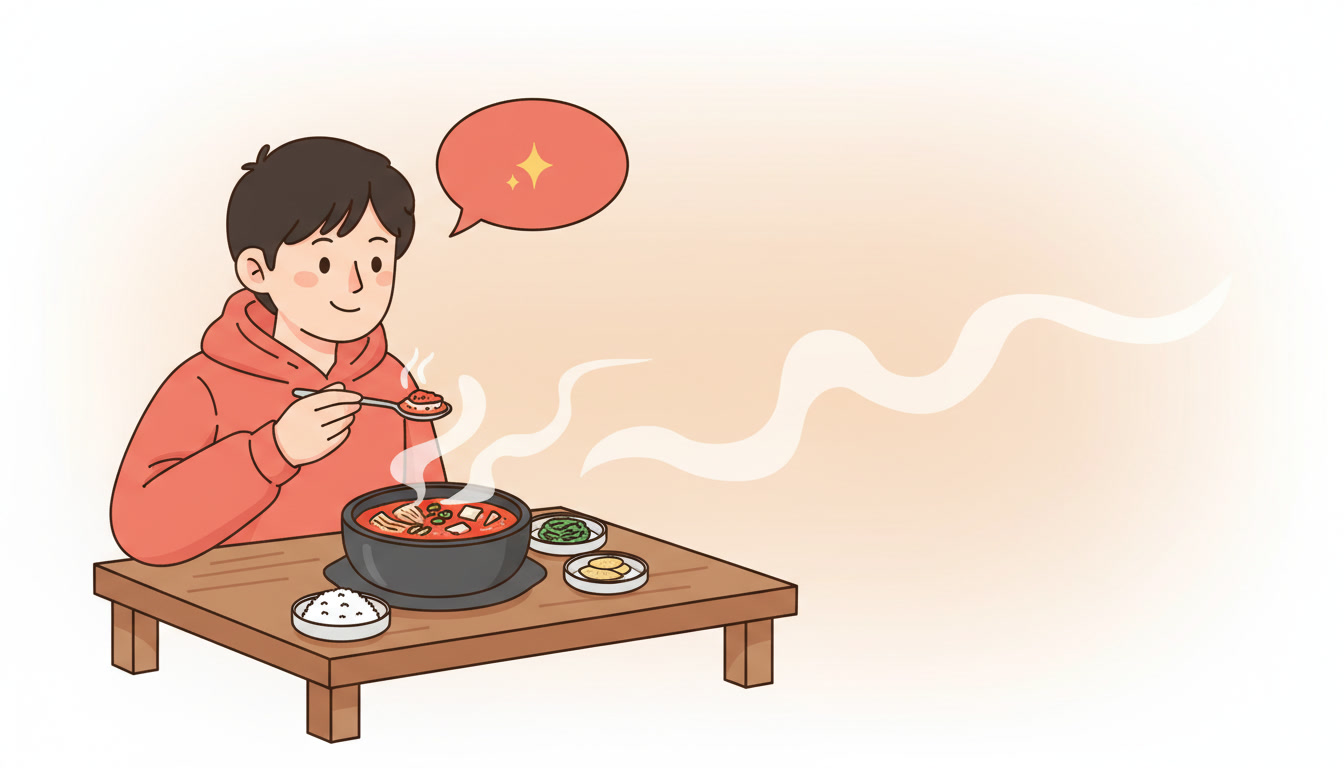
Someone puts a bowl of 김치찌개 in front of you. You take the first bite and say 맛있어요 (masisseoyo). Correct. Polite. And a little bit dead, because what a Korean speaker says on a first bite is 맛있네요 (masinneyo), and the one ending you left out is the sound of you tasting it right now.
That missing ending is the whole problem for a certain kind of learner. You are two years in. Your particles are fine. Every sentence you produce ends in -아요/-어요, and every sentence is grammatical, and somehow you still sound like a textbook being read aloud. Speech built only from clean textbook sentences sounds translated and lifeless, and the fix is four Korean sentence endings that sit on top of the -어요 you already know: -네요, -군요, -잖아요 and -거든요.
This is a different problem from speech levels. All four endings here live on the polite -요 level; the National Institute of Korean Language's learner dictionary tags every one of them 두루높임, the everyday polite register. They don't change how respectful you are. They change what you are telling the listener about who knew what.
One question picks the ending: who already knows this?
그 가게 문 닫았거든요 (geu gage mun dadatgeodeunyo) and 그 가게 문 닫았잖아요 (dadatjanayo) are the same sentence with the same stem. The first means "that shop's closed, just so you know." The second means "that shop's closed, remember?" Nothing about the shop changed. What changed is whether you think the listener already had the fact.
That one axis sorts all four. -거든요 delivers something the listener doesn't have; -잖아요 appeals to something they do. -네요 is a realisation happening out loud, and -군요/-구나 is the quieter, inward version, "ah, I see." Elon.io's overview of the family arranges eight endings along the same line, which is a good sign that the line is real and not a teaching shortcut.
English does the same job with little words at the front: "oh, it's raining," "remember, it's closed," "I can't, you see, I'm vegetarian," "ah, I see." Korean moves that work to the end of the verb. Once you hear it that way, the four stop being four grammar points and become one habit: before the last syllable, ask who already knows.
맛있어요 vs 맛있네요: what -네요 adds to the same sentence
비가 와요 (biga wayo) is the weather. 비가 오네요 (biga oneyo) is the weather plus you looking out of the window and noticing it. The cleanest test I know for the pair comes from the -네(요) page at Elon.io: if you would naturally say "oh," "wow" or "huh" before the sentence in English, Korean wants -네요. If you are reporting a fact you already knew, use plain -어요.
Same stem. -어요 reports. -네요 reports plus the moment you found out.
The two can share a sentence. 맛있어요. 근데 좀 짜네요 (masisseoyo. geunde jom jjaneyo), "it's good. But it's a little salty": plain -어요 for the verdict you've settled on, -네요 for the thing your tongue just found. That is what a native speaker sounds like at the table, and it is the line to steal.
Where it breaks is just as useful. 한국은 아시아에 있네요 sounds like you just discovered that Korea is in Asia. 저는 내일 부산에 가네요 is wrong because you can't be surprised by your own plan; that one is 저는 내일 부산에 가요. The ending needs something you didn't know a second ago.
It works on the past, too, as long as the noticing is happening now. 어? 벌써 다 왔네요 (eo? beolsseo da wanneyo), "huh, we're already here."
A column for Japanese learners by 박천홍 at the University of Tokyo, published by Asahi Press, has the sharpest version: rush home, find the drama already over, and you say 아, 끝났네 (a, kkeunnanne). Push away a manuscript you just finished and it's 끝났다! The difference is noticing versus cheering.
The usual textbook line, the one the learner dictionary and TOPIK Guide both give, is that -네요 is for things you learned through direct experience, and that's the tendency. But Better Korean, a Korean-teaching newsletter, points out that in real conversation people use -네요 on something they just heard, as long as they react to it. The ending tracks the reaction, and the reaction can be to a sentence as easily as to a bowl of soup.
네요 or 군요: noticed together, or sinking in alone
Two people see an outfit at the same moment. The one who speaks first says 옷이 예쁘네요 (osi yeppeuneyo), and a native answer on italki is firm that 옷이 예쁘군요 would be the odd choice there. -네요 is outward: we both see it, I'm saying it. -군요 is the sound of a fact landing inside your head. Better Korean's pair is 불고기가 맛있군요 when someone has told you bulgogi is good, versus 불고기가 맛있네요 with a fork in your hand.
In fast, friendly conversation most native speakers default to -네요. 오늘 정말 춥군요 is grammatical but sounds introspective, a little bookish, next to 오늘 정말 춥네요. Where -군요 earns its place is the penny-drop: 그래서 연락이 없었구나 (geuraeseo yeollagi eopseotguna), "ohh, so that's why they went quiet."
Two things about the form. Verbs take 는 before it, so 지금 가는구나, never 가구나; adjectives, nouns and the past don't: 예쁘구나, 학생이구나, 벌써 갔구나. And -구나 is the plain form, the one you use to yourself, to friends you're in 반말 with, and to children, where it turns warm: 많이 컸구나, "my, you've grown." HowToStudyKorean's lesson on ~구나 says these sentences feel like the speaker is talking to themselves, which is exactly why 그렇구나 (geureokuna) is the default casual "oh, I see" when a friend tells you something:
나 어제 회사 그만뒀어. (na eoje hoesa geumandwosseo, "I quit my job yesterday.") 아, 그랬구나. (a, geuraetguna, "Oh, I see.")
Compare 오늘 날씨 진짜 좋다, where the answer is 그러게 (geureoge), "I know, right." 그렇구나 receives news. 그러게 shares a feeling you already had. Elon.io lays the two out and adds the trap for anyone older than you: bare -구나 tilts downward, toward juniors, and aimed up at a manager it sounds like a pat on the head. Up the ladder the ending is -군요, ideally with the honorific -시-, and the fix that page gives for 아, 그렇구나 said to a 부장님 is 아, 그러시군요.
-구나 points down or inward. Up the ladder it's -군요, and to a boss the honorific -시- goes with it.
잖아요 means "as you know", and sometimes they didn't
이게 무겁잖아요! (ige mugeopjanayo), "but this thing is heavy, can't you see?" The ending started life as -지 않아요, "isn't it the case that…?", and the University of British Columbia's open Korean textbook traces the contraction -지 않아요 > -쟎아요 > -잖아요 and treats the result as a verb ending in its own right. The question form fell off. The presupposition of agreement stayed. Every -잖아요 still carries "you know this."
It has three jobs. A gentle reminder: 내일 시험이잖아요. 오늘은 좀 일찍 자요. A mild "I told you so": 아까 말했잖아, 왜 또 물어봐. And building an argument on shared ground: 비싸잖아요. 그러니까 지금 사지 마요. All three only work if the listener plausibly has the fact.
Which is the first way it goes wrong. Learners hear -잖아요 constantly and start attaching it to news.
Nobody knew you were emigrating. -잖아요 claims they did; -거든요 tells them.
The bare, 반말 version of this to a stranger is its own small disaster, covered in what K-drama Korean is safe to say out loud. The second way it goes wrong is subtler and survives politeness.
Say your manager asks why you were late and you answer 제가 어제 아팠잖아요 (jega eoje apatjanayo). You added -요. You were polite. You also told your 부장님 that he should already have known you were sick, and HowToStudyKorean's lesson on ~잖아(요) uses this exact scene to warn that it "might sound very rude." The author's Korean wife hears the ending as "I TOLD you it was like that!" His fix: 부장님도 아시다시피 저는 어제 아파서 회사에 늦게 왔어요, "as you also know, I was sick yesterday, so I was late." Same shared fact, offered instead of asserted.
Elon.io reaches the same verdict from the other direction: "even -잖아요 aimed upward risks sounding blaming," and its softer alternative is 아까 말씀드린 것 같은데요 (akka malsseumdeurin geot gateundeyo), "I think I mentioned it earlier." In a meeting, the move is to drop the ending entirely and go formal. A Chinese-language Korean-teaching blog gives the meeting-room pair: 규정상 그렇게 되어 있습니다, "that's how the regulations are set," rather than 규칙이 그렇잖아요.
None of this makes -잖아요 rude. The HowToStudyKorean author says he hears people use it all day without anyone looking angry, and tone carries most of it. The caution is directional. Between friends it's a shrug. Pointed upward, the "you should know this" built into the grammar is still there under the -요.
Try it in Conversa
Practice with AI characters who adapt to your level and give real-time feedback.
Try Conversa Free거든요 answers a "why" nobody asked out loud
저 먼저 갈게요. 내일 일찍 일어나야 되거든요. (jeo meonjeo galgeyo. naeil iljjik ireonaya doegeodeunyo.) "I'll head out first. I have to be up early tomorrow, you see." The first sentence is a promise-type 갈게요. The second is the reason nobody asked for, and -거든요 is how Korean hands over a reason before the question arrives. The shortest summary of the pair is -거든요 informs, -잖아요 reminds.
It declines food without a fight: 글쎄요, 저는 방금 아침을 먹었거든요, "well, I just had breakfast." It explains an errand: 공항에 가요. 친구가 한국에 오거든요. Both from TOPIK Guide, which also has the one rule learners skip: -거든요 "cannot be used as the very first sentence of a conversation or as a direct response to someone's opening question." It needs something already on the table to explain. Open with it and the listener hears a reason for nothing.
It also sets up a story. HowToStudyKorean's lesson on ~거든(요) has 제가 캐나다 사람이거든요. 그래서 프랑스어도 할 수 있어요: "I'm Canadian, you see. So I can speak French too." The -거든요 says "hold this, I'm about to use it."
This next part is my observation, not a rule from a grammar page: because every -거든요 answers an implied why, a learner who ends every explanatory sentence with it sounds like a person reeling off excuses. Say you turn up late and answer with my made-up run: 늦었어요. 차가 막혔거든요. 알람이 안 울렸거든요. 어제 잠을 못 잤거든요. Each sentence is fine. Together they're a defence.
TOPIK Guide's own tone note for the ending includes "slightly defensive," and HowToStudyKorean points to the snapped-back 아니거든! (anigeodeun, "it is NOT!") as the form younger speakers use to shove a disagreement into a conversation. One -거든요 per explanation. The rest can be plain -어요 or -아서요.
The opposite failure is the one most two-years-in learners actually have. -거든요 and -잖아요 are among the most frequent words in spoken Korean and the rarest in a written report, and a speaker who never uses them sounds like a report. 근데 나 오늘은 좀 힘들 것 같아. 일이 좀 많거든. That second sentence is what a friend sounds like. Just don't write it in a memo: 이 정책은 효과가 없거든요 is a sentence no document should contain.
If you know Japanese, ね is not 네요
これ、美味しいね and 이거 맛있네 line up perfectly, and that is the trap. The Asahi Press column from the -네요 section is titled, roughly, "isn't -네(요) just ね?", and the answer is no. ね checks or seeks agreement on something the listener is assumed to share. -네 marks something the speaker is noticing for the first time. The 美味しいね example works in both languages only because a first bite is a first noticing.
The two co-authors from the manuscript example say 終わったね in Japanese because they're sharing the moment, and in Korean that's 끝났다!, not a noticing at all. And ね as a softener on a request, 食べてね, has no -네 at all: it's just 먹어.
Angela Kim's 2001 corpus study of 822 ね tokens across fifteen novels and their Korean translations found ね landing most often on -지 (about a third of confirmation uses) and -군, with -네 taking only five to seven percent. Her conclusion: no single Korean equivalent, just a set of endings that split ね's jobs between them. If you want a working map, ね-as-shared-ground is closest to -지요 and -잖아요, ね-on-a-first-bite is -네요, and よ-as-news is closest to -거든요. That last line is my analogy, not Kim's finding. The Japanese post on よ and ね covers the other side.
Korean sentence endings on one card
| Ending | Who knew what | English feel | To someone senior | The slip |
|---|---|---|---|---|
| -네요 | I'm finding out right now | "oh," "wow" | fine; add -시- (잘하시네요) | using it on facts you already knew (있네요 for Korea in Asia) |
| -군요 / -구나 | it just sank in | "ah, I see" | 그렇군요 / 그러시군요; never bare -구나 | 그렇구나 to a boss |
| -잖아요 | you already know this | "remember," "you know" | risky; it says they should have known | attaching it to news (이민 가잖아요) |
| -거든요 | you didn't know this, here's why | "you see," "the thing is" | polite level; just don't open with it | a run of them, which sounds like excuses |
Drop the -요, and swap -군요 for -구나, and you have the 반말 forms, with the same jobs and sharper edges.
Tonight, when someone hands you food, say 맛있네요 and not 맛있어요. Tomorrow, when someone older tells you something, answer 아, 그러시군요 instead of a bare 네.
Give one reason with -거든요 and stop. Save -잖아요 for a friend who forgot something you both know. That's four habits, one per ending, and none of them needs a new verb. It does need your -어요 conjugation to be automatic already; if you are still building those forms, this layer is noise, and it will keep until they're solid.