Your Korean coworker is wrestling a stack of boxes and you want to help. You say 제가 도와줄 거예요 (jega dowajul geoyeyo), "I'll help." The grammar is clean. The vibe is off. What you said sounds less like an offer and more like a status update, the way you'd announce that the bus comes at six. The fix is one syllable. Say 도와줄게요 (dowajulgeyo) and now you're actually volunteering, to them, right now.
That gap is the whole problem with Korean future forms. English gives you one word, "will," and you point it at everything: "I'll call you," "I'll be 30 next year," "that'll be delicious." Korean splits those jobs across three different endings, and "will" can't tell you which one to grab. So stop thinking about when and start thinking about who you're pointing at.
Why "will" is the wrong map
Here's the same verb, 먹다 (meokda, "to eat"), wearing all three forms:
- 먹을게요 (meogeulgeyo): "I'll eat it," as a promise to you.
- 먹을 거예요 (meogeul geoyeyo): "I'm going to eat," as my plan.
- 먹겠어요 (meokgesseoyo): "I bet it's tasty / I'll eat, formally," as a guess or a flourish.
One English sentence, "I'll eat it," covers all three. That's why English speakers freeze. The forms don't sort by time. They sort by your relationship to the listener and how sure you are. Once you see that, picking the right one stops being a coin flip.
할게요: a promise pointed at the listener
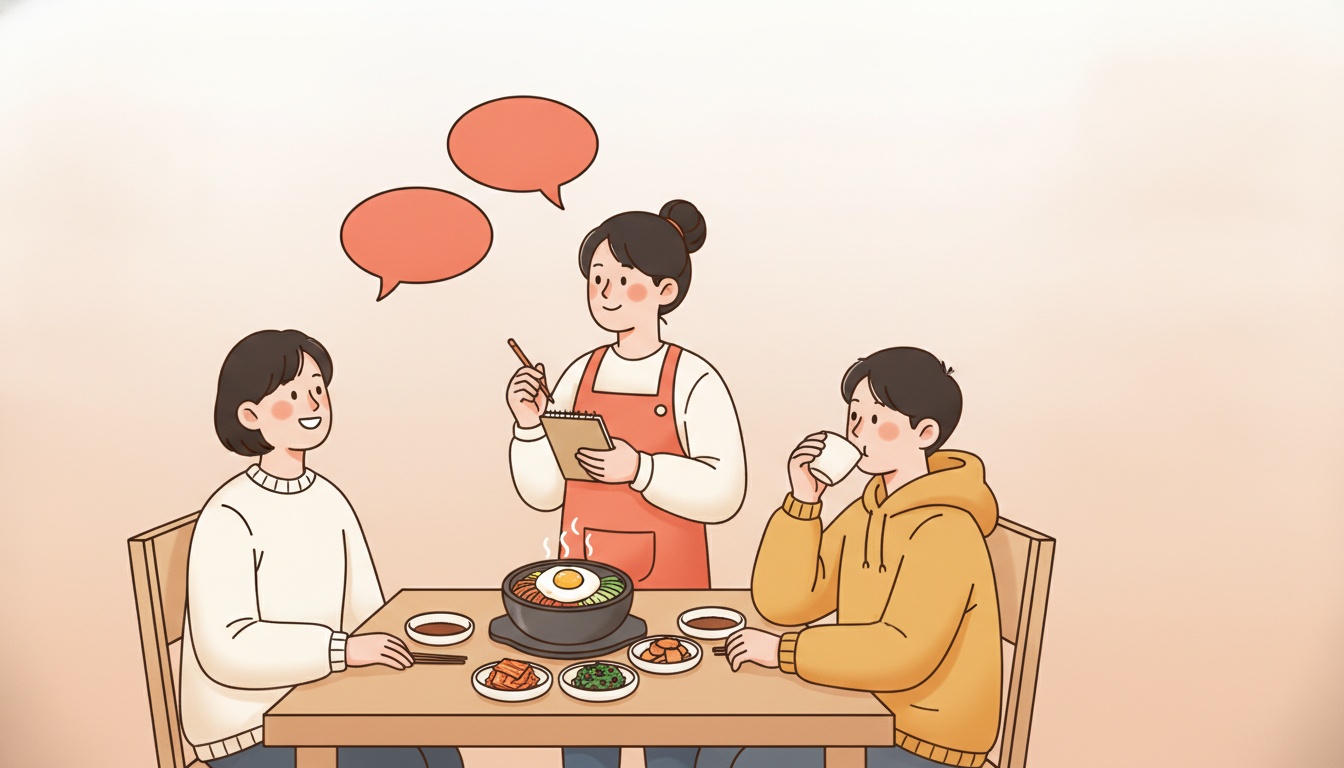
When the waiter is standing there and you say 비빔밥 먹을게요 (bibimbap meogeulgeyo), "I'll have the bibimbap," you're not narrating a plan you made this morning. You're deciding right then, out loud, for the person in front of you. That's the heart of -(으)ㄹ게요: it's a commitment aimed at the listener (Migaku, GoodJobKorean). 제가 할게요 (jega halgeyo) means "I'll do it, since you brought it up."
This listener-orientation has a hard grammatical consequence: you can only use -(으)ㄹ게요 with a first-person subject. You can promise your own behavior, not someone else's. 제가 갈게요 ("I'll go") is fine. 그가 갈게요 ("he'll go") is broken Korean, because you can't make a promise on his behalf (GoodJobKorean). If the subject is anyone but you, the form is wrong.
One listening note. 할게요 is spelled with a plain ㄱ, but Koreans pronounce it 할께요, with the tensed kk sound, and the same goes for 먹을게요 sounding like 먹을께요. You won't see it written that way, so train your ear for the harder consonant.
할 거예요: a plan that doesn't need you
Say 저는 갈 거예요 (jeoneun gal geoyeyo), "I'm going," and you've stated a plan that's true whether or not anyone's listening. You'd already decided. You're just reporting it. That's -(으)ㄹ 거예요: a plan or a prediction that exists independent of the conversation (Better Korean, 90 Day Korean).
Because it isn't a promise to anyone, it takes any subject you like. 누나가 갈 거예요 ("my older sister will go") is perfectly natural, where the 할게요 version would have been impossible. It also does plain prediction: 내일 비가 올 거예요 (naeil biga ol geoyeyo), "It'll rain tomorrow." Nobody's promising the weather. It's a forecast.
Now the trap. Go back to your coworker and the boxes. If you answer a request for help with 도와줄 거예요 instead of 도와줄게요, it can land oddly flat, the way confirming a calendar invite is not the same as saying "yeah, I've got you" (Korean Study Life). The plan form is correct grammar and slightly cold pragmatics. When someone needs you in the moment, reach for 할게요.
하겠어요: the form that isn't really "future"
The first time you hear 맛있겠다 (masitgetda) you'll want to translate it as future tense, and you'll be wrong. Someone sets a plate down, it looks great, and they say 맛있겠다, "that looks delicious." It's a guess from appearances, not a prediction about later. That's what -겠- mostly does: conjecture and attitude, not time (TOPIK Guide, YouSuckAtKorean).
You already know one -겠- form without realizing it. 알겠습니다 (algetseumnida), "got it," is what you say when you understand an instruction. Notice there's no future in "got it" at all. The form also carries a formal, announcing register, which is why a weather report says 내일 비가 오겠습니다 rather than the casual 올 거예요, and why a first introduction is the frozen phrase 처음 뵙겠습니다 (cheoeum boepgesseumnida), "nice to meet you." For an everyday "I'm going to do X," -겠- is rarely your daily driver. If you mean a plain plan, 할 거예요 is the natural choice, and the formal weight of -겠- belongs to the same register territory as Korean speech levels.
Try it in Conversa
Practice with AI characters who adapt to your level and give real-time feedback.
Try Conversa FreeConjugation in 60 seconds
The endings attach to the verb stem, and the only thing you check is whether the stem ends in a vowel or a consonant.
- Vowel-final stem (가다 → 가, 하다 → 하): add -ㄹ게요 / -ㄹ 거예요. So 갈게요, 할 거예요.
- Consonant-final stem (먹다 → 먹): add -을게요 / -을 거예요. So 먹을게요, 먹을 거예요.
That little (으) is just there to keep two consonants from crashing into each other after a consonant-final stem. The -겠- form is easier still: it slots straight onto the stem before your ending, no vowel check needed. 먹겠어요, 가겠습니다.
This is the same stem-plus-ending logic that drives most of the language, and it's worth getting fluent with the building blocks, including the irregular verbs that bend the rule.
One scene, all three
Here's a ten-second stretch of a restaurant where every form does a different job:
Server: 주문하시겠어요? (jumunhasigesseoyo?) "Are you ready to order?" You: 네, 비빔밥 먹을게요. (ne, bibimbap meogeulgeyo.) "Yes, I'll have the bibimbap." Your friend: 저는 김치찌개 먹을 거예요. (jeoneun gimchijjigae meogeul geoyeyo.) "I'm getting the kimchi stew."
The server uses -겠- as a polite, formal offer. You use 할게요 because you're deciding, on the spot, to the server. Your friend uses 할 거예요 because they're reporting a plan that was theirs all along. Same restaurant, same few seconds, three different relationships to the moment.
The question to ask before you pick
Before you say 할게요 or 할 거예요, stop asking "is this the future?" and ask "am I promising you something, stating my own plan, or just guessing?" Promising the listener is 할게요. Stating your plan is 할 거예요. Guessing or being formal is 하겠어요. The tense is almost beside the point.
The catch is that you can know this cold and still default to the wrong form the second a real conversation speeds up, because there's no English instinct to lean on. The only fix is reps: say 도와줄게요 to an actual person waiting on an actual answer, enough times that the promise form beats the plan form to your mouth. That's the kind of back-and-forth you can drill with Conversa, an AI conversation partner you can practice speaking with, so the choice becomes a reflex instead of a rule you recite.