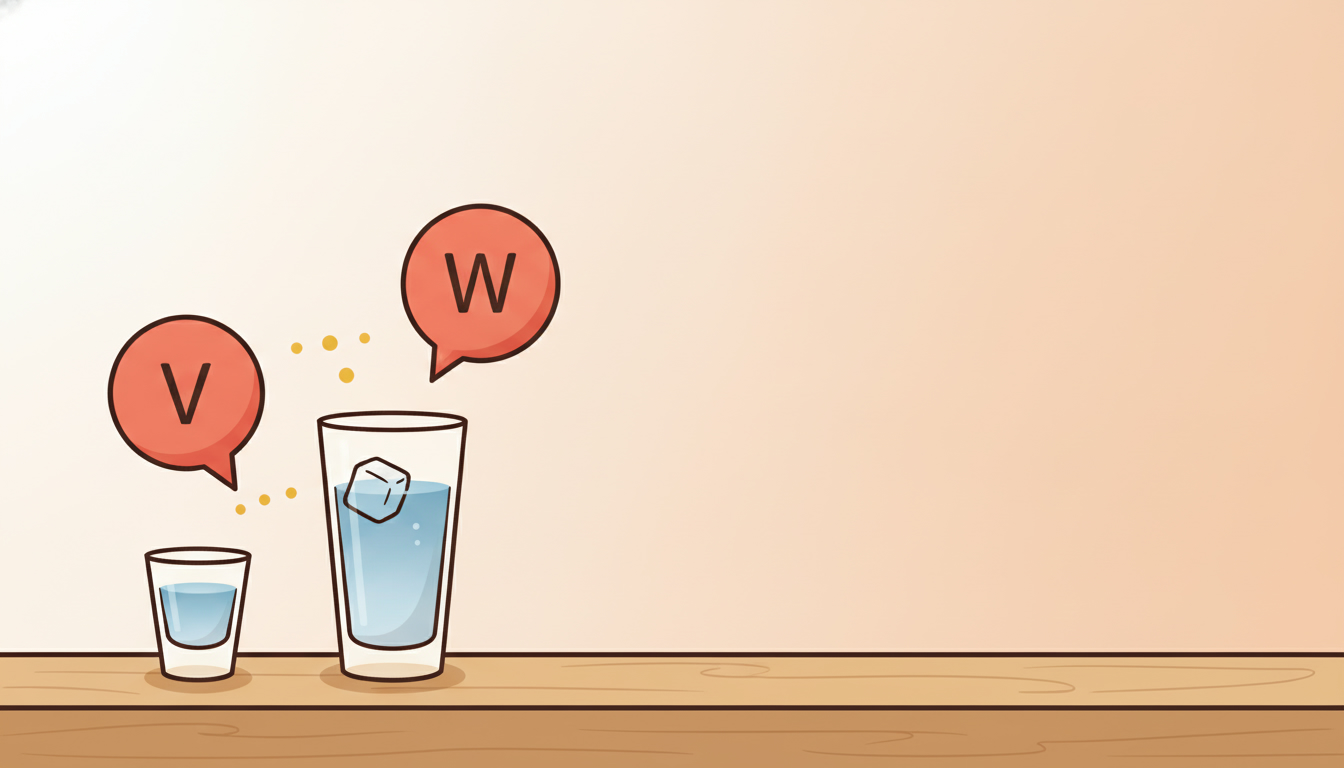
A Russian friend orders at a bar in Chicago: "One wodka, and a glass of vater for my husband." Two words, two mistakes. They point in opposite directions. The vodka picked up a W it shouldn't have. The water lost the W it needed. Same speaker, same breath, and she didn't hear either one. That's what nobody tells Russian speakers about W vs V pronunciation: it's one problem with two faces.
The history here is almost too neat. Wiktionary traces vodka back to Russian водка, a diminutive of вода, "water," from the same Proto-Indo-European root that gives English water. One ancient word, split across two languages, and the accent flips the consonant the wrong way on both halves.
That symmetry is the whole problem. Fix only the half you've been told about and you make the other half worse.
Russian gives you /v/ and no reason to need /w/
Вода, вино, восток. The Cyrillic в at the front of those three words is the same labiodental v-sound: top teeth resting on the bottom lip, air buzzing through the gap. You've made that sound a hundred thousand times. Standard Russian's consonant inventory, as Wikipedia's Russian phonology overview lays out, has /v/ and /vʲ/ and no /w/ phoneme at all. No Russian word hangs on the difference between west and vest. Your ear was never given that job.
Russian isn't one accent, though. Southern dialects have a "semivowel /w~u̯/ in the place of the Standard and Northern /v/" across Kursk, Tula, Ryazan and a dozen more oblasts, and that same phonology overview notes standard Russian /v/ itself often loosening into an approximant [ʋ] in spontaneous speech. The raw material isn't foreign. The contrast is.
Meanwhile your в is already busy. It devoices to [f], or to [fʲ] when it's soft, at the end of a word and in front of a voiceless consonant: любовь comes out [lʲʊˈbofʲ], вторник comes out [ˈftornʲɪk]. One letter, two jobs, and neither of them is [w].
Even Russian's borrowing rules can't settle on English ⟨w⟩. The standard practical-transcription table says render it as у, except in the listed cases where you render it as в. Washington is Вашингтон. Watergate is Уотергейт. If the sound feels unstable to you, that's inherited: your language never picked a side. Russian does the same thing to English /h/, which is why Harry Potter is Гарри Поттер on Russian shelves.
Then you learn to say /w/, and break your /v/
"It's where they keep the nuclear wessels." Walter Koenig's Chekov, in Star Trek IV (1986), is an American actor's idea of a Russian accent, and that's what makes it useful: look at what the caricature picked to exaggerate. It isn't water turning into "vater." It's vessels turning into "wessels," a real English /v/ replaced by a /w/ that doesn't belong there. One of the most quoted Russian accents in American film is built on the over-correction, not on the original mistake.
This has a name. Hypercorrection is "the nonstandard use of language that results from the overapplication of a perceived rule," and the textbook version for learners is someone who has finally mastered a sound their first language lacks and starts spraying it over words that never needed it.
Russian teachers see it from the inside. Enginform, writing in Russian for Russian learners, puts the sequence plainly: "Овладев произношением звука /w/… многие начинают использовать его в словах, где следуют произносить звук /v/" (having mastered /w/, many start using it in words where they should be saying /v/), and lists the casualties: visit becomes "wisit," very becomes "wery," vase becomes "wase."
None of this is a secret. Hadar Shemesh names "wery" instead of very and "ewen" instead of even. BoldVoice flags saying "wary" for very as an overcorrection of the water/vater problem.
Rastislav Metruk found the same two-way traffic in Slovak, a language with the same /v/-yes-/w/-no profile: his learners mispronounced both sounds "to almost the same degree". Slovak isn't Russian, but the profile is. What almost nobody does is train the way back. The advice stops at "practice your W," which is the instruction that caused the second error in the first place.
The teeth test tells you which sound you just made
Put a fingertip lightly on your top teeth and say vest, then west. On vest you'll feel your lower lip come up and press. On west nothing should touch at all.
That's the entire diagnostic, and it's binary. English /v/ is a labiodental fricative: teeth on lip, buzz, a position you hold. English /w/ is a voiced labial–velar approximant, which is doubly articulated. Your lips round, and at the same time the back of your tongue lifts toward the soft palate. Nothing touches your teeth at any point in it. If your teeth touched your lip, you made a /v/, whatever word you thought you were saying.
Two things this catches that the usual advice misses. The first is the near-miss: round your lips without raising the back of your tongue and you get [ʋ], which is neither English /v/ nor English /w/, and it's what "just make kiss lips" coaching tends to produce. The second is that /w/ is a glide. It's a movement rather than a shape. That's why "hold this position" instructions never quite land for it.
One honest limit. The test works best at the start of a word, where you have a moment to register what you felt. Mid-word /v/, in invite or even or seven, is where over-correction actually hides: the sensation is identical, but the syllable is gone before you've judged it. For those, record yourself and listen back. English /v/ is a sticking point from other directions too, as Korean speakers discover with f, v and z.
Build /w/ out of a sound you already own
Say у. Just the vowel, held: oooo. Your lips are already doing the /w/ shape, and so is the back of your tongue.
This isn't a metaphor. The reference description of /w/ says it plainly: in most languages it "is the semivocalic counterpart of a close back rounded vowel [u]." English /w/ is a Russian у that doesn't get to be a syllable. You already own the sound. What you don't own is the habit of running it into the next vowel fast enough that it stops counting as one.
So build it out of the vowel instead of aiming at the consonant:
- oo-est → west
- oo-ater → water
- oo-ine → wine
- oo-ee → we
- oo-ork → work
Say each one as two separate syllables first, slow enough to feel silly. Then squeeze the gap. After a few passes the у stops being a vowel and turns into the consonant, and you'll have produced an English /w/ without going anywhere near your teeth. The back-of-tongue position that the kiss-lips advice leaves out arrives free, because Russian /u/ already has it.
Try it in Conversa
Practice with AI characters who adapt to your level and give real-time feedback.
Try Conversa FreeNow protect the /v/ you already had
Vodka, video, very, invite, seven, over, love, vest. Read that list out loud with your finger on your teeth and make every single one buzz.
This is the drill that almost never gets assigned, and it's the reason the over-correction sticks. You spend a week teaching your mouth a new sound, the mouth gets enthusiastic, and it starts applying that sound to words that were already correct. Your Russian в was right all along for every English word spelled with a V.
That's the rule worth memorizing, and English rarely offers one this clean: if it's spelled with a V, your в was already correct. Leave it alone. Almost every word that needs the new sound is spelled with a W, and the exceptions are a short list worth memorizing: one and once start with /w/ despite the spelling, ⟨qu⟩ and ⟨gu⟩ hide one in the middle (queen, quick, language, penguin, persuade), and who, whose, whole have no /w/ at all despite carrying one on the page.
Run the V list immediately after your oo-onramp session, while the new /w/ is fresh and greedy. That ordering is deliberate. You're re-anchoring the sound that's about to get overwritten.
W vs V minimal pairs, run both directions
West and vest. Say them back to back, ten times, watching your mouth in a mirror.
The pairs that hold up across accents:
- west / vest
- wine / vine
- worse / verse
- wet / vet
- wail / veil
- went / vent
Two notes on pairs you'll see elsewhere. While / vile works fine if you're modeling on General American or standard British English, but in Scottish, Irish and some southern US accents while starts with /ʍ/ instead, so against those speakers it drills a contrast you don't need. And wary / vary is a genuine pair, though for most American speakers vary and very are already homophones thanks to the Mary-marry-merry merger, so that one quietly doubles as your wery/very drill.
Then the part that matters: say each pair in both orders. W first, then V first. Drilling only vest → west trains the exact habit that produces "wodka," because you're rehearsing one direction of travel. Alternate, and check your teeth on every rep.
Sentences that make you switch mid-breath
"We invited everyone over for vodka and water."
Every /w/ and /v/ in that sentence is a live trap, and they alternate fast enough that you can't autopilot one substitution through the whole line. Isolated word lists let you concentrate. Sentences don't. Over-correction is an attention problem, so it hides during careful drills and surfaces the moment you're actually talking to someone.
A few more to work through:
- "Vera went west in a velvet vest."
- "We were very well traveled."
- "The waiter served water with the veal."
Record these on your phone and listen back. The mirror can't follow your mouth mid-word, and your ear can't monitor production in real time while you're also building sentences. If you'd rather run them against something that talks back, Conversa gives you an AI conversation partner you can say the same line to fifteen times without anyone getting bored.
Back at the bar
The order comes out as "one vodka, and a glass of water." Teeth on lip for the first word. Lips rounded, teeth clear, for the second. Nobody at the bar notices anything, and that's the entire goal.
Expect the swap to come back when you're tired, arguing, or three sentences into a story you're excited about. That's normal, and it isn't a sign the work failed. What you're building isn't a perfect /w/ on every attempt. It's a default that holds when you're not watching it, and a finger you can put on your teeth when you catch yourself wondering which sound just came out.