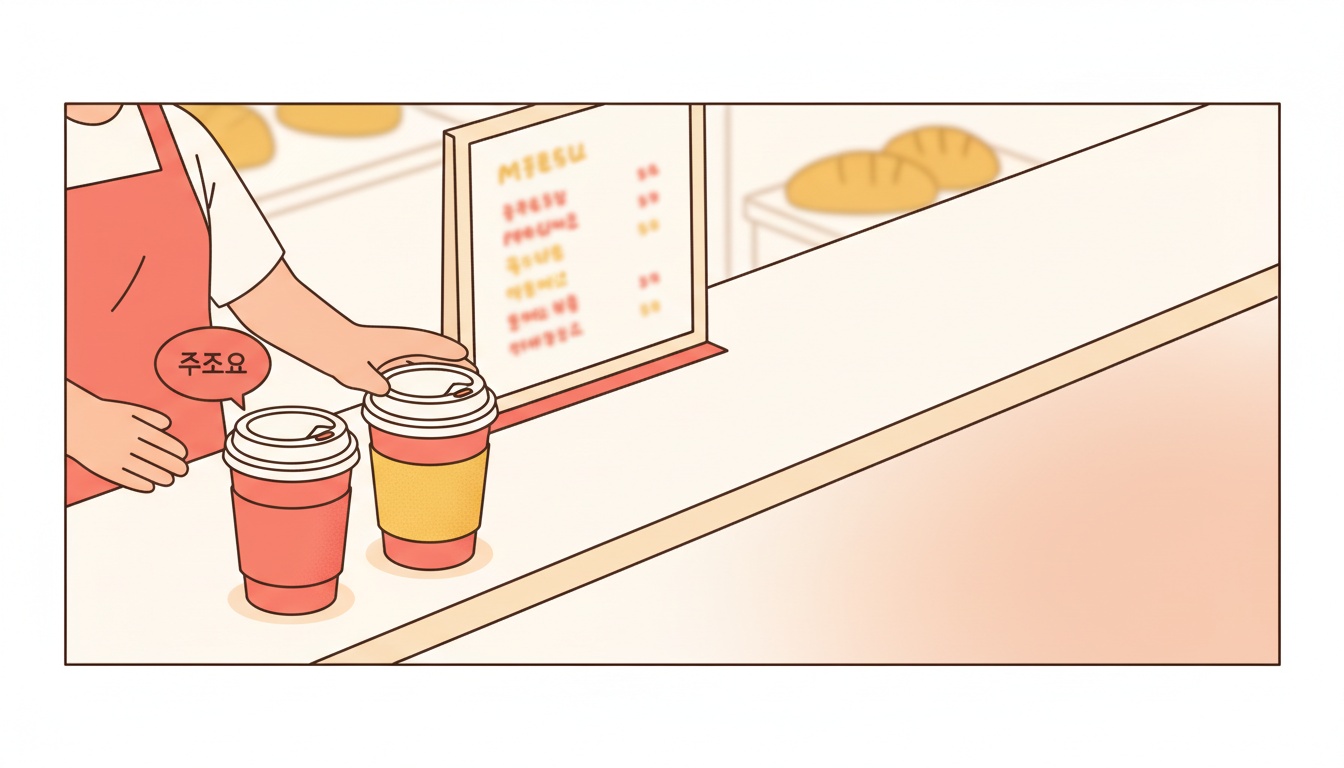
A beginner walks into a café in Seoul. They know exactly what they want to order, 아이스 아메리카노 한 잔 (aiseu amerikano han jan, one iced americano), and they freeze anyway. Not because of the word for "please." Because they can't remember whether to attach 주세요 or 주십시오 or 줘 to the end, and their textbook showed them seven options with seven numbered charts, and the person behind the counter is waiting.
This is the Korean speech level panic, and it's the real reason English speakers avoid opening their mouths in Korea. The grammar is a dimension English doesn't have. The textbooks respond by dumping the whole seven-level system on page one and watching learners drown in it. Here is the thing your textbook should have led with: in 2026 Seoul, actual humans use two of those seven levels for almost everything. Once you learn those two, plus the one phrase that lets you switch between them safely, you can function.
Korean speech levels: your textbook shows seven, real Korean uses two
Open any Korean grammar book and you'll find a chart with seven speech levels (하소서체, 하십시오체, 하오체, 하게체, 해라체, 해요체, 해체) numbered and laminated like they all matter equally. In modern spoken Korean, only four of those are in common use, and for a beginner, even four is a lie.
You hear 하소서체 in church and sageuk (historical) dramas. You hear 하오체 from actors playing Joseon-era court officials, and almost nowhere else in daily speech. 하게체 turns up in old novels and in a grandfather talking to his middle-aged son. 해라체 lives mostly in news headlines and textbooks. That leaves two levels you will actually use every day: 해요체 (the polite -요 form) and 하십시오체 (the formal -습니다 form). Banmal (the casual 해체) rounds out the set, but you don't get to use it until someone invites you to. The permission ritual that makes that switch is a section below.
The two endings that cover almost everything
The verb 먹다 (meokda, to eat) gives you the whole picture in one row. In a polite conversation you say 먹어요. In a formal setting you say 먹습니다. Between close friends you say 먹어.
Here is the working set, every verb you'll need in your first month:
| Verb | English | Formal (-습니다) | Polite (-요) | Casual |
|---|---|---|---|---|
| 먹다 | eat | 먹습니다 | 먹어요 | 먹어 |
| 가다 | go | 갑니다 | 가요 | 가 |
| 하다 | do | 합니다 | 해요 | 해 |
| 있다 | be / exist | 있습니다 | 있어요 | 있어 |
| 보다 | see | 봅니다 | 봐요 | 봐 |
해요체 (the -요 form) is your everyday default. Use it with strangers, shopkeepers, the café barista, coworkers you don't know well, your friend's parents, the Airbnb host, taxi drivers. 90 Day Korean calls it the safest everyday choice, which is exactly right. It's polite enough to not offend anyone, casual enough that no one will think you're cosplaying a 1980s news anchor. Your café sentence in 해요체: 아이스 아메리카노 한 잔 주세요. Done.
하십시오체 (the -습니다 form) is the stiffer register. Business introductions, job interviews, speeches, announcements on the Seoul subway, news anchors, and the first thirty seconds of meeting a client. 처음 뵙겠습니다 (cheoeum boepgetsseumnida, "nice to meet you [for the first time]") is pure 하십시오체. 감사합니다 lives here too. Imagine saying 식사하셨습니까? to your girlfriend's mom after three months of Sunday dinners together. It would sound like you were addressing the prime minister. For the same situation, 식사하셨어요? is the natural register: same respect level, warmer delivery.
Default to -요 in anything that isn't obviously formal, and switch into -습니다 only when the situation clearly calls for it.
Why English speakers freeze at this
English used to have thou for intimates and you for strangers, and over a few centuries it collapsed that distinction into one word. French kept tu and vous. German kept du and Sie. Korean blew past both of those and built a grammar where every verb ending encodes the social distance between you and the person you're listening to.
So the problem isn't that you're forgetting a rule. You're missing an entire cognitive dimension. Every time you speak Korean, your brain has to run a calculation English never made it run: who is this person to me, and which ending matches? The same thing happens in Mandarin, where the particle 了 isn't past tense even though every English brain reaches for it that way; you're not missing a rule, you're missing a category English doesn't mark. Once you accept that the new dimension exists, the panic shrinks. You are not memorizing seven charts. You are developing one reflex.
The permission ritual: 반말해도 돼요?
Picture a new junior employee (26) meeting her team lead (34) at a Seoul startup on day one. Both use -요 with each other. Two weeks in, over lunch, the team lead says:
우리 이제 말 편하게 할까요? 나이 차이도 얼마 안 나고. (Shall we speak more comfortably now? We're not that far apart in age.)
네, 좋아요. 감사합니다. (Yes, sounds good. Thank you.)
This dialogue is illustrative, not a transcript, but the pattern is exact. The older one offered, the younger one accepted, and from that conversation forward banmal is on the table.
You do not unilaterally drop -요 on a Korean person. As Migaku puts it, "you don't get to decide when to use 반말; the relationship decides." The older or higher-status person either initiates the switch or explicitly gives permission. The three phrases that surface this ritual, all of which you should recognize when someone says them to you:
- 반말해도 돼요?: "Can I speak casually?" (what you say if you want to ask first)
- 말 편하게 하세요: "Speak comfortably" (what an older person says to let you relax)
- 말 놓으셔도 돼요: "You can drop the formal speech" (more explicit version of the same)
This ritual works between peers and near-peers. You do not negotiate banmal with your boss's boss, your professor, or your partner's grandmother. With a genuine age or power gap, you stay in -요 indefinitely, and no one finds that strange.
The age-ask isn't rude. It's a register calibration.
If a Korean asks 나이가 어떻게 되세요? (naiga eotteoke doeseyo?, "how old are you?") within the first five minutes of meeting you, they're not being nosy. They are doing math, and the number that matters is your birth year. They need to know whether to call you 오빠/언니/형/누나, whether banmal will be possible later, and whether to hold onto 하십시오체 or relax into 해요체 with you. The positive result of the calculation is the word 동갑 (donggap, "same age"). When a Korean says it to you after the age exchange, it's a small social green light. You're peers. The register math is settled.
This works differently than it sounds in English. In a register-sensitive language, asking someone's age early is functional. It is how speakers figure out which form to use. Don't read it as an invasion of privacy. Read it as the Korean equivalent of a handshake.
Try it in Conversa
Practice with AI characters who adapt to your level and give real-time feedback.
Try Conversa FreeK-drama register switches, and what they're telling you
Two characters have been using -요 with each other for eight episodes. In episode nine, one of them drops to banmal without asking. If you were reading the subtitles, you probably missed the social earthquake. The other character didn't.
Watch any romance drama and you will see this scene, usually in the episode that marks the relationship getting serious. A mid-relationship level-drop is almost never accidental in a well-written drama. It's the writer telling you the characters just crossed a line. The opposite move is just as loud. A character who had been using banmal suddenly switching back to -요 inside a relationship that used to be casual is almost always a freeze-out or a cold, formal apology. You stopped being close, and the verb endings are announcing it.
Dramas are stylized. Real-life register switches happen more gradually, usually through the permission ritual above. But the social weight of a level change is real, and watching dramas with this one concept in mind gives you a training dataset most beginners never notice they have.
The mistakes native speakers actually notice
Saying 고마워 to a shopkeeper is not rude in a theoretical sense. It is the kind of mistake that makes the shopkeeper's face do a small, involuntary thing. You wanted 감사합니다 (formal) or 고마워요 (polite, note the -요 on the end). The difference between the wrong form and the right form is one syllable. The author of HowToStudyKorean has a personal anecdote about using the wrong level with a school principal and learning the hard way that the offense is real.
Three specific mistakes that get noticed:
- Dropping -요 too early with a new friend. The premature switch to banmal lands harder than the opposite mistake. Staying in -요 too long just makes you look careful. Dropping into banmal unilaterally makes you look presumptuous.
- Mixing registers in the same sentence. 감사합니다… 잘 가 (formal thank-you, then casual goodbye) makes a native speaker's eye twitch. Pick one level and ride it through.
- Using banmal with anyone older, ever, without an invitation. The power gap makes this the one mistake you cannot talk your way out of. It applies to your thumbs too: Korean texting abbreviations like ㅇㅋ and ㄱㅅ are banmal in two letters, so the reply to a boss or teacher is 넵, not ㅇㅋ.
The upside: as a foreigner, you get real slack. Koreans know the system is alien to you. What they notice is that you're trying, and the fix is almost always cheap. Use -요. Stay in -요. Wait for someone to tell you otherwise.
The survival kit
The next time you're ordering coffee in Seoul, 주세요 at the end of the sentence is doing 90% of the work. Learn 해요체 first. Learn to recognize 하십시오체 when you hear it on the subway and in business meetings. Learn the phrase 반말해도 돼요? so you recognize the handshake when someone offers it. Everything else in that seven-level chart is something you can layer on later, once the survival kit stops being the part that's scary.