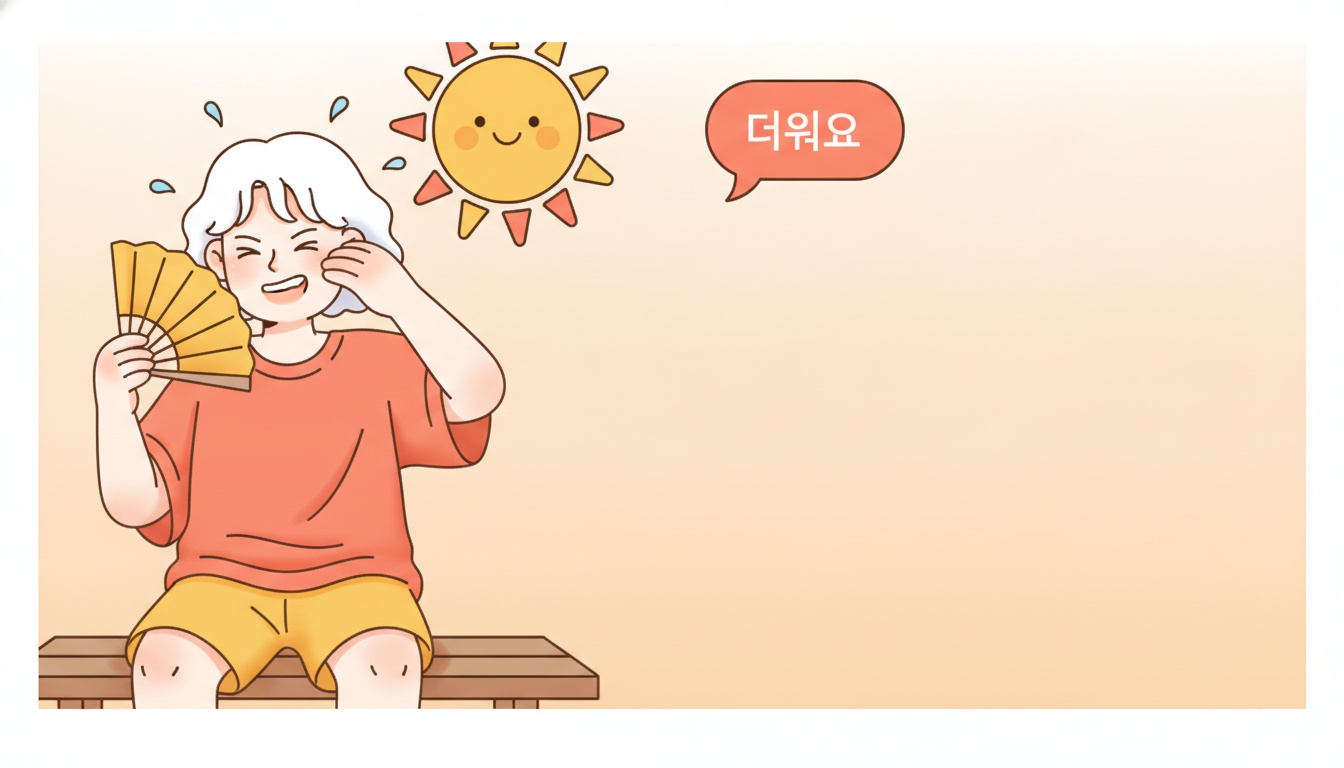
You learned the rule on day one. To make a verb polite, take the stem and add -아요 or -어요. So you meet 덥다 (deopda), "to be hot," you drop the 다, you add -어요, and you proudly say 덥어요.
No Korean has ever said 덥어요.
The word is 더워요 (deowoyo). The ㅂ at the bottom of 덥 quietly turned into 우 the moment a vowel ending showed up. Nobody warned you, because nothing on the page looks different. 덥다 sits in the dictionary next to 입다 (ipda, "to wear"), which conjugates to 입어요 exactly the way your rule predicted. Same final consonant. Same dictionary format. One follows the rule, one breaks it, and you can't tell which is which by looking.
That gap is the whole problem with Korean irregular verbs. This post is about closing it.
Why Korean irregular verbs aren't really irregular
English irregular verbs are pure memorization. Go becomes went, bring becomes brought, and there is no system: you learn each one as its own fact and the next verb tells you nothing about the one after it.
Korean works the opposite way. The "irregulars" sort into a small number of sound-change families, and once you know the family, you can conjugate a verb you have never seen before. 덥다 isn't a random exception. It's a member of the ㅂ family, and every ㅂ-irregular does the same thing for the same reason: 덥어요 is clumsy to say, 더워요 glides. The change is your mouth taking the easy path, written down.
So the goal isn't to memorize a hundred forms. It's to learn six families (ㅂ, ㅡ, 르, ㄷ, ㅅ, ㄹ) and, just as importantly, to spot the regular lookalikes that share a final consonant but follow the plain rule. There's a seventh trick for adjectives at the end, but the six below come first. Learn them in this order. The first three carry most of your daily speech.
The ㅂ family: where most beginners first faceplant
덥다 → 더워요. 춥다 (chupda, "to be cold") → 추워요. 쉽다 (swipda, "to be easy") → 쉬워요. 어렵다 (eoryeopda, "to be difficult") → 어려워요. The pattern is fixed: a stem-final ㅂ becomes 우 before a vowel ending, and you can confirm any of these in the National Institute of Korean Language's learner dictionary, which lists the conjugated forms for every entry.
Here's the part that actually trips people up. Not every verb ending in ㅂ does this. 입다 → 입어요 ("wear"). 잡다 (japda, "to catch") → 잡아요. 좁다 (jopda, "to be narrow") → 좁아요. These keep their ㅂ and take the plain ending. There's a rough rule of thumb that holds often enough to be useful: the ㅂ-irregulars are mostly adjectives (hot, cold, easy, hard, heavy, close), and the ㅂ-regulars are mostly action verbs (wear, catch, chew). It won't catch every case, but when you meet a new ㅂ-adjective, betting on irregular is the smart bet.
One oddity worth thirty seconds: 돕다 (dopda, "to help") doesn't go to 도워요. It goes to 도와요, with 와 instead of 워. It's the one high-frequency verb that breaks the ㅂ pattern's own sub-rule, so just file it. (There's a second 와-verb, 곱다, but it's literary and rarely comes up in speech, so don't spend memory on it.)
The ㅡ family: hiding inside your most common adjectives
바쁘다 (bappeuda, "to be busy") → 바빠요. 아프다 (apeuda, "to be sick, to hurt") → 아파요. 예쁘다 (yeppeuda, "to be pretty") → 예뻐요. The stem-final ㅡ vowel just vanishes, and a new vowel takes its place.
Which vowel? Look at the syllable before the ㅡ. If that syllable has a bright vowel (ㅏ or ㅗ), you get ㅏ: 바쁘 has 바, so 바빠요. If it has anything else, you get ㅓ: 예쁘 has 예, so 예뻐요. And when there's no syllable before the ㅡ at all, it defaults to ㅓ: 쓰다 (sseuda, "to write, to use") → 써요, 크다 (keuda, "to be big") → 커요.
Learn this family early, because it owns vocabulary you need in your first month. 아프다, 바쁘다, 배고프다 ("to be hungry"), 크다, 쓰다. You will reach for these constantly, and every one of them changes shape when you make it polite. Talk To Me In Korean covers this family in its irregular-verb lessons if you want a second walkthrough with audio.
The 르 family: the one you'll say a hundred times a day
모르다 (moreuda, "to not know") → 몰라요. You cannot get through a Korean conversation without this verb, and it belongs to the family that surprises people most. 다르다 (dareuda, "to be different") → 달라요. 빠르다 (ppareuda, "to be fast") → 빨라요. 부르다 (bureuda, "to call, to sing") → 불러요. 고르다 (goreuda, "to choose") → 골라요.
The mechanism: the ㅡ in 르 drops, and an extra ㄹ appears, so you end up with a double ㄹ. 모르 + 아요 isn't 모라요, it's 몰라요. The first time you hear someone say 몰라요 at full speed it sounds nothing like the dictionary word 모르다, which is exactly why this family is worth drilling out loud rather than just reading. Wiktionary's Korean entries show the full conjugation table for each of these with the irregular class labeled.
The ㄷ family: same consonant, opposite behavior
듣다 (deutda, "to hear, to listen") → 들어요. The stem-final ㄷ turns into ㄹ before a vowel ending. 걷다 (geotda, "to walk") → 걸어요. 묻다 (mutda, "to ask") → 물어요.
This family hands you the cleanest minimal pair in Korean grammar. 듣다 → 들어요 ("hear") is irregular. 닫다 (datda, "to close") → 닫아요 ("close") is regular. Identical-looking stems, both ending in ㄷ, and they split. There's no surface clue. You can confirm each one's class in the Naver Korean dictionary, the everyday reference most Korean speakers reach for.
If you want proof that spelling can't save you, look at 묻다. It's two different verbs spelled the same. As "to ask," it's irregular: 물어요. As "to bury," it's regular: 묻어요. One spelling, two conjugations, decided entirely by meaning. This is why you have to learn the polite form of a verb at the same time you learn the verb.
The ㅅ family: the consonant that just disappears
짓다 (jitda, "to build, to cook rice") → 지어요. The stem-final ㅅ drops before a vowel ending, and here's the twist that separates it from the ㄷ family: nothing rushes in to fill the gap. 낫다 (natda, "to recover, to be better") → 나아요, with two vowels sitting next to each other and a tiny pause between them. 붓다 (butda, "to pour, to swell") → 부어요.
The lookalikes follow the plain rule, as usual. 웃다 (utda, "to laugh") → 웃어요. 씻다 (ssitda, "to wash") → 씻어요. 벗다 (beotda, "to take off") → 벗어요. These keep their ㅅ. The drop-versus-keep split is the same trap as everywhere else, which is the encouraging part: it's the same skill each time.
Try it in Conversa
Practice with AI characters who adapt to your level and give real-time feedback.
Try Conversa FreeThe ㄹ family: the one that only drops in specific spots
살다 (salda, "to live") looks regular most of the time. 살아요, 살았어요, no surprises. The ㄹ only disappears in front of a specific set of endings: those that start with ㄴ, ㅂ, or ㅅ. So 살다 becomes 삽니다 (formal), 사는 (when modifying a noun), and 사세요 (honorific). Same story for 알다 ("to know") → 압니다, 만들다 ("to make") → 만드는, 팔다 ("to sell") → 팝니다. The ㄹ isn't vanishing at random. It steps aside for those three consonants and stays put everywhere else.
That's the six families that cover almost every verb and adjective you'll meet. Adjectives have one extra trick worth thirty seconds: the ㅎ pattern. 그렇다 (geureota, "to be so") → 그래요. 어떻다 (eotteota, "how is it") → 어때요. 빨갛다 (ppalgata, "to be red") → 빨개요. The ㅎ drops and the vowel collapses to ㅐ. The famous exception is 좋다 ("to be good"), which keeps everything and goes to 좋아요 the regular way, so don't let the most common ㅎ-looking adjective fool you into thinking it's in this club. How To Study Korean has the most exhaustive tables if you want every member of every family.
How to actually learn these without a giant table
Write 덥다 / 더워요 on one flashcard, never 덥다 by itself. That single habit fixes the real problem, because the trouble was never the rules. It was that you couldn't tell 덥다 from 입다 by looking. Learn each new verb together with its -아요/어요 form, the way you'd learn a face with a name, and the dictionary form stops being a trap.
As for order: don't try to swallow all six families at once. Take ㅂ, ㅡ, and 르 first, because they cover the adjectives and verbs you use on day one. Pick up ㄷ, ㅅ, and ㄹ as specific verbs come up in your studying, and let the ㅎ adjectives arrive whenever they arrive. If you're practicing out loud with a tutor or with an AI conversation partner like Conversa, you'll feel the irregular ones snap into place faster than any chart can teach them, because you'll be saying 더워요 in an actual sentence instead of reciting it.
These families also explain a lot of what you've been mishearing. Many of the same sound changes show up in the gap between written and spoken Korean, and the "easy rule, hidden trap" shape is the same one behind Korean's two words for "not". Korean isn't trying to ambush you. It just runs on a handful of patterns nobody printed in bold.
So the next time you meet a new ㅂ-adjective and your instinct says 덥어요, stop, smile, and say 더워요. You're not guessing anymore. You know which family it's in.