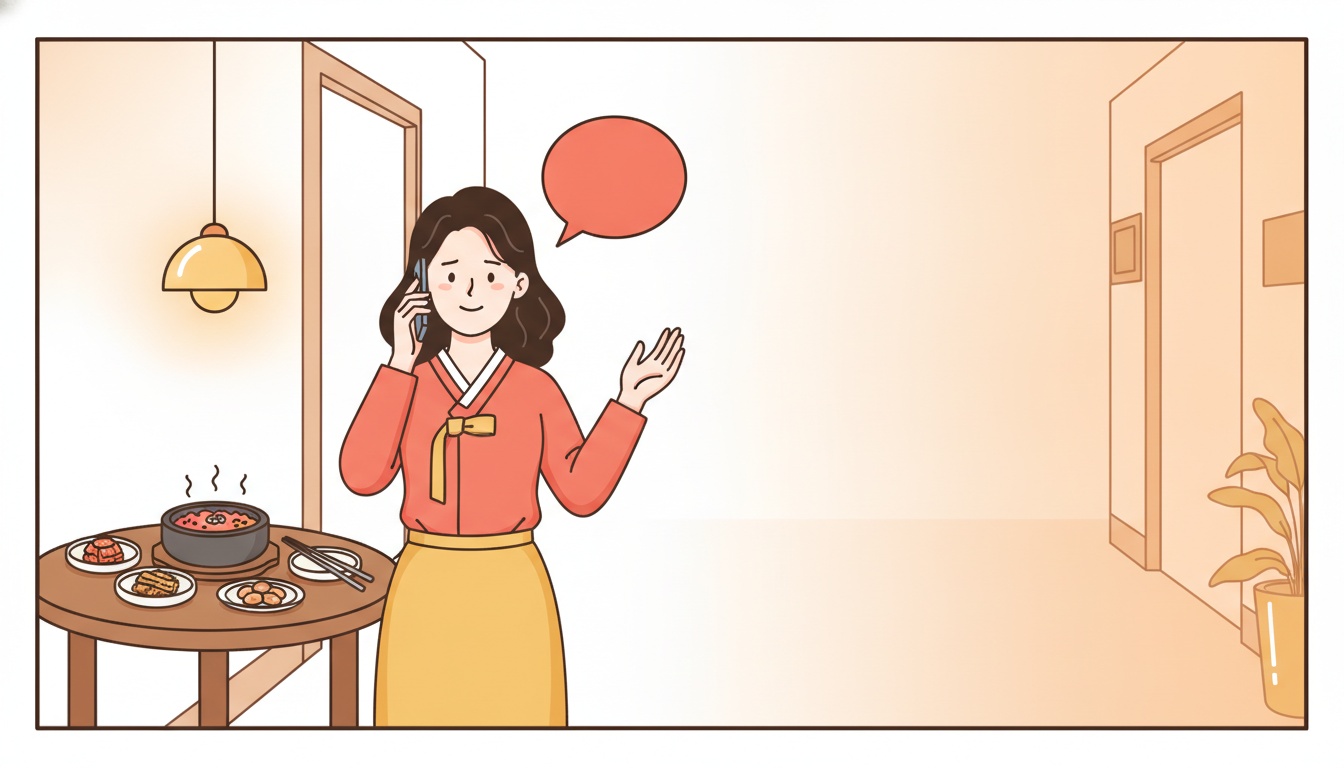
Your Korean coworker invites you to dinner on Friday. You already have plans, so you reach for the sentence your textbook taught you: 안 가요 (an gayo), "I'm not going." The grammar is perfect. The message is a problem. What you actually said lands closer to "I've decided not to come," and the conversation goes a little quiet.
The sentence you wanted was 못 가요 (mot gayo): "I can't go." One syllable of difference. English merges both into "I'm not going," so nothing in your native language warns you that Korean negation splits "no" into a choice and an inability, and that picking the wrong one can turn a scheduling conflict into a snub.
Here's how the split works, why 못 is the socially safe option, the three traps that catch learners even after they've memorized the basic rule, and the formal long forms you'll meet the first time you read a Korean news article.
Did you choose, or couldn't you?
안 (an) negates decisions. 커피를 안 마셔요 means "I don't drink coffee" in the sense that you've looked at coffee and said no thanks. 겨울에는 자전거를 안 타요 means you don't ride your bike in winter because you'd rather not freeze. In every 안 sentence, the subject is steering.
못 (mot) negates ability. 우유는 못 마셔요 means "I can't drink milk." Your opinion of milk is irrelevant; your stomach has voted. 손이 아파서 글씨를 못 써요 means "my hand hurts, so I can't write." Something outside your will is blocking the verb.
The split shows up sharpest in the past tense, where English flattens everything into "didn't":
- 어제 파티에 안 갔어요 (an gasseoyo): I didn't go to the party. I stayed home on purpose. Maybe the host should wonder why.
- 어제 파티에 못 갔어요 (mot gasseoyo): I didn't go to the party. I wanted to. Work, illness, a missed bus: something stopped me.
Same English translation, two different stories. Korean listeners hear the difference instantly, which is exactly why the dinner invitation above went wrong. Kimchi Grammar's breakdown runs the same verb through both negators if you want more side-by-side pairs.
The polite no: why Koreans say 못 가요 even when they could go
죄송하지만 못 가요, "I'm sorry, but I can't go," is the standard polite refusal in Korean, and natives often reach for it even when the honest answer is closer to 안. The 못 frames the no as circumstance. Nobody loses face, nobody has to hear "I am choosing not to spend Friday with you."
Answer with 안 가요 instead and you've made the refusal personal. One learner tells the story of confusing the two with Korean friends and watching the temperature of the conversation change.
The literal truth ("technically I could come, I just have a thing") is beside the point. This is a politeness strategy, the same way an English speaker says "I can't make it" rather than "I won't be coming." Korean just bakes the strategy into a single syllable.
If you want to go one step softer, Koreans often skip the flat refusal entirely: 아쉽지만 참석하기 어려울 것 같아요, roughly "it's a shame, but I think it will be difficult to attend." Notice there's no negator at all. "Difficult" does the work.
The takeaway for your first year of Korean: when declining anything, reach for 못. Save 안 for facts about your habits and preferences. Your verb endings carry politeness too, and that system has its own rules; the speech levels guide covers that half of not offending anyone.
The 하다 sandwich: 공부 안 해요, never 안 공부해요
Hundreds of Korean verbs are built from a noun plus 하다 (hada, "to do"): 공부하다 is literally "study-do," 운동하다 is "exercise-do," 청소하다 is "cleaning-do." With these verbs, beginners put 안 in front of the whole package and produce 안 공부해요, a sentence no native speaker says.
The negator goes inside the sandwich, between the noun and 하다:
- 공부 안 해요: I don't study.
- 운동 안 해요: I don't exercise.
- 어제 청소를 안 했어요: I didn't clean yesterday.
Think of it as negating the "do," since that's the only verb in the room. The noun is just cargo. 90 Day Korean's 안 lesson lists more examples if the pattern hasn't clicked. The same rule applies to 못: 숙제를 못 했어요, "I couldn't do my homework."
Plain verbs that aren't 하다 compounds keep the negator out front, where your textbook promised it would be: 안 먹어요, 못 자요, 안 갔어요.
노래를 못해요: when 못 means you're just bad at it
못 has a second job. Attached directly to 하다 with no space, 못하다 (mothada) means "to be bad at something." 난 수학 못해요 doesn't mean circumstances prevent you from doing math. It means you're bad at math, as a standing fact about you.
Compare:
- 노래를 못해요: I'm a bad singer. (Skill judgment, no space.)
- 목이 아파서 노래를 못 해요: My throat hurts, so I can't sing right now. (Circumstance, space.)
The spacing carries the meaning in writing, and in speech the context does. The boundary is soft in the wild, though: don't be surprised when texts from native speakers ignore the space, so treat it as a strong hint rather than a law of physics. The useful direction is reading comprehension. When a Korean friend texts 나 요리 못해 about themselves, they're calling their own cooking bad, and laughing at it, so you can too.
Try it in Conversa
Practice with AI characters who adapt to your level and give real-time feedback.
Try Conversa FreeAdjectives refuse 못
You can't be "unable to be happy" in Korean grammar. 못 only negates actions, so descriptive verbs reject it: "it's not good" is 안 좋아요 or 좋지 않아요, never 못 좋아요. "I'm not sick" is 안 아파요; 못 아파요 doesn't exist.
This one is good news. It deletes half your decisions: if the word describes a state or quality, 안 is the only option, and you can stop deliberating.
The long forms: -지 않다 and -지 못하다
안 가요 has a longer twin, 가지 않아요. So does 못 가요: 가지 못해요. Same meaning, different register. The short forms run spoken Korean; long-form negation shows up in writing, news, and formal speech. 저는 운동하지 않아요 says "I do not exercise" with its collar buttoned. 내일 모임에 가지 못할 거예요, "I will not be able to attend tomorrow's meeting," belongs in an email to your boss, where 못 가요 alone might read as abrupt.
As a beginner you need to recognize the long forms everywhere and produce them almost nowhere. Default to 안 and 못 in conversation. By the time you start writing emails in Korean or reading news articles, -지 않다 will already be familiar.
The long form also covers adjectives: 좋지 않아요 means the same as 안 좋아요, one register notch up, and 행복하지 않아요, "I'm not happy," follows the same pattern.
The thirty-second version
Before any Korean "no," one question: did I choose this, or did the world choose it for me? Chose it: 안. World chose it: 못. Declining an invitation: default to 못, even when it's a white lie. 하다 verbs: negator between the noun and 하다, 공부 안 해요. No space after 못 before 하다 and you've said "bad at it." Adjectives only ever take 안.
The fastest way to make the choice automatic is to be forced into it live. Practice declining invitations with an AI conversation partner like Conversa, where a botched 안 가요 costs you nothing, and the rep your textbook can't give you takes about five minutes a day. Decline a few dinners with 못 가요 and the dinner-party mistake at the top of this post becomes one you read about instead of one you made.
If you're also studying Mandarin, this fork should feel familiar: Chinese splits its "not" by aspect instead of volition, and the 不 vs 没 guide walks the same kind of minefield.