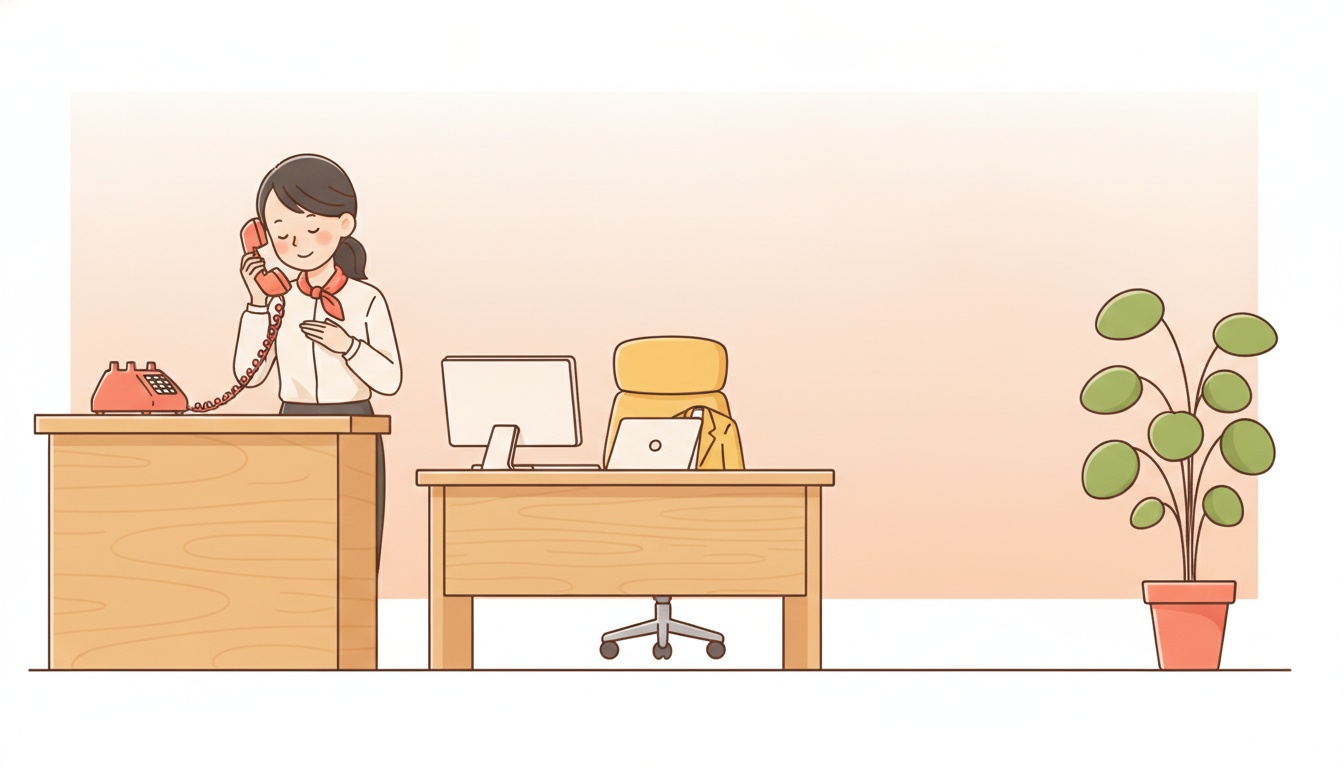
Call a Japanese office and ask for the department head, and the receptionist will say something like 田中はただいま席を外しております (Tanaka wa tadaima seki o hazushite orimasu): "Tanaka is away from his desk right now." Look closely at that sentence. No さん after Tanaka, even though he's her boss. And おります, a humble verb, used for his actions, the actions of the most senior person in the building.
If your Japanese education so far has been "add です/ます to be polite," every choice in that sentence looks wrong. It's all correct keigo (敬語). The textbook politeness you learned at N5 is real, but it's one layer of a three-layer system, and the other two layers run on a logic that has nothing to do with who outranks whom.
Here's the full map: the three layers, the verbs that transform entirely, and the in-group rule that explains why that receptionist talks about her own boss the way she'd talk about a child.
The three layers, and which one you already know
Take one trip to a client's office and watch the verb "to go" change shape three times:
- 行きます (ikimasu): "I'm going." Polite, neutral.
- いらっしゃいます (irasshaimasu): "[The client] is going." Honorific.
- 参ります (mairimasu): "I'm going [humbly]." Humble.
Same movement, three social positions. Those are the three layers, and they answer different questions (Coto Academy has the full breakdown):
Teineigo (丁寧語) is the です/ます you know. It's aimed at the listener and says "I'm being courteous to you." It makes no claims about anyone's status. This is the floor: you can speak teineigo your entire life in Japan and never offend a stranger.
Sonkeigo (尊敬語) raises the other person. You apply it to their actions: the client looks at it becomes ご覧になる, the client says becomes おっしゃる. You never use sonkeigo for your own actions. Saying 私が召し上がります ("I will graciously eat") sounds like crowning yourself.
Kenjougo (謙譲語) lowers you. You apply it to your own actions when they involve someone you're being respectful toward: I'll ask becomes 伺います, I'm called Sakura becomes さくらと申します. If you've studied Korean, the architecture will feel familiar; Korean speech levels wire respect into the verb endings in much the same way.
One honest complication: when Japan's Agency for Cultural Affairs published its official keigo guidelines in 2007, it split these three categories into five, separating out "courteous" verbs like 参る and beautified nouns like お金. You don't need the five-way split at N4. You do need to know it exists, because it's the official answer to why 参る sometimes shows up where no exalted listener is in sight.
いただきます and the seven other verb swaps
You already use the most famous suppletive keigo verb every time you eat. いただきます, the thing you say before a meal, is the humble verb for "receive." Whole verbs swapping out, rather than endings changing, is how the core of sonkeigo and kenjougo works. There's no rule that derives 召し上がる from 食べる. You memorize the pairs (Japanistry keeps a full table).
These eight rows cover most of what you'll hear in real life:
| Plain | Honorific (their action) | Humble (your action) |
|---|---|---|
| いる (to be) | いらっしゃる | おる |
| 行く・来る (go/come) | いらっしゃる | 参る |
| する (do) | なさる | いたす |
| 言う (say) | おっしゃる | 申す |
| 食べる・飲む (eat/drink) | 召し上がる | いただく |
| 見る (see) | ご覧になる | 拝見する |
| 知っている (know) | ご存知だ | 存じている |
| 会う (meet) | お会いになる | お目にかかる |
Every other verb uses a productive pattern instead. For honorific, お + verb stem + になる (お帰りになる, "[someone esteemed] returns home"). For humble, お + verb stem + する (お手伝いします, "I'll help you"), or ご + Sino-Japanese noun + する (ご連絡します, "I'll contact you"). Two patterns, eight irregular rows, and you can build most of the keigo you'll need for years.
The uchi/soto switch: why you humble your own boss
Now back to that receptionist. Inside the office, she absolutely uses sonkeigo for Tanaka. 部長はもうお帰りになりましたか ("Has the department head gone home?") is normal speech toward a superior. But the moment an outside caller is on the line, Tanaka stops being her superior and becomes part of her uchi (内), her in-group, and the caller becomes soto (外), the outside.
Respect flows across the group boundary, toward the outsider. So she humbles everyone inside the boundary, including the boss (My Senpai walks through this rule).
Quoting your boss makes the flip easy to see:
- To a coworker: 部長がおっしゃっていました。 ("The department head said so." Honorific. Fine.)
- To a client: 田中が申しておりました。 ("Tanaka said so." Humble, and name only.)
Use the first sentence with a client and you've elevated your own team above the person you're serving. It reads less like extra politeness and more like calling your own mom "Her Excellency" to a stranger.
Notice that 田中 lost more than the honorific verb. Inside the company he's 田中さん or 田中部長; described to an outsider, he's plain 田中, title and さん both gone, and the name suffixes have rules of their own beyond this one. Stripping the honorifics off your own people is itself a form of humility.
And the boundary moves. Talking to another department, your team is uchi and they're soto. Talking to another company, your whole employer is uchi. Talking about your family to anyone, your family is uchi, which is why you say 母 (haha, plain "mother") about your own mom to others but お母さん about theirs. If you've read about Japanese giving and receiving verbs, this is the exact same machinery; あげる and くれる flip on the same boundary.
This rule is the part of keigo that conversion tables can't teach, because the right form depends on who's listening, and that changes mid-day, sometimes mid-sentence. It's also hard to drill alone. Reading about it is one thing; producing 申しておりました on the phone with three seconds to think is another. An AI conversation partner like Conversa gives you a place to practice this kind of exchange out loud, get it wrong safely, and run it again, which is most of what new employees in Japan do during their first month anyway, just with more sweating.
Try it in Conversa
Practice with AI characters who adapt to your level and give real-time feedback.
Try Conversa Freeお and ご: one rule, a few famous exceptions
Why is it お名前 (your name) but ご住所 (your address)? The prefix tracks the word's ancestry: native Japanese words (wago) take お, Chinese-origin words (kango) take ご (Tofugu explains the split). 名前 is native; 住所 is Sino-Japanese. So you write ご連絡いたします ("I will contact you") with ご because 連絡 came from Chinese.
The exceptions are common enough that you'll meet them in week one of any office job: お電話, お時間, お料理 are all Chinese-origin words that take お anyway, because they became everyday household vocabulary. Learn the rule, then learn those three. Past that, when you're unsure, leaving the prefix off is safer than guessing wrong.
The konbini will teach you keigo wrong
Stand at a convenience store register and you'll hear 千円からお預かりします ("I'll take it from one thousand yen") and よろしかったでしょうか ("Was that alright?" in past tense, about an order you placed four seconds ago). Both phrases are everywhere. Both are considered errors by prescriptivists: that から has no business being there, and the past tense asks about a decision that hasn't finished happening. The phenomenon has a name, manual keigo, because part-time workers learn it from training manuals rather than from grammar.
This matters to you for two reasons. First, the konbini is many learners' main source of native keigo input, and it's feeding you nonstandard forms; prescriptivists would rather hear よろしいでしょうか (present tense) and lose the から entirely.
Second, it's genuinely reassuring: the reason these manuals exist is that nineteen-year-old native speakers can't produce correct keigo without a script. The bar you're trying to clear is one that natives also clear with cue cards.
You can also be too polite
A waiter who asks お召し上がりになられますか has stacked honorifics three layers deep: the honorific verb 召し上がる, wrapped in the お〜になる honorific pattern, with an honorific られる on top. The correct form is just 召し上がりますか. Piling on more keigo doesn't add more respect. Past one layer per verb it becomes nijuu keigo (二重敬語), double keigo, and the official guidelines class it as inappropriate (Japanistry has a list of common offenders).
A few stacked forms got grandfathered in through sheer usage. お伺いします, technically a humble verb wrapped in the humble お〜する pattern, appears in dictionaries and business-etiquette guides and is conventionally accepted. You don't need to memorize the exceptions list. You need the principle: one layer of keigo per verb, and when natives hear more than that, it sounds nervous rather than respectful.
Sonkeigo vs kenjougo: three questions you can run in real time
The client's phone is ringing and you have about two seconds to pick a verb. Three questions get you there:
- Whose action is this? Mine or theirs?
- Is that person inside or outside my group, right now, relative to whoever's listening?
- So do I raise them (sonkeigo) or lower me (kenjougo)?
If the answer to question one is "theirs" and they're soto, reach for sonkeigo. If it's "mine," reach for kenjougo. If you're just being generally courteous, です/ます already does the job, which is why nobody should panic before N4. A tourist needs teineigo and nothing else. The two upper layers start paying rent when you have Japanese coworkers, clients, or in-laws.
And when you inevitably get it wrong, you'll be in good company. Wasabi's keigo guide notes that plenty of native speakers can't use keigo properly either.
Next time a clerk hands you your change and asks よろしかったでしょうか, you'll hear the seam in their training manual. That's the moment you'll know the system has stopped being a table in a textbook and started being something you can actually hear.