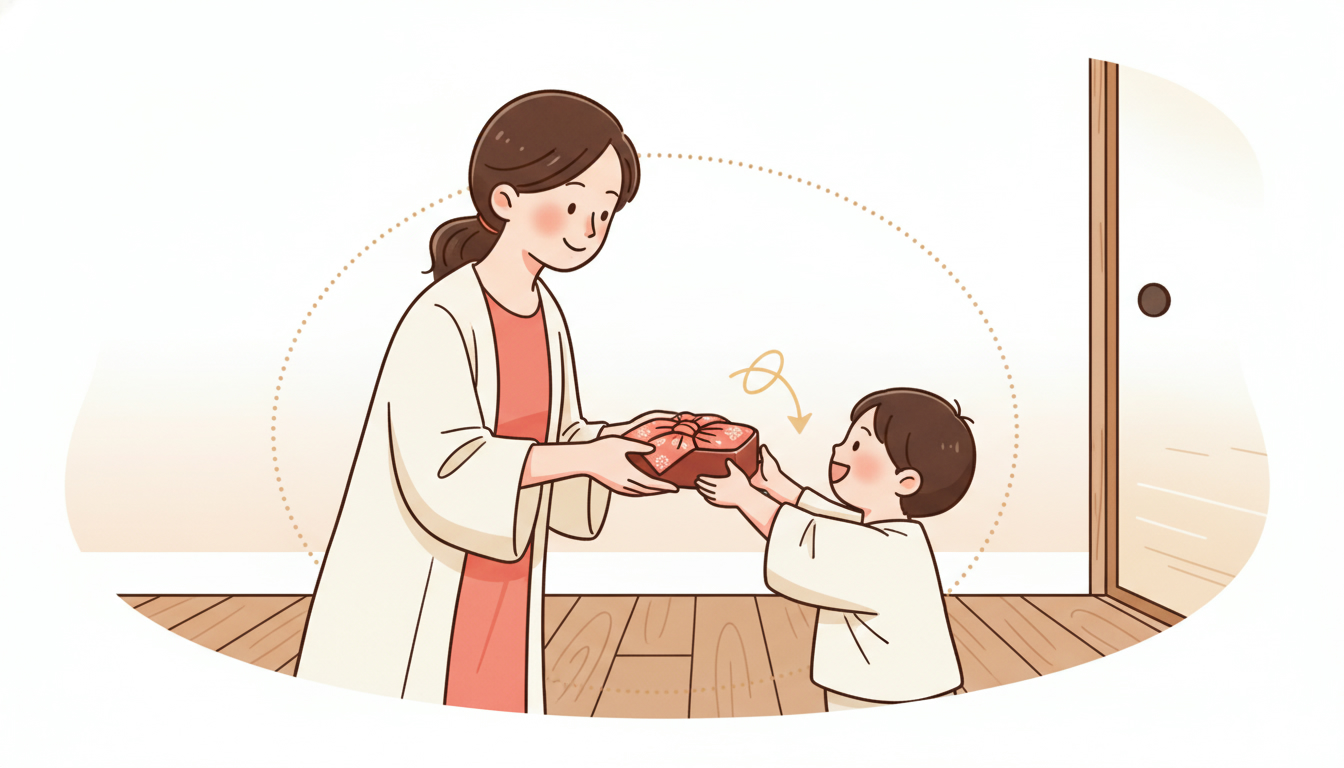
A Japanese learner posts in a forum: 母が私にお弁当を作ってあげた. The replies pile in. No, no, no. It's 母が作ってくれた. The grammar is fine. The vocabulary is fine. The verb is wrong because the speaker treated their own mother like a stranger.
English has one verb for "give" and lets prepositions do the steering. Japanese makes you pick a side before you say the verb. あげる goes outward. くれる comes inward. もらう reverses the arrow and makes you the receiver. The choice depends on who's inside your social circle, and the trap English speakers fall into is that we don't think of family as inside a circle. We think of "give" as a neutral verb. In Japanese it isn't.
By the end of this post you'll have the in-group rule that fixes the mom/bento sentence, the three core verbs, and the te-form layer where most daily usage actually lives. The politeness grid is at the bottom.
The three verbs in thirty seconds
あげる (ageru). I (or someone on my side) give outward. Recipient takes に.
私は佐藤さんに本をあげた。 Watashi wa Satō-san ni hon o ageta. "I gave Satō-san a book." (Coto Academy)
くれる (kureru). Someone gives inward, to me or someone on my side. The recipient (often me) takes に, and a lot of the time に私 gets dropped because it's obvious.
友達が私にプレゼントをくれた。 Tomodachi ga watashi ni purezento o kureta. "A friend gave me a present." (Tae Kim's Guide to Japanese)
もらう (morau). I (or someone on my side) receive. The giver takes に or から.
私は佐藤さんに本をもらった。 Watashi wa Satō-san ni hon o moratta. "I received a book from Satō-san." (Coto Academy)
If あげる and くれる look like they're doing the same job, that's the bug. They're both "give," but they pick opposite sides of the transaction. The side they pick is yours.
The in-group rule, and why family counts as you
Japanese groups people into 内 (uchi, in-group) and 外 (soto, out-group). Your in-group is whoever you'd identify with in this conversation: family, close friends, your team at work, the people you'd say "we" about in English. Your out-group is everyone else. Tofugu's rule of thumb is direct: "you take the same standpoint as the people in your in-group, as opposed to people outside your social circle."
When an outsider does something that lands on someone in your in-group, the verb tracks your perspective, not theirs. That's why these are correct:
佐藤さんは母に本をくれた。 "Satō gave my mother a book." (Coto)
友達が弟にプレゼントをくれる。 "My friend gives my brother a present." (Tofugu)
If your friend gave your brother a present, you'd say "thank you." You'd answer the door if your brother got mail. Your brother is on your side. Japanese makes you put that into the verb. Saying あげた there sounds like you've parked your own brother behind a velvet rope.
This is also why no one says 母が作ってあげた about their own mother. Mom belongs to your in-group. The action came in toward you. The verb has to be くれる.
Uchi/soto is not a fixed concentric ring of self → family → company → strangers. It shifts with context: when you're talking to a stranger your whole company is uchi; when you're talking inside the company, your team is uchi and other teams aren't. For a beginner, treating family as uchi will be right almost every time.
The te-form layer is where daily conversation lives
The standalone verbs are the simpler half of the system. In daily conversation you'll hear the te-form compounds (〜てあげる, 〜てくれる, 〜てもらう) even more often, because they describe favors instead of object transfers. These don't talk about handing over a thing. They talk about an action done as a favor.
〜てくれる: someone did me a favor
This is the workhorse of daily speech. Anytime someone outside your in-group does something good for someone inside it, native speakers add 〜てくれる without thinking.
母は僕に毎日弁当を作ってくれる。 Haha wa boku ni mainichi bentō o tsukutte kureru. "My mom makes my bento every day."
友だちが駅まで送ってくれた。 "My friend took me to the station."
部長は私に寿司をおごってくれました。 "My boss treated me to sushi."
(All three from JLPT Sensei.)
You can technically drop the くれる. 母は弁当を作った is grammatical Japanese. It also feels emotionally flat to a native ear, the way "the woman drove me to the airport" sounds about your mother in English. Adding くれる is what makes the sentence sound like a person describing their actual life.
〜てあげる: politeness landmine
〜てあげる looks like the symmetrical counterpart to 〜てくれる, and structurally it is. Socially it isn't. Saying I did this for you in Japanese can sound like you're mailing the listener an invoice for the favor.
友達に日本語を教えてあげる。 "I'll teach my friend Japanese." (Tofugu)
This sentence is fine when you're describing the situation to a third party. Said to the friend, it lands a step pushy. Said about anything you did for a superior, it gets worse. Maggie Sensei warns that 〜てあげる toward a boss reads as condescending. The default-safe move when you'd like to do someone a favor is to drop 〜てあげる entirely and use 〜ましょうか (shall I…?) instead. Same offer, different social register.
〜てもらう: I had it done
〜てもらう puts you in the driver's seat. You're the one who arranged for, requested, or benefited from someone else's action. English doesn't have a clean translation. The closest is I had X done or I got X to do Y.
友達に日本語を教えてもらう。 "I'll have my friend teach me Japanese." (Tofugu)
いつも母に洗濯をしてもらっている。 "I always have my mom do the laundry." (Maggie Sensei)
Quick contrast: 〜てくれる feels like the giver acted on their own. 〜てもらう feels like you arranged it. In real speech the two blur. When in doubt, use 〜てくれる.
Try it in Conversa
Practice with AI characters who adapt to your level and give real-time feedback.
Try Conversa FreeThe politeness grid
あげる has a humble cousin (さしあげる) above it and a casual cousin (やる) below it. くれる has an honorific cousin (くださる) above it. もらう has a humble cousin (いただく). Most articles bury this in prose. Here it is as one table.
| Direction | Down / casual | Neutral | Up |
|---|---|---|---|
| Outward (give) | やる | あげる | さしあげる (humble) |
| Inward (give to me/mine) | (n/a) | くれる | くださる (honorific) |
| Receiving | (n/a) | もらう | いただく (humble) |
A few notes:
- やる still shows up for plants, animals, and casual masculine speech (ネコにエサをやる, "I feed the cat"). Plenty of speakers default to あげる even with pets. It isn't a law.
- さしあげる and いただく are humble: they lower you. くださる is honorific: it elevates the giver. The asymmetry is the point. When a superior gives to you, you raise them. When you give to a superior, you crouch.
- These keigo forms aren't optional in business Japanese. Wikipedia's honorific-speech reference lists them under the irregular respectful and humble verb pairs every Japanese employee learns in their first month at work.
Where these verbs hide in daily speech: requests
Almost every "could you…?" you'll hear in a Japanese workplace, train station, or restaurant is built from くれる or もらう. Once you see the pattern you'll hear it everywhere.
- 〜てくれる? Casual. 朝6時に起こしてくれる? (Asa roku-ji ni okoshite kureru?) "Can you wake me at 6?" (Maggie Sensei)
- 〜てくれませんか Polite. すみません、写真を取ってくれませんか? "Excuse me, could you take a photo?" (JLPT Sensei)
- 〜てもらえませんか Slightly more deferential. 漢字で書いてもらえませんか。 "Could you write that in kanji?" (Tae Kim)
- 〜ていただけませんか Highest politeness. 写真を撮っていただけませんか。 "Could you please take a photo?" (JLPT Sensei)
The ladder runs from a dropped くれる at the bottom through the humble いただく at the top. You're using the same verbs as a hotel concierge, just rotated for register.
When 〜てくれる isn't grateful
The textbook gloss "くれる carries gratitude" is mostly true and slightly wrong. The verb marks the speaker's emotional stance toward an outsider's action on their in-group, and that stance is usually positive. Sometimes it isn't. Obana and Haugh (2018) cataloged a malefactive sense in East Asian Pragmatics with examples like:
よくも騙してくれたな。 "How dare you deceive me!"
嫌なこと言ってくれたねえ。 "Wow, you really said something nasty."
恥かかしてくれた。 "You really humiliated me."
Same grammar as the polite version. The sarcasm lives in the tone and the context. Don't be surprised when you see 〜てくれた being used as a knife. The structure is "they did this to me from outside"; how you feel about it depends on what they did.
What to actually do this week
Pick one family member. Re-narrate three things they did for you today using 〜てくれる. (Mom made dinner: 母が晩ご飯を作ってくれた. Dad fixed the bike: お父さんが自転車を直してくれた. Older sister picked you up: 姉が迎えに来てくれた.) The instinct to say あげる there is the English habit. Re-train it once, on people you actually know, and the rest of the system clicks into place.
If you've also been bouncing off particles, the は vs が breakdown is the other system that has to be in place before any of this feels natural. These verbs lean hard on に and が, and getting the particles wrong undoes the work. The other place where the verb itself encodes who's doing what is Japanese transitive and intransitive verb pairs, which is worth a look once くれる feels solid.