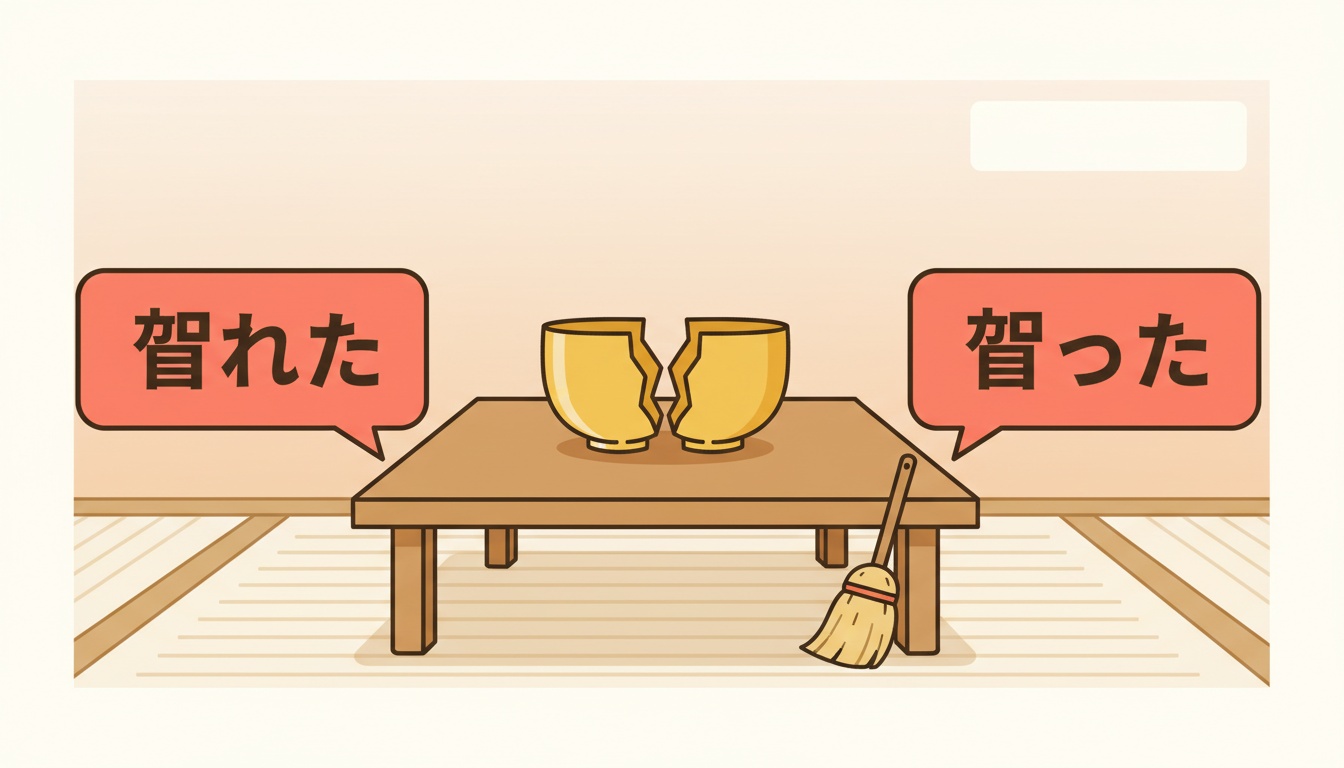
You're at dinner at a Japanese friend's apartment. You reach for your glass, elbow the edge, and it shatters on the floor. Your instinct: 「私がコップを割った」, "I broke the cup." Your host, already halfway to the broom closet, says 「コップが割れた」, "The cup broke."
Same event. But in Japanese, those are two different verbs: 割る waru (to break something) and 割れる wareru (to break on its own). English uses one word for both. Japanese doesn't, and that single difference is one of the most common sources of particle errors, weird pauses, and confused stares for learners at JLPT N3 and below.
The good news: Japanese verb pairs aren't random. Most of them follow predictable sound patterns, and once you see those patterns, you stop memorizing and start predicting.
The particle tells you which verb you need
ドアが開く。 Doa ga aku. "The door opens." Intransitive: the door does it by itself, marked with が.
ドアを開ける。 Doa wo akeru. "I open the door." Transitive: someone acts on the door, marked with を.
That's the whole rule. Intransitive verbs (自動詞, jidōshi, literally "self-moving verb") pair with が. Transitive verbs (他動詞, tadōshi, "other-moving verb") pair with を. If you wrote を but the verb is intransitive, you've picked the wrong half of the pair. Tofugu's transitivity guide has an excellent deep-dive on this particle distinction if you want to explore further. (And if the は vs が distinction also trips you up, we have a separate guide to picking the right particle.)
Two common mistakes that follow directly from this:
❌ ドアを開く. aku is intransitive. It can't take を for the thing that opens.
❌ ドアが開ける. akeru is transitive. It needs を for the object being opened.
You can check any verb on Jisho.org, which tags every entry as either "Transitive verb" or "Intransitive verb." When in doubt, look it up; the particle will follow.
The が/を mismatch works as a debugging tool. If you're mid-sentence and the particle feels wrong, it probably is, and swapping to the other verb in the pair usually fixes both problems at once.
Six patterns that predict which verb is which
You don't need to memorize every pair in Imabi's exhaustive catalog. Most fall into about six families based on how the verb endings differ. Learn the families and you can guess the right verb from its shape.
-aru is intransitive, -eru is transitive
This is the biggest and most consistent family. If you learn one pattern, learn this one.
始まる hajimaru (it begins) → 始める hajimeru (to start something) 閉まる shimaru (it closes) → 閉める shimeru (to close something) 集まる atsumaru (they gather) → 集める atsumeru (to gather them) 止まる tomaru (it stops) → 止める tomeru (to stop something) 決まる kimaru (it's decided) → 決める kimeru (to decide)
The mnemonic writes itself: -aru verbs happen on their own. -eru verbs need an executor. It's not perfect, but it's sticky.
-u is intransitive, -eru is transitive (with exceptions)
開く aku (it opens) → 開ける akeru (to open it) つく tsuku (it turns on) → つける tsukeru (to turn it on)
This family looks clean, but watch out: a few pairs flip the mapping. 焼ける yakeru (it burns) is the -eru form but it's the intransitive one. 折れる oreru (it snaps) is also -eru and also intransitive. These exceptions are worth checking individually on Jisho.org rather than trusting the pattern blindly.
-su marks the transitive
When one verb in a pair ends in -su, that one is almost always transitive. Think of the s in -su as "someone does it."
落ちる ochiru (it falls) → 落とす otosu (to drop it) 消える kieru (it disappears) → 消す kesu (to erase / turn off) 出る deru (it comes out) → 出す dasu (to take it out) 動く ugoku (it moves) → 動かす ugokasu (to move it)
-reru is intransitive, -su is transitive
A subset of the -su family, but worth knowing separately because the -reru ending is distinctive:
壊れる kowareru (it breaks) → 壊す kowasu (to break it) 汚れる yogoreru (it gets dirty) → 汚す yogosu (to make it dirty) 倒れる taoreru (it falls over) → 倒す taosu (to knock it over)
-ru becomes -su or -seru (causative-like pairs)
起きる okiru (to wake up) → 起こす okosu (to wake someone up) 寝る neru (to sleep) → 寝かす nekasu (to put someone to sleep)
These blur the line between transitive verbs and causatives. The intransitive describes what you do yourself; the transitive describes making someone else do it. A parent says 子供を寝かす (kodomo wo nekasu): "I put the child to sleep." The child says 寝る: "I sleep."
The irregular handful
A few high-frequency pairs don't follow any pattern. These just need memorization, but there are only a handful:
入る hairu (to enter) → 入れる ireru (to put in) 見える mieru (to be visible) → 見る miru (to see / look at) 聞こえる kikoeru (to be audible) → 聞く kiku (to listen)
Notice that 見える and 聞こえる (the intransitive "perception" verbs) describe what reaches you without effort, while 見る and 聞く describe actively looking or listening.
The -te iru trap nobody warns you about
電気がついている。 Denki ga tsuite iru. "The light is on."
電気をつけている。 Denki wo tsukete iru. "I am turning on the light."
Both use -te iru. In English, both might translate as "the light is on." But the first one describes a state (the light is currently on, nobody is doing anything), and the second describes an action in progress (someone is flipping the switch right now).
The pattern:
Intransitive + te iru = resulting state. ドアが開いている means "the door is open"; it opened at some point and is still open.
Transitive + te iru = action in progress. ドアを開けている means "someone is opening the door"; the action is happening now.
This trips up English speakers constantly because English uses the same phrasing for both. If you tell your roommate 窓が閉まっている (mado ga shimatte iru), you're saying "the window is closed." If you say 窓を閉めている (mado wo shimete iru), you're saying "I'm closing the window." Getting these mixed up can turn a simple observation into a confusing announcement.
Try it in Conversa
Practice with AI characters who adapt to your level and give real-time feedback.
Try Conversa FreeWhy Japanese lets the cup break itself
Back to the dinner party. Your host didn't say コップが割れた to be polite about your clumsiness, or not only that. Japanese has a strong pragmatic preference for intransitive descriptions when something goes wrong. The cup broke. The train was late (電車が遅れた). The vase fell (花瓶が落ちた). No agent. No blame. The event just happened.
The transitive alternative (私がコップを割った, "I broke the cup") sounds like a direct confession in Japanese. It's not wrong, but it's marked. You'd use it if you specifically wanted to take responsibility, like telling your boss you accidentally deleted a file.
This pattern runs through everyday Japanese. It's a window into how Japanese communication works: describing the result rather than naming the cause smooths over social friction. Learning to reach for the intransitive when things go wrong will make your Japanese sound more natural than any amount of vocabulary drilling.
Ten pairs to learn first
These ten cover most daily situations. For each one, the intransitive goes with が and the transitive with を.
| Intransitive (が) | Transitive (を) | Meaning |
|---|---|---|
| 開く aku | 開ける akeru | open |
| 閉まる shimaru | 閉める shimeru | close |
| つく tsuku | つける tsukeru | turn on / attach |
| 消える kieru | 消す kesu | turn off / disappear |
| 出る deru | 出す dasu | come out / take out |
| 入る hairu | 入れる ireru | enter / put in |
| 落ちる ochiru | 落とす otosu | fall / drop |
| 始まる hajimaru | 始める hajimeru | start |
| 止まる tomaru | 止める tomeru | stop |
| 集まる atsumaru | 集める atsumeru | gather |
If you want to verify any of these (or look up new pairs you encounter), Jisho.org tags every verb as transitive or intransitive right in the entry.
Next time something breaks, spills, or falls in your Japanese life, pause for half a second. Did someone do it, or did it just happen? The verb (and the particle) will follow from the answer.