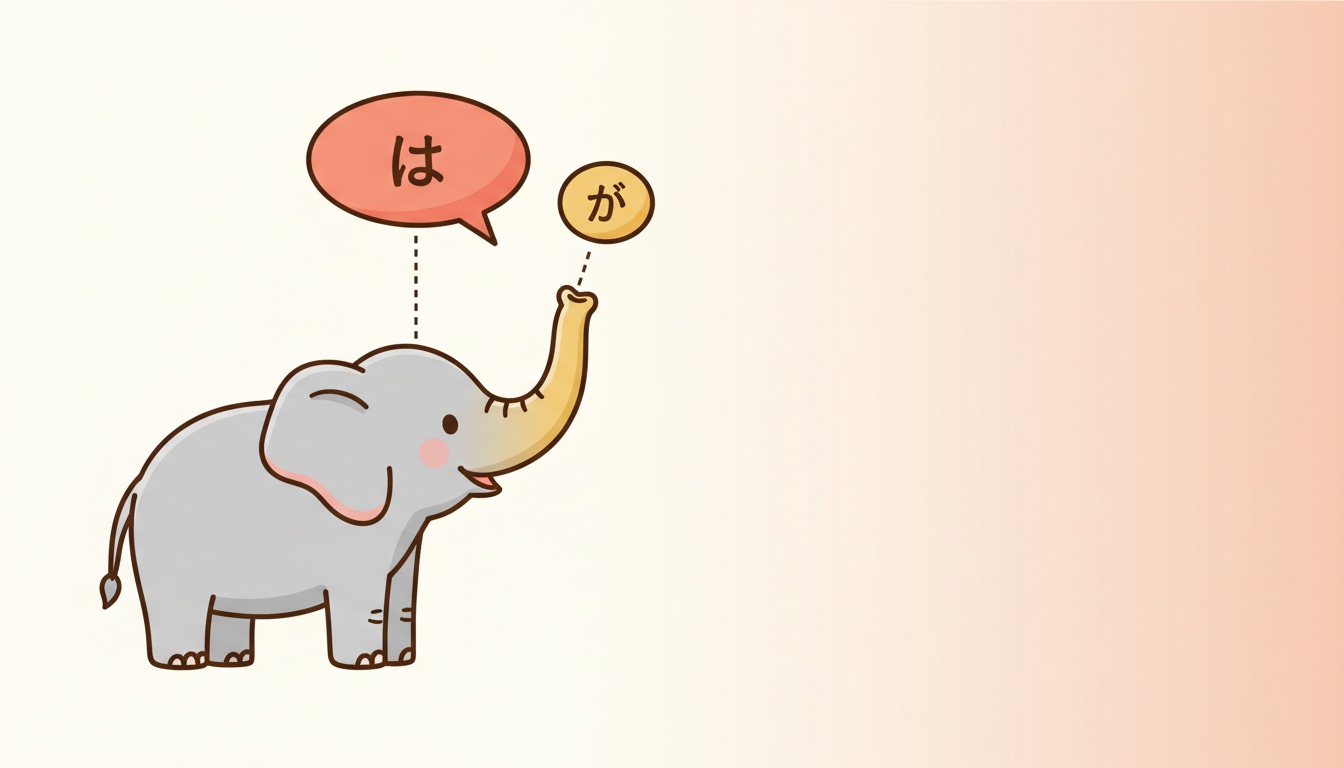
象は鼻が長い. Zou wa hana ga nagai. "Elephants, noses are long." One sentence, one meaning, one shrug from any Japanese speaker, and two particles the textbook told you were synonyms. If your Genki chapter said は and が are both "subject markers," that sentence is where the shortcut falls apart. は and が are not two flavors of the same thing. They do completely different jobs, and mixing them up is the single biggest reason your JLPT N5 sentences sound off to a native speaker.
Here are the four rules that actually predict which one to use, each with a test you can run on any sentence you're about to say.
The shortcut that breaks: は isn't a subject marker at all
が marks the grammatical subject. は marks the topic. Tofugu lays this out cleanly, and Tae Kim frames the same split as topic vs. identifier. That's the one definition worth memorizing. That word "topic" is doing most of the work, and it isn't the same thing as "subject." The topic is what the sentence is about, something already agreed upon between speaker and listener. The subject is who or what is doing the verb. In English these collapse into one word, which is why the textbook shortcut exists in the first place.
Look at 象は鼻が長い again. The topic is 象 (elephants, the thing we're talking about). The grammatical subject of 長い (to be long) is 鼻 (noses). Elephants aren't long. Noses are long. Japanese has no problem saying both in one breath because it has two particles for two jobs. English just flattens the whole thing into "elephants have long noses" and hides the distinction.
If you only remember one thing from this post, remember that. は is a spotlight pointing at the topic; が is a finger pointing at the subject. They coexist because those aren't the same target.
Rule 1: New information gets が. Reintroduction gets は.
Every Japanese folktale opens the same way:
昔々、おじいさんがいました。おじいさんは山へ行きました。 Mukashi mukashi, ojiisan ga imashita. Ojiisan wa yama e ikimashita. "Once upon a time, there was an old man. The old man went to the mountain."
First sentence, first appearance: the old man is brand new information, so he takes が. Second sentence, he's now the established topic we're both tracking, so he takes は. Same old man, different particle, because the grammatical situation changed between sentences.
The diagnostic: if the noun is the answer to "who?" or "what's there?", use が. If you could rephrase it as "speaking of ___ ," use は. Try it on your own sentences. It catches most N5 errors before you make them.
Rule 2: Inside a relative clause, は is forbidden
私が書いた本 ✓: watashi ga kaita hon, "the book I wrote" 私は書いた本 ❌
That single contrast is the rule. Every top article buries it under three thousand words of preamble, but there's nothing philosophical about it. は's job is to frame the whole sentence. Inside an embedded clause (a relative clause, a subordinate clause, anything tucked inside a larger sentence), there's no sentence to frame, only a noun to modify. There's no room for a topic. So the subject of the embedded clause has to take が.
Watch what happens when you stack both:
私が書いた本はこれです。 Watashi ga kaita hon wa kore desu. "The book I wrote is this one."
Two particles, two jobs, doing exactly what they're built for. 私が書いた is the relative clause ("I wrote"), and it uses が because it has to. 本は marks the whole thing as the topic of the main sentence, and it uses は because it can. One sentence, both particles, no ambiguity.
The diagnostic: if the subject you're about to mark is inside something else (a noun phrase, a dependent clause, a modifier), default to が and don't think twice.
Rule 3: 好き, 欲しい, 分かる, できる, ある, いる take が
猫が好きです。 Neko ga suki desu.: "I like cats."
Not 猫を好きです. English speakers almost always get this wrong on their first try, because "like" is a transitive verb in English, and the direct-object marker in Japanese is を, so 猫を好き feels right. It isn't.
Here's the part nobody tells you: 好き is an adjective, not a verb. Specifically a na-adjective. It's closer in shape to English "agreeable" than "like." "Cats are agreeable to me" is clunky in English but structurally exact in Japanese. Adjectives don't take direct objects. They describe subjects, and the subject they describe takes が.
The same pattern runs through a whole family of N5 vocabulary:
- 水が欲しい mizu ga hoshii: "I want water"
- 日本語が分かります nihongo ga wakarimasu: "I understand Japanese"
- ピアノが弾ける piano ga hikeru: "I can play piano"
- 犬がいます inu ga imasu: "there is a dog"
Feeling, preference, ability, possession, existence. The thing being felt, preferred, known, owned, or existing takes が in every case. These aren't really verbs in the transitive-action sense. They're descriptions of a state, and Japanese treats the thing in that state as the grammatical subject.
The diagnostic: if the English verb is "like / want / understand / can / have / there is," the Japanese particle is が.
Rule 4: Question words take が, and so do their answers
誰が来ましたか。 田中さんが来ました。 Dare ga kimashita ka? Tanaka-san ga kimashita. "Who came? Tanaka came."
You can't ask 誰は来ましたか. That sentence isn't actually asking "who." A topic is something already agreed upon, and the entire point of a question word is that the thing isn't known yet. So 誰, 何, どこ, いつ take が when they're the grammatical subject.
Here's the piece you won't find on Tofugu: the answer has to match. Answering 誰が来ましたか with 田中さんは来ました is grammatically fine but pragmatically wrong. It answers a different question. The が in the answer is doing something linguists sometimes call exhaustive reading: "it was Tanaka who came, and only Tanaka." That's the contract the question set up. Break it and the conversation gets a half-second of silence.
The diagnostic: if the subject of your sentence is or answers a 誰 / 何 / どこ / いつ, use が.
Try it in Conversa
Practice with AI characters who adapt to your level and give real-time feedback.
Try Conversa FreeMinimal pairs: hear the particle flip
私が行きます means "I'm the one who's going." 私は行きます means "As for me, I'll go." Same two words, particle flipped, and two genuinely different sentences. Here are three more pairs that work the same way:
-
雨が降っています → "It's raining." The neutral, new-information, weather-report register.
-
雨は降っています → "The rain, yes, it is falling." Contrastive. There's an unsaid "but."
-
本がある → "There's a book." You're presenting it, maybe you were looking for one.
-
本はある → "The book, I do have." Contrastive again. The implication is that you might be missing something else.
Read them out loud. The rules predict the meaning shift, and that's the whole payoff. If you've practiced this kind of particle-level distinction in Chinese, you already know how much a tiny grammatical marker can change a sentence's weight. The parallel posts are the three Mandarin de particles and why 了 is not past tense. Both are "the textbook taught you wrong" situations that resolve the same way: learn the actual rule and the sentence stops being weird.
The three mistakes the rules predict in advance
私は猫を好きです. Almost every English speaker produces that sentence in their first month of Japanese, and every one of them is wrong. 好き is an adjective, so the cat takes が, not を. Here are the three common errors and the rules that catch them:
- 私は猫を好きです ❌ → 私は猫が好きです ✓ (Rule 3: 好き is an adjective)
- 私は書いた本 ❌ → 私が書いた本 ✓ (Rule 2: embedded clauses)
- 何はありますか ❌ → 何がありますか ✓ (Rule 4: question words)
In my experience, these three cover most of the は/が errors I see from English-speaking beginners in their first six months. If you catch yourself about to produce one, run the matching diagnostic before you speak.
The drills that make this click are speaking drills, not reading drills. You have to produce the particle under time pressure before your brain freezes up on it. An AI conversation partner you can practice with, like Conversa, gives you reps-per-minute you can't get from a flashcard app. Without a tool, the exercise is the same: build a sentence, pick は or が, say it out loud, check against the rules.
Five minutes a day for two weeks will get Rules 2 and 4 into reflex. Rule 1 (new vs. reintroduced info) takes longer, because it depends on tracking the whole conversation and not just the sentence in front of you, so don't expect that one on a schedule. What the four rules will do immediately is turn 象は鼻が長い from a trick question into a diagnosable sentence. The next time you hit a weird double-particle sentence in the wild, you'll know exactly which particle is doing which job, and why both of them have to be there.