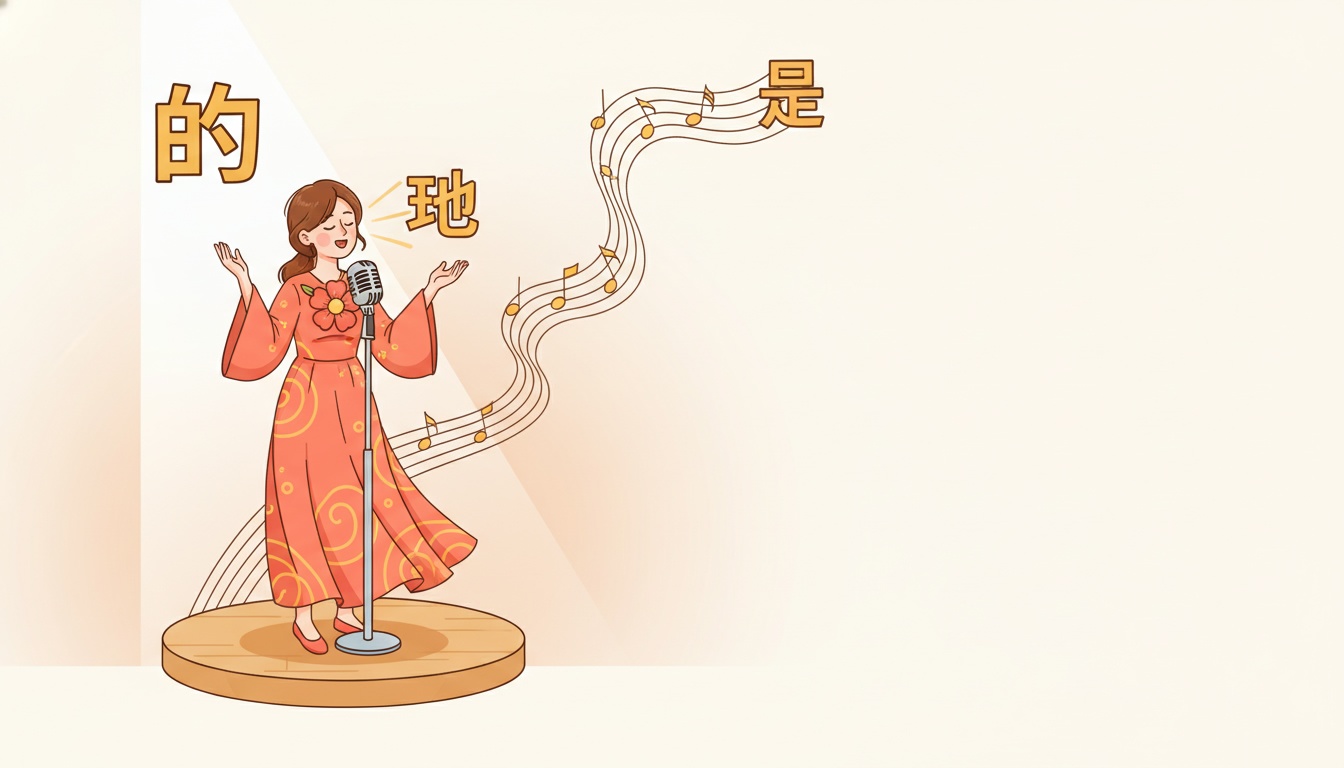
In speech, the sound de does triple duty in Mandarin. 漂亮的花 (piàoliang de huā, "pretty flower"), 慢慢地走 (mànman de zǒu, "walk slowly"), and 跑得快 (pǎo de kuài, "runs fast") all contain the same neutral-tone syllable. In writing, they use three different characters: 的, 地, 得. The first time you submit a graded essay or sit the HSK writing section, the difference stops being optional.
The good news: you do not need to memorize three separate rule sets. There is one rule, and it is about position.
The one rule, in one sentence
的 goes before a noun. 地 goes before a verb. 得 goes after a verb. That's it. Chinese Boost calls this the "quick and dirty" rule, and it handles the vast majority of cases you will ever write.
Here is one sentence that uses all three, annotated:
漂亮的女孩认真地唱得很好。 Piàoliang de nǚhái rènzhēn de chàng de hěn hǎo. "The pretty girl sings very well, seriously."
- 漂亮的女孩 → adjective before a noun, so 的.
- 认真地唱 → adverb before a verb, so 地.
- 唱得很好 → evaluation after a verb, so 得.
Three slots, three characters, zero overlap. Commit that sentence to memory and the rest of this post is just examples. Its natural sibling is 了, which isn't past tense the way textbooks tell you, and the two together cover the particles your HSK grader is watching for.
的: the one that attaches stuff to nouns
我的书 (wǒ de shū) is "my book." 红色的苹果 (hóngsè de píngguǒ) is literally "red's apple," meaning a red apple. 书的封面 (shū de fēngmiàn) is "the cover of the book." In each case, something is describing a noun, and 的 sits between the describer and the thing being described.
The describer can be a single adjective (漂亮的花, piàoliang de huā, "pretty flower"), a possessor (约翰的书, Yuēhàn de shū, "John's book"), or a whole relative clause (我昨天买的书, wǒ zuótiān mǎi de shū, "the book I bought yesterday"). As long as the thing after 的 is a noun, 的 is the right character.
Wikipedia's Chinese particles article classifies all three as "structural particles" (结构助词) and specifically calls 的 an attributive marker. In plain English, that means "the particle that sticks modifiers onto nouns." That is the whole job.
的 is also one of the most common characters in written Chinese. It is so common that the Pinyin input method on your phone almost certainly defaults to it when you type de. More on that later, because that default is doing real damage to your Chinese friends' written accuracy.
地: the one that attaches manner to verbs
慢慢地走 (mànman de zǒu, "walk slowly") is the canonical example. The describer sits before the verb, and it tells you how the action happens. That describer, plus 地, forms what English calls an adverb.
More examples, all from standard textbook usage:
- 认真地学习 (rènzhēn de xuéxí): "study seriously"
- 他小心地拿起了玻璃杯 (tā xiǎoxīn de ná qǐ le bōlí bēi): "he carefully picked up the glass"
- 孩子们快乐地唱歌 (háizimen kuàilè de chànggē): "the children sing happily"
- 安静地睡着了 (ānjìng de shuìzháo le): "fell asleep quietly"
One nice wrinkle: Chinese reduplicates adjectives to intensify them, and the reduplicated form still takes 地. A monosyllable doubles (早早地起床, zǎozao de qǐchuáng, "get up very early"), and a disyllable uses an AABB pattern (她高高兴兴地去学校, tā gāogāo-xìngxīng de qù xuéxiào, "she goes to school in a very happy mood"). Dig Mandarin has a clean breakdown of the reduplication rules if you want to drill them.
If the word sits before a verb and answers "how?", it's 地. Almost always.
得: the one that attaches a verdict to verbs
跑得快 (pǎo de kuài) means "runs fast." The descriptor 快 sits after the verb 跑, and that is the signal to use 得. The structure is verb + 得 + how it turned out.
- 她吃得很快 (tā chī de hěn kuài): "she eats very quickly"
- 你说得很好 (nǐ shuō de hěn hǎo): "you said it very well"
- 他高兴得跳起来了 (tā gāoxìng de tiào qǐlái le): "he was so happy he started jumping"
- 学习得很认真 (xuéxí de hěn rènzhēn): "study very hard"
得 also handles the "can/can't" potential complement: 听得懂 (tīng de dǒng) means "can understand by hearing," and 做得到 (zuò de dào) means "can manage it." The syntax is still verb + 得 + outcome, so the position rule holds.
East Asia Student's grammar summary lines up all three particles side by side, and once you see 得 as "the one that lives after the verb," the rule clicks and stops being arbitrary.
The pair that makes the rule stick: 他慢慢地说 vs 他说得很慢
他慢慢地说 (tā mànman de shuō) and 他说得很慢 (tā shuō de hěn màn) both translate into English as "he talks slowly." In Chinese, they mean different things, and the difference is the position rule in miniature.
- 他慢慢地说: the manner word mànman sits before the verb 说. It describes how he is choosing to speak. You would say this about a teacher slowing down for a beginner class.
- 他说得很慢: the descriptor hěn màn sits after the verb 说. It is a judgment on how his speech came out. You would say this about someone whose speech is just naturally slow, or about a stroke patient relearning to talk.
Same words, same English translation, different grammatical roles. The only signal is whether the descriptor comes before or after the verb. If you can feel that difference, you understand the whole system.
Try it in Conversa
Practice with AI characters who adapt to your level and give real-time feedback.
Try Conversa FreeWhy your Chinese friend's WeChat looks wrong
Open any WeChat group chat and count the 的s. You will see it in slots where 地 or 得 belong, and nobody in the chat will blink.
This is not because they forgot grammar. It is because 的 is one of the most common characters in written Chinese, and Pinyin input methods rank it first in the candidate list when you type de. Hit space, move on: the IME did the work for you, and you got 的 whether you wanted it or not. John Pasden at Sinosplice has been documenting this for years. He writes that "teenagers texting their friends are typically pretty lazy and won't pay much attention to the distinction (frequently over-using 的)," and that "some native speakers will even tell you that the distinction is unimportant."
They are half-right. In a WeChat group full of friends, nobody cares. Nobody is grading you, and the reader's brain reconstructs the intended character from context. This is why self-studiers who learn from podcasts, dramas, and chat apps can go for years without ever noticing the distinction. Their input is full of casual writing where the rule gets collapsed.
The problem is that the casual rule and the formal rule are different, and no one warns you. (If you've studied Japanese, the は vs が distinction is the same class of "tiny particle, big meaning" problem in a different language.)
When you actually have to get it right
HSK 3 is where 的/地/得 accuracy first becomes a graded expectation in the writing section. The Mandarin Zone HSK 3 guide explicitly calls out 的 and 得 as "key points" to review, alongside 了. Above HSK 3, the stakes climb: essay questions, structured writing prompts, and longer-form tasks all assume you can keep the three particles straight without thinking.
HSK is not the only place it matters. The distinction is graded, explicitly or implicitly, in any formal writing with your name on it:
- Emails to a professor, job applications, cover letters.
- Official reports and published articles.
- Subtitles and translation work, because the people who notice will notice.
- Essays in a Chinese class, obviously.
The English analogy that lines up best is its vs it's. Nobody in a group text cares if you mix them up, and most people couldn't tell you the rule off the top of their head. On a résumé, it's a red flag. On a submitted paper, it costs marks. The 的/地/得 distinction works the same way: fluid in casual writing, strict in formal writing, and the gap between the two is what trips learners up.
The rule you actually need is: write correctly from the start. Typing the wrong one in chat is a habit you'll have to break later, and unlearning is harder than learning.
One thing to try this week
Next time you read a Chinese news article, textbook sentence, or subtitled line, pick any 的, 地, or 得 you see and run the position test out loud. Before a noun? 的. Before a verb? 地. After a verb? 得. Do that ten times a day for a week, and the rule will start catching itself. You will spot the wrong one in a caption the way an English speaker spots a misplaced apostrophe.
The other half of the work is writing the characters yourself under pressure, in real conversations, where you don't have time to look anything up. That is what practice with an AI conversation partner like Conversa is for: you get corrected in the moment instead of three weeks later when HSK results come back. If you want to try it, get Conversa.