我看完书了 and 我把书看完了 both translate to "I finished the book." Both are grammatically clean. But pick a Beijing taxi driver, a Taipei barista, and a Shanghai engineer at random, and most of them will reach for the second one when the action is complete and the book is the specific one sitting on the table. The textbook calls this the "把 construction" (or "ba construction" if you're reading English-language references) or "OSV word order." Both labels are correct. Neither tells you when to actually grab it instead of plain SVO.
This post hands you a four-signal checklist and a single test that maps your English instincts onto 把 directly: if the English version of the sentence wants a phrasal verb, the Mandarin version almost always wants 把.
The phrasal-verb test
English packs results into particles. You don't clean the room, you clean it up. You don't put the book, you put it down. You don't throw the wrapper, you throw it away. The particle changes the verb's meaning from "the action" to "the action plus its result on the object."
Mandarin does the same job in a different slot. Instead of a particle, the result rides on the verb as a complement: 收拾干净 (clean-tidy), 放下 (put-down), 扔掉 (throw-away), 关上 (close-up), 修好 (fix-good). And when the verb is doing that two-part work, 把 shows up to mark the object that's being acted on.
So the test is: translate the sentence into English first. If you reached for a phrasal verb, you're already in 把 territory. A few from real learner phrasebooks:
- "I lost my wallet" → 我把钱包弄丢了 (
wǒ bǎ qiánbāo nòng diū le, literally "I made-lost my wallet"). Chinese Boost has a collection of these in their ten-minute summary. - "I broke the cup" → 我把杯子摔坏了 (
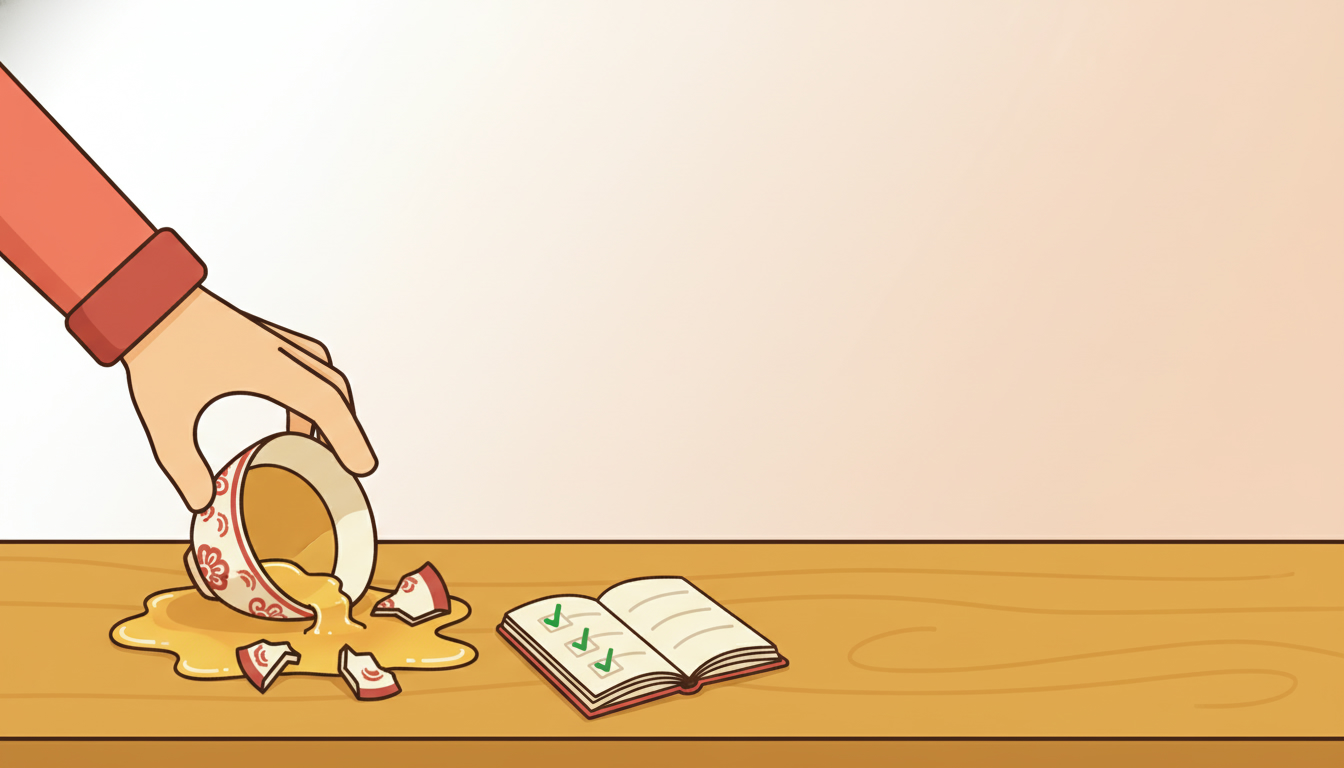
wǒ bǎ bēizi shuāi huài le, "I smash-broke the cup"). - "He fixed my computer" → 他把我的电脑修好了 (
tā bǎ wǒ de diànnǎo xiū hǎo le). - "Translate this into Korean" → 把这句话翻译成韩语 (
bǎ zhè jù huà fānyì chéng hányǔ). - "Please bring the food over" → 请把菜拿过来 (
qǐng bǎ cài ná guò lái).
Where English packs the result into a particle, Mandarin puts it on the verb and marks the object with 把.
The pattern is mechanical once you see it. The phrasal-verb instinct is the 把 instinct.
This is a heuristic, not a published rule. No linguist I found calls it "the phrasal-verb test" in print, and AllSet's Result Complement reference only goes as far as noting that Chinese verb-result compounds and English resultatives behave alike. The diagnostic still works in practice; treat it as a starting instinct, not a grammar law.
The four signals that trigger 把
Look at 我把杯子摔坏了 ("I broke the cup"). Four things have to be true for that 把 to be doing real work, and you can run them as a checklist before you speak.
1. The object is specific
把 doesn't take generic objects. 我吃面条 (wǒ chī miàntiáo, "I eat noodles") is fine without 把 because you're describing a habit. 我把面条吃了 (wǒ bǎ miàntiáo chī le, "I ate the noodles") needs 把 because you're talking about those specific noodles, the ones that just disappeared from your bowl. Chinese Boost makes the same point with 我把书看完了: the book is a specific book the speaker and listener already know about.
2. The verb has a result complement
Bare verbs don't survive in a 把 sentence. 我看书 ✓. 我把书看 ✗. Add a complement and the sentence snaps into shape: 我把书看完了 (read-finished), 我把作业写完了 (write-finished). The complements doing the heavy lifting are 完, 掉, 上, 下, 好, 干净, 在, 给, plus directionals like 过来 / 进去. The Chinese Grammar Wiki's result-complement page lists most of them. The same complement-stacking shows up across the 了 particle, which is why you'll see 了 hanging off almost every example sentence in this post.
3. The action affects or moves the object
把 is what Wang Li called the "disposal" construction (per Wikipedia's bǎ construction entry) for a reason: the object ends up changed, finished, moved, broken, or handed off. 我把衣服洗干净了: the clothes are now clean. 她把废纸扔进了垃圾桶: the scrap paper is now in the bin. If nothing happens to the object, no 把.
4. Negation goes before 把, not inside it
我没把书看完 ✓ ("I didn't finish the book"). 我把书没看完 ✗. The negator sits in front of 把, never between 把 and the verb. Chinese Boost puts it bluntly: "you can never negate within the 把 structure."
The negator sits in front of 把, never between 把 and the verb.
A small honest caveat: most 把 negation is 没 / 没有 for a denied past action (我没把手机弄丢, "I didn't lose my phone"), or 不要 / 别 for a prohibition (不要把钱借给他, "don't lend him money"). Bare 不 with 把 is rare in normal speech. Default to 没 for past denial and 别 for commands and you'll cover almost everything you actually need to say.
把 vs no 把
我吃饺子了 versus 我把饺子吃了: same English, two different feelings about those dumplings. Three pairs make the difference visible:
- 我吃饺子了 (
wǒ chī jiǎozi le, "I ate dumplings", a description of what I did) vs 我把饺子吃了 (wǒ bǎ jiǎozi chī le, "I ate the dumplings", a description of what happened to those dumplings). FluentU's worked examples walk through more contrasts in the same shape. - 我卖了自行车 vs 我把自行车卖了. Both mean "I sold the bike." The 把 version foregrounds the disposal of that specific bike, the one we were just talking about.
- 请关门 ("please close the door", grammatical but flat) vs 请把门关上 ("please close the door", with the door specific and the action complete). Many speakers default to the 把 version when the door is the specific door in front of them and the action is meant to be complete.
The more specific the object and the more complete the action, the more natives reach for 把.
The shift in meaning is small, sometimes vanishing. Chinese Boost actually says the difference is "negligible" when both are grammatical. You're not learning a meaning rule. You're learning a default instinct: the more affected the object and the more complete the action, the more natives reach for 把.
Try it in Conversa
Practice with AI characters who adapt to your level and give real-time feedback.
Try Conversa FreeWhere 把 doesn't go
*把咖啡喜欢 is broken Mandarin in any classroom in the world. Four classes of verb refuse 把 the same way, and once you can name them you'll cut your wrong-把 errors in half.
- Stative and psychological verbs: 喜欢 (like), 爱 (love), 想 (think / miss), 知道 (know), 认识 (recognize). Loving someone doesn't change them. You can't "dispose of" your liking. So
*把咖啡喜欢is broken; 我喜欢咖啡 is the only legal frame. (Wikipedia and Chinese Boost both list these.) - Bare perception verbs:
*把它看✗. Add a complement and the same verb works: 把它看完 ✓ ("watch it through to the end"), 把它看见 ✓ ("catch sight of it"). The verb alone won't carry 把. - Copula and existence: 是 (to be) and 有 (to have) never take 把. There's nothing to dispose of in "X is Y" or "X has Y." (Source: Written Chinese.)
- Bare verbs without aspect or complement: even an action verb that would be fine elsewhere can't sit in a 把 sentence by itself. The verb has to be carrying something: a complement, a 了, a duration phrase, a direction.
把 vs 吧: the homophone gotcha
Both sound roughly like "ba" to a learner's ear. They are completely different particles.
- 把 (
bǎ, third tone) is the grammatical particle this whole post is about. It sits between subject and object: Subject + 把 + Object + Verb + Complement. - 吧 (
ba, neutral tone) is a sentence-final modal particle. It softens commands and turns statements into suggestions or tag questions. 我们走吧 (wǒmen zǒu ba) is "let's go." 你是学生吧? is "you're a student, right?" (ChinesePod's homophone breakdown covers all four "ba" characters in one place.)
In writing they're never confused; the characters are different. In listening, position is your tell: 把 lives early in the sentence, 吧 lives at the very end. If your ear is still sorting out the third-tone-vs-neutral-tone difference, the tones primer covers the underlying pitch contrast that makes them sound similar in the first place.
A drill that costs you five minutes
Take these five English sentences. For each, run the four signals. Decide whether the Mandarin version takes 把. Then check yourself.
- "Please bring the food over." → 请把菜拿过来. 把 ✓.
- "I love coffee." → 我爱咖啡. No 把 — 爱 is stative, the coffee isn't being affected. The instinct to reach for 把 here is the thing you're trying to retrain.
- "Don't lend him money." → 不要把钱借给他. 把 ✓ (specific money, complement 给, prohibition correctly placed before 把).
- "I lost my phone." → 我把手机弄丢了. 把 ✓ (the phrasal-verb test fires immediately on "lost"; the result complement 弄丢 is doing the same job as the English particle).
- "He sees the cat." → 他看见猫. No 把.
The goal is for those four signals to fire automatically the next time you're about to say "I cleaned up my room" or "I broke the cup" in Mandarin. Reading about 把 won't get you there. Producing 把 sentences out loud, getting corrected when you forget the complement or stick the negation in the wrong place, will. That's what an AI conversation partner like Conversa is for.
If you've been treating 把 as something you'll get to "later," now's the moment. The phrasal-verb test alone will fix half the sentences you've been quietly avoiding for months.