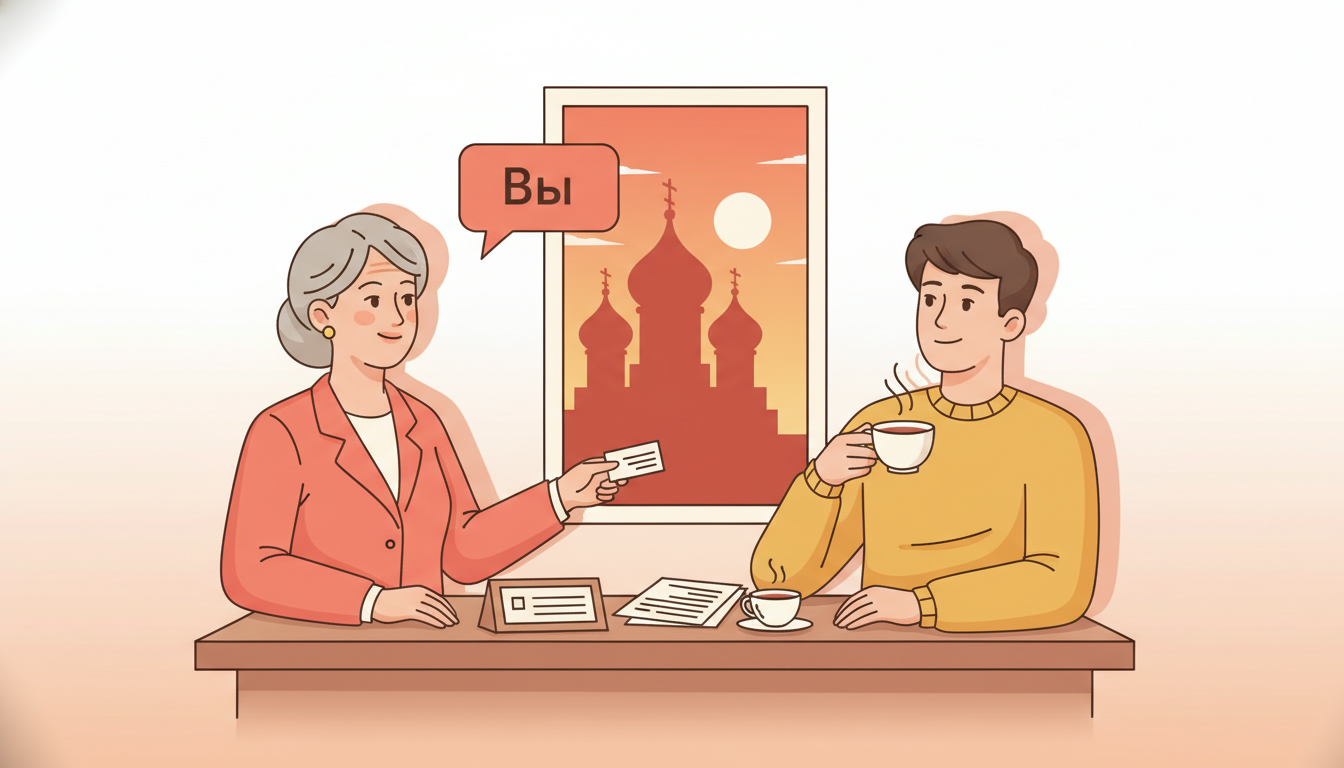
A learner walks into a Moscow office on day one. They've memorized that ты is informal and вы is formal. They sit down across from a colleague named Иван Иванович and freeze. Not because of the pronoun. Because the colleague's boss just walked in and called him Ваня, and now nobody in the room is using the same name for the same person, and the learner has no idea which name they're allowed to use, let alone which pronoun goes with it.
This is the Russian address problem, and it's the thing that makes English speakers go quiet in meetings even after a year of Duolingo. Ты vs вы (ty vs vy) isn't French tu/vous. The pronoun rides on top of a four-tier name system, and the two move together. Get the pronoun right and the name wrong and you sound theatrical, sarcastic, or rude. Once you see the grid, the panic goes away.
The trap: ты/вы isn't a pronoun choice, it's half a system
"Иван, ты можешь мне помочь?" said to your boss on day one is a small social disaster. The pronoun is wrong, the name is wrong, and a Russian listener registers both at the same time. Most guides will tell you ты is informal, вы is formal, and stop there. The half they skip is which name you're allowed to pair the pronoun with.
Russian gives you four ways to label the same human:
- Full legal name: Иван Иванович Петров. This appears on documents, in court, and in the first introduction at a podium. Nowhere else.
- Имя + отчество (name + patronymic): Иван Иванович. The teacher, the doctor, the senior colleague. Russia's "Dr. Smith."
- Bare first name: Иван. Adult peers, modern offices, anyone you've met but aren't friends with yet.
- Diminutive: Ваня. Closer still: Ванечка, Ванька. Friends, family, kids.
Same person, four labels. The label you pick locks down which pronoun you're allowed to use. Russia Beyond describes the имя+отчество tier as the workplace polite default; RusslandJournal walks through the diminutive ladder for major names (Александр → Саша → Сашенька, Мария → Маша → Машенька, Дмитрий → Дима / Митя).
How patronymics actually form
Илья's daughter is Ильинична, not Ильовна. Никита's daughter is Никитична, not Никитовна. The patronymic suffix is a rule, not a lookup table, and most textbooks just list Иван → Иванович and walk away.
- Father's name ends in a hard consonant → -ович (son), -овна (daughter). Иван → Иванович / Ивановна. Александр → Александрович / Александровна. Пётр → Петрович / Петровна.
- Father's name ends in a soft consonant or -й → -евич, -евна. Николай → Николаевич / Николаевна. Сергей → Сергеевич / Сергеевна. Дмитрий → Дмитриевич / Дмитриевна.
- Father's name ends in a vowel → special -ич / -ична forms. Илья → Ильич / Ильинична. Никита → Никитич / Никитична. Кузьма → Кузьмич / Кузьминична.
The vowel-ending bucket is where beginners hypercorrect. Native speakers on italki are blunt: the -овна reflex on Никита is wrong, and a Russian listener clocks it instantly. Wikipedia's East Slavic naming customs article covers the full set of edge cases if you want to go deeper.
The rule means you can predict the patronymic of almost any Russian father's name on first hearing. You don't need to memorize a list.
The grid: which pronoun goes with which name tier
Here is the picture nobody on the consumer-facing internet draws. Pronoun across the top, name tier down the side, and what each cell means:
| Name tier | + ты | + вы |
|---|---|---|
| Иван Иванович (name + patronymic) | ❌ Impossible | ✅ Workplace standard |
| Иван (bare first name) | ✅ Friends, post-switch | ✅ Modern office, mid-formality |
| Ваня (diminutive) | ✅ Friends, family | ⚠️ Marked: sarcastic, theatrical, or affectionate-but-distancing |
| (no name, e.g. молодой человек / девушка) | ❌ Strangers don't get ты | ✅ Default polite stranger |
Read the marked cells out loud. They're where the system bites.
The two safe workplace combinations sit in the top two rows. вы + Иван Иванович is what your Russian boss expects on day one ("Иван Иванович, вы можете мне помочь?"). вы + Иван is the modern compromise: respectful enough for a workplace, casual enough that nobody feels like they're at a 1970s ministry meeting. Many modern Russian offices, especially in tech and startups, lean on this register.
The trouble row is вы + Ваня. Picture an older colleague, smiling thinly, saying "Ну что, Ванечка, вы опять опаздываете?" ("Well, Vanechka, late again, are we?"). The pronoun says "I'm being formal with you," the diminutive says "I'm close to you," and the mismatch is the whole point. It can read as gentle sarcasm, ironic affection, or theatrical distancing. It's never neutral. Don't aim for it by accident.
The fully missing combination is ты + Иван Иванович. It doesn't happen in real Russian. The patronymic carries enough institutional weight that the casual pronoun bounces off it.
For strangers whose names you don't have, the post-Soviet vocabulary settled on молодой человек (young man) and девушка (young woman) plus вы. "Извините, девушка, вы не подскажете, где метро?" ("Excuse me, miss, could you tell me where the metro is?")
The switch: Давай на ты
The Russian transition from вы to ты is not a private decision. It's a ritual, and it has a script. Russians literally announce it.
Three phrases you'll hear, in roughly increasing politeness:
Давай на ты?
Может, на ты?
Давай(те) перейдём на ты?
All three mean "let's switch to ты." Hack Your Russian and Learn Russian 101 both list the full set. Acceptance is "Да, давай на «ты»." The polite decline is "Давайте останемся на «вы»."
Etiquette: the older or higher-status person initiates. A junior asking up reads as overstepping. If you're 24 and your team lead is 40 and they haven't offered, you don't ask. You wait. They might never offer, and that's fine. Modern Russian offices let you live in вы indefinitely.
The thing no other guide spells out: when the pronoun moves, the name usually moves with it. Once Борис Николаевич offers you ты over lunch, you don't keep calling him Борис Николаевич. That's the имя+отчество tier and it's tied to вы. You move down to Борис, or further to Боря if the relationship warrants. Both dials shift in the same conversation. That's why the switch feels like a real social event in Russian and a non-event in English.
Try it in Conversa
Practice with AI characters who adapt to your level and give real-time feedback.
Try Conversa FreeCapitalized Вы in writing: the German Sie analogy
In formal Russian writing (business letters, official documents, traditional cards), there's a second register dial you don't hear: capitalized Вы. It works like German Sie. When you address one respected person, you write Вы, Вас, Ваш, Вашу with a capital letter as an extra sign of respect.
A canonical opener:
Уважаемый Иван Иванович!
Благодарю Вас за Вашу помощь...
(Dear Ivan Ivanovich, thank you for your help...)
Note: capitalize only when addressing one specific person. Plural Вы (a group) stays lowercase. Russificate's tip on the rule also flags the modern reality: in chat, Telegram, casual email, and most digital writing, the lowercase form is now standard. Nobody capitalizes Вы in a Slack message. If you're writing a job-application cover letter or a thank-you note to a host family, capitalize. Otherwise don't bother.
The two patterns that get you in trouble
If the grid above looks like a lot, focus on the two shapes that cause real damage.
Don't use ты with someone older or senior unless they've offered. Even if you feel close, even if they're easy to talk to, the unilateral drop reads as presumptuous. Wait for "Давай на ты?" Stay in вы as long as you need to. No native speaker has ever rolled their eyes at a foreigner being too polite.
Don't pair вы with a diminutive accidentally. "Вы, Ванечка..." can be a deliberate move (a parent gently scolding their adult son, an older colleague being mock-formal), but if you stumble into it, it'll sound off in a way you can't quite explain to yourself. When you're not sure, default to вы + bare first name (Иван) or вы + name+patronymic (Иван Иванович). Both are safe.
One drill that builds the muscle
Pick three people you'd talk to in your life right now. Not Russian people. Your actual life. A boss, a close friend, a stranger you'd ask for directions.
For each one, write the Russian address you'd use. Pronoun + name tier. The boss is вы + Иван Иванович (or вы + Иван if your office runs casual). The friend is ты + Ваня. The stranger is вы + молодой человек / девушка.
Then write the possessive form for each: ваш отчёт for the boss, твой отчёт for the friend. Now say all three out loud, in order, without thinking about the pronoun for more than a beat. That's the reflex you're building. An AI conversation partner like Conversa is one way to drill this with live feedback, but the work is the same: pick the address, say it, switch.
The next time you watch a Russian film, listen for the moment a character uses вы to a friend they normally call ты. That's a power move, a freeze-out, or an apology too cold to say warmly. Russians notice both dials in real time. Once you see the grid, you do too. If you're working on Korean too, the permission ritual that lets you switch into 반말 is the same pattern in a different language. Nobody drops formality alone. Somebody offers and somebody accepts.