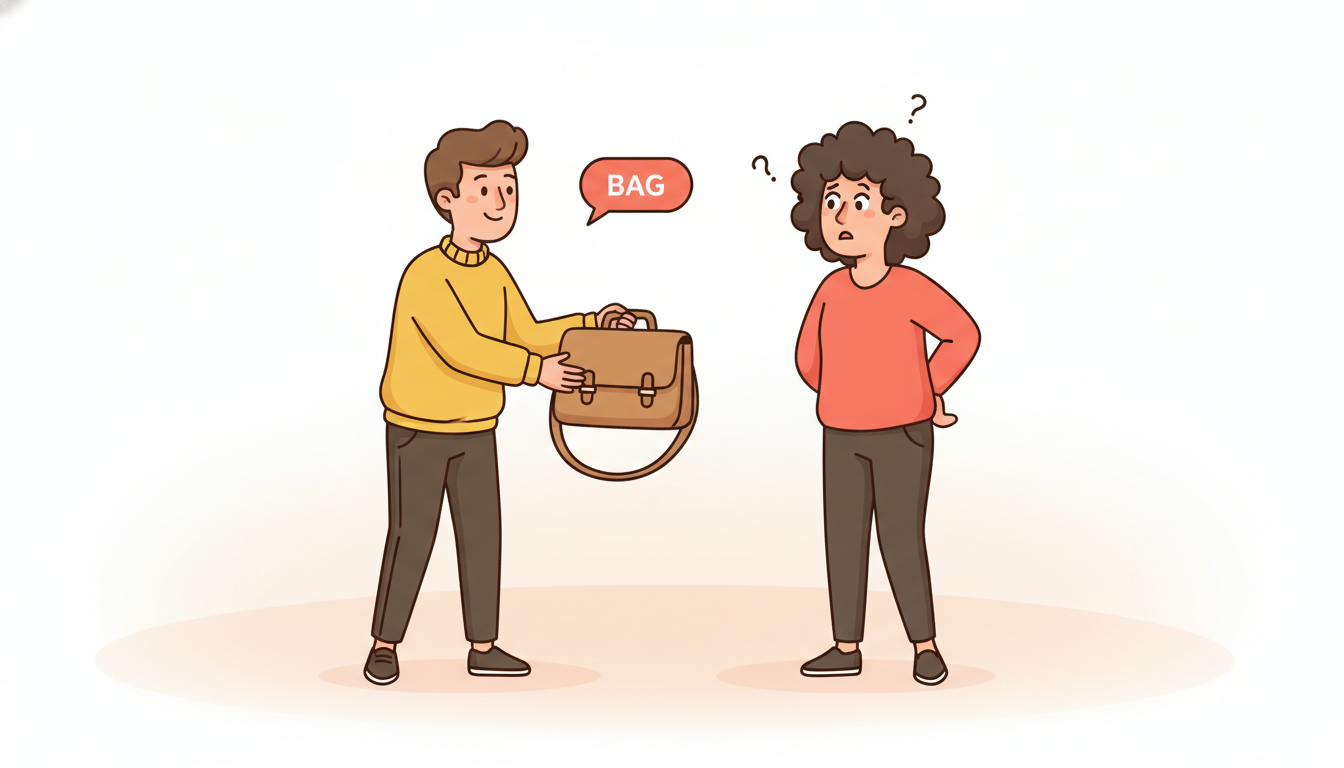
A German colleague says, "Could you please put this in my bag?" The Australian project manager hears, "...put this in my back," and pauses for a beat. The German speaker said the right word. The bag sound and the back sound left their mouth as the same syllable. This is one of the cleanest, most systemic features of German-English, and it isn't a vocabulary problem. It's a single phonological rule firing on every voiced final consonant the speaker produces in English.
What follows: name the rule, show the words it touches, explain the cue English ears actually use to tell bag from back (it isn't the consonant), and give the two-cue drill that locks the fix in two weeks.
Why bag sounds like back (and good sounds like goot)
The rule has a name in German linguistics: Auslautverhärtung, literally "final hardening." German requires that voiced obstruents (/b d g v z/) devoice to /p t k f s/ at the end of a syllable. Hund (dog) is pronounced [hʊnt], not [hʊnd]. Tag (day) is [taːk]. Rad (wheel) is [raːt]. halb (half) is [halp]. lieb (dear) is [liːp]. The spelling keeps the underlying consonant, but the brain ships the voiceless version every time.
This isn't optional and it isn't conscious. When a German speaker says Hund, the /t/ at the end is what the brain hears itself produce, even though the spelling and the morphology say /d/. Wikipedia's Final-obstruent devoicing article catalogs the same pattern in Dutch, Polish, Russian, and Catalan, but German is the textbook case.
When a German speaker switches to English, the brain doesn't switch off the rule. It keeps applying it. So bag /bæɡ/ comes out [bæk]. good /ɡʊd/ comes out [ɡʊt]. had comes out [hæt]. please comes out [pliːs]. was comes out [wɒs]. The substitution is 100% predictable from German phonology.
The German rule and the English rule, side by side
Hund must end in [t]. Tag must end in [k]. halb must end in [p]. That's the German rule: at the end of a syllable, voiced obstruents go voiceless. There is no version of these words where the speaker can opt out.
English does the opposite, equally automatically. Voiced obstruents stay voiced (or partially voiced — more on that below). The German speaker can't simply "remember" not to devoice in English, because the rule fires below conscious choice. Telling yourself "say /d/, not /t/" at the moment you produce the word is too late. The fix has to retrain the reflex.
German devoices every voiced final; English keeps it voiced and lengthens the vowel in front of it.
The full inventory of pairs the rule collides with in English:
| Voiced (English) | Devoiced (German English) | Meaning flip |
|---|---|---|
| bag /bæɡ/ | back /bæk/ | luggage vs. body part |
| bad /bæd/ | bat /bæt/ | adjective vs. animal/object |
| dog /dɒɡ/ | dock /dɒk/ | animal vs. boat platform |
| save /seɪv/ | safe /seɪf/ | verb vs. noun/adjective |
| raise /reɪz/ | race /reɪs/ | verb vs. verb |
| prize /praɪz/ | price /praɪs/ | reward vs. cost |
| leave /liːv/ | leaf /liːf/ | verb vs. plant part |
These aren't accent oddities. They're meaning flips.
When devoicing flips the meaning of the word
"Please put this knife in my bag" landing as "Please put this knife in my back" is the example flagged in Clare Lavery's ELT compendium, and it shows why this feature matters. Most accent features mark you as foreign. This one makes you misunderstood.
A longer vowel plus voicing carried into the g is what separates bag from back.
A handful of sentence-level flips that hinge on a single voiceless final:
- "I had a bad day at work." → "I had a bat day at work."
- "Could you raise the price?" → "Could you race the price?"
- "We need to save the document." → "We need a safe document."
These fail because the listener's brain reaches for the closest English word to what it heard, and the closest English word is also a perfectly common one. Nothing flags as off until the meaning falls apart a sentence later.
The same rule, three failure surfaces
The rule fires on every voiced final the speaker produces, so it surfaces in three different parts of English at once.
Single words. Bag, bad, dog, save, leave, prize. Drilled in isolation, they're easy to flag.
Plural -s. English plurals after voiced sounds end in /z/, not /s/. Dogs is /dɒɡz/, kids is /kɪdz/, beds is /bɛdz/, jobs is /dʒɒbz/. Devoiced, they become "docks," "kits," "bets," "chops." The plural marker itself gets neutralized. A German speaker saying "I have three kids" can land as "I have three kits." Kits is a real English word (a set of supplies, or baby foxes), just not the one the speaker meant.
Plural after a voiced sound is /z/; the d and the s both stay voiced.
Past tense -ed. Past tense after voiced sounds ends in /d/. Lived is /lɪvd/, raised is /reɪzd/, robbed is /rɒbd/, used is /juːzd/. Devoiced, they become "lift," "raced," "ropped," "use" (present). Now the listener hears a different tense. Lived and lift are different verbs in different time frames, and the speaker's whole sentence shifts under them.
One rule, three grammatical surfaces. Drilling vocabulary alone misses two-thirds of where it shows up.
The cue English ears actually use: vowel length
The /æ/ in bag lasts about 250 milliseconds. The /æ/ in back lasts about 180. That seventy-millisecond gap, not the consonant, is what tells an English listener which word you said.
This is the part most pronunciation guides skip. Even native English speakers don't fully voice their final consonants in fast speech. By the time you reach the /ɡ/ at the end of bag, the voicing is often half-gone. So how does the listener know it's bag and not back?
The vowel.
In English, the vowel before a voiced final is noticeably longer than the same vowel before a voiceless one. Peterson and Lehiste's 1960 study in the Journal of the Acoustical Society of America measured this directly. Their finding, which has been replicated for sixty-five years: vowels before voiceless consonants run about three-quarters the length of vowels before voiced ones. Same vowel symbol on the page. Different real time in the air.
Linguists call the shortening pre-fortis clipping — the Open Textbook chapter on American English phonetics walks through it with audio. Eyes /aɪz/ and ice /aɪs/ is the cleanest demo: same diphthong, but eyes lasts noticeably longer.
Here's the punchline. Auslautverhärtung does two things at once: it devoices the final consonant, and it tends to shorten the preceding vowel along with it. The English listener, already used to half-devoiced finals, can usually still parse a half-devoiced bag if the vowel is long. A half-devoiced bag with a clipped vowel is just back. Both cues lost. The listener has nothing left to parse with.
The two-part fix
Cue 1: keep the buzz going past the consonant. Place fingers lightly on your throat and say a long /v/. Feel the vibration. Now say a long /f/. No vibration. Alternate: /v/, /f/, /v/, /f/. The vibration has to continue into the final consonant, not stop just before it. Drill word-finally: have, have, have. please, please, please. bag, bag, bag. Hand stays on throat. The buzz has to be present at the consonant or the consonant collapses to its voiceless twin.
Cue 2: lengthen the vowel. When the final is voiced, hold the vowel an extra beat. Exaggerate at first, because exaggeration is what builds the muscle memory: baaag, not bag. baaad, not bad. raaaised, not raised. The exaggeration drops naturally once the new timing is automatic.
Both cues together is the package. Voicing alone often clips in fast speech and the listener still parses correctly because the vowel duration carries the signal. Length alone, even with the consonant fully devoiced, often signals the contrast on its own. Together, both cues survive fast speech.
Try it in Conversa
Practice with AI characters who adapt to your level and give real-time feedback.
Try Conversa FreeA five-minute drill that locks both cues
Five voicing pairs, three steps, five minutes a day, two weeks. That's the whole drill.
Step 1: listen and identify. Pick five voicing pairs: bag/back, bad/bat, save/safe, raise/race, prize/price. Pull each one up on Forvo or any pronunciation app and listen for the vowel length difference. Don't worry about the consonant yet. Train your ear on the timing first.
Step 2: exaggerate. Read each pair aloud, dragging the vowel before the voiced member: baaag, back. baaad, bat. saaave, safe. raaaise, race. priiize, price. Hand on throat, confirming the buzz on the voiced member. The exaggeration should feel a little ridiculous. That's the point.
Step 3: sentence production. Read this stack at normal speed: "My dog had a bad day. The kids robbed the bag. She raised the prize. We saved the dog's bones." Four sentences, every sentence has a voiced final somewhere. If any one of them clips or devoices, restart from sentence one.
After two weeks, drop the exaggeration and let the new timing sit at conversational speed. The voicing usually follows the length without further work.
If you want a low-friction way to drill these in actual conversations rather than reading lists, Conversa is an AI conversation partner you can talk to in English. The repetition this drill needs falls out naturally from talking instead of practicing.
Three fixes that don't actually work
"Just pronounce final consonants more clearly." This usually produces a heavier accent, not a fixed one. It addresses neither voicing nor vowel duration. The German speaker ends up over-articulating the [k] in back with even more energy, which doesn't help.
"Think of the sound as English, not German." Auslautverhärtung is below conscious awareness. Telling yourself to "think English" doesn't reach the layer where the rule fires. The fix has to be physical (throat, vowel timing), not mental.
Adding a vowel after the final to keep the voicing alive. Bag-uh, good-uh, raised-uh. This is a real attempt to extend the voicing past the consonant, but it produces a different L1-transfer error: the paragogic vowel. That's the Italian-speaker version of the same problem, and it sounds equally non-native, just in a different costume. The fix is a longer vowel and continued voicing, not an extra syllable.
Two cues, two weeks, no more bag-back confusion
Auslautverhärtung is arguably the biggest L1 feature in German-English, and the one most likely to flip meaning instead of merely signaling foreignness. The fix has two pieces: keep voicing past the consonant, and lengthen the vowel that precedes it. Both pieces are physical and trainable. Five minutes a day, two weeks, and the rule that ships Hund as [hʊnt] starts shipping bag as [bæɡ].
If pronunciation is the half of German English you're working on now, the other half (register and softeners) is what makes the same speaker sound brusque even when every consonant is clean. That's the round-one piece on Anglo softeners.