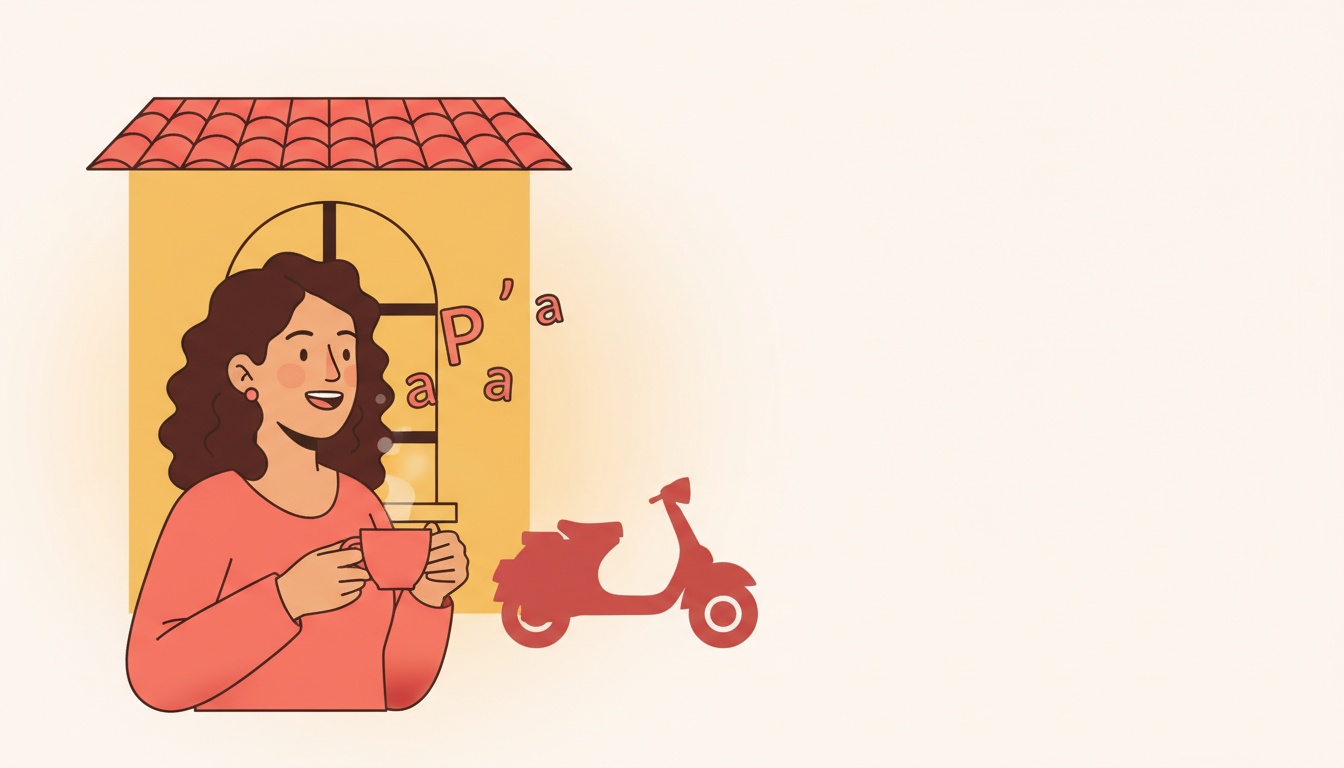
Read this aloud the way it lands in your mouth: I'd like to stop at the next station. If a small vowel landed on the end of like, stop, next, or station, you have what linguists call a paragogic vowel, and it's the single feature that marks an Italian accent in English faster than the rolled R, the th substitutions, or anything else.
Italian wants a vowel after every consonant; English lets the consonant close the word.
The "It's-a me, Mario" parody is built on a real linguistic mechanism with a real name. Once you can name it, you can fix it.
The vowel you can't hear yourself add
Stand in front of a mirror and say five words in a row, clipping each one dead at the consonant: stop. work. think. next. films. If a faint -a or -uh keeps slipping onto the end, you've just produced a paragogic vowel.
Paragoge is the technical name for adding a vowel to the end of a word. It's one of three flavors of vowel epenthesis, and it shows up in many languages where speakers borrow words that end in consonants their phonology doesn't normally allow. Japanese famously does it to biiru (beer) and baseball (beesubooru). Italian does it to English the same way, and the flavor of the inserted vowel is the part that gives the accent its signature.
For Italian speakers, the inserted vowel is usually a short -a or -e (some sources transcribe it as schwa). Stop becomes stop-a. Work becomes work-a. Think becomes think-a. Bus lands close to bus-a in connected speech. The conscious self never decided to add anything. The mouth just refused to stop on a bare consonant.
Your brain is applying Italian rules correctly
Latin amicus lost its -us and became Italian amico. The same shift dropped the consonants off thousands of inherited words during the Vulgar Latin period, starting roughly in the first century AD. The whole modern Italian sound system inherited the result: a strong preference for open syllables, with native words almost always ending in a vowel. Parla, libro, casa, freddo, lavoro, ragazzo. The pattern isn't decoration; it's documented in the sound shift from Classical Latin to Proto-Romance.
Italian native words almost always end in a vowel; English words routinely end on a bare consonant.
Italian phonology only tolerates a small set of consonants in word-final position in native vocabulary, and even those are rare. When a loanword like sport arrives, Italian often half-pronounces the final stop, leaves it unreleased, or tacks on a small vowel to soften the landing. Modern Italian speakers do say bar, film, and taxi without a vowel tail, but those words are loanwords, and even they get pulled back toward the open-syllable preference in fast speech.
When you speak English, your phonotactic system is still on. It expects a vowel after every consonant, and it inserts one when English doesn't supply it. You're not making a mistake. You're applying the right rules to the wrong language. The fix is teaching the mouth to override those rules for a specific set of contexts.
Where the vowel actually lands
Stop, work, think, films, bus. Five English words, five different ways the paragogic vowel sneaks in. The contexts split into five patterns, and once you can hear them you can target them.
Final stop consonants. Stop, work, think, big, job, hot, red, run. Any word ending in /p, t, k, b, d, g/. The closure is the moment your mouth wants to release into a vowel. Train your mouth to release into silence instead.
Final consonant clusters. Films, asks, texts, months, thanks. Italian phonology hates stacking consonants at the end of a syllable, so the brain cracks the cluster open with a vowel: filmis, askis, textis. The cluster wasn't the bug; the syllable structure was.
Voiceless fricatives at end. Bus, gas, cough, laugh. Less obvious but still leaky, especially in connected speech.
Single-syllable words with final stress. Italian default stress is penultimate (more on that below), so a one-syllable English word feels structurally wrong. Adding a vowel restores the expected shape.
Loanwords already pre-Italianized in your head. If you grew up hearing sport-a or meeting-a used in casual Italian conversation, your English version inherits that adaptation. BoldVoice's notes on Italian-speaker pronunciation call this out specifically as one of the most common patterns to retrain.
The end-stop drill
Five minutes a day, two weeks. This is the practice that actually changes the habit.
Pick 30 consonant-final English words. A starting list: stop, work, think, next, films, asks, texts, big, job, red, hot, run, kept, milk, six, fact, help, gift, most, last, fish, push, life, off, bath, mouth, smooth, breathe, with, both. Read them aloud, one at a time, and clip every final consonant clean. Total silence after each word, no vowel tail.
Rule one: if a vowel sneaks in, restart the entire list from the top. The restart builds the new motor pattern. Cheating the restart is how the habit survives.
Rule two: do it without context. No sentences yet. Single words, in a list. Sentences pull the rhythm back toward Italian and the paragogic vowel rides along on the rhythm.
Phase two, after a week: pair words. Stop now. Work hard. Think fast. Next station. Films open. Say each pair without dropping the clip on the first word. This is harder than it looks. The temptation to link the consonant into the next vowel is enormous, and that linking is fine in English (more on that), but it has to happen on your terms, not as automatic vowel insertion.
Phase three: shadow one minute of an English podcast, focusing only on word endings. Track nothing else. The narrowing makes the practice stick.
The stress trap that rides shotgun
Italian default stress is penultimate. Par-LA-no, a-MI-co, ra-GAZ-zo, la-VO-ro. Most native words land their stress on the second-to-last syllable, and the words that break the rule fall into two camps: some take a written accent (città, caffè) precisely because they break the default, and others stress the third-to-last syllable (te-LE-fo-no, MA-cchi-na) — a marked but common pattern Italians call sdrucciola.
English doesn't share the rule. English stress is lexical and unpredictable: PHO-to-graph but pho-TO-gra-pher. CON-tract (the noun) but con-TRACT (the verb). RE-cord and re-CORD. There's no shape rule that tells you where the stress goes; you have to learn each word.
The two patterns interact in a sneaky way. Repetti's research on Italian loanword adaptation shows that one of the reasons Italians sometimes insert a paragogic vowel is to create an extra syllable that lets the stress land on the penultimate position, the way Italian expects. Stop under Italian stress becomes STOP-a: a two-syllable word with stress on the first, penultimate of two. The vowel and the stress habit are linked at the source.
The practical fix: when you learn a new English word, mark its stress before you drill its sounds. Get the rhythm right and the vowel addition often disappears on its own.
Try it in Conversa
Practice with AI characters who adapt to your level and give real-time feedback.
Try Conversa FreeWhat native English actually does at word boundaries
English does link consonants into following vowels. An apple comes out as a-napple. Stop it comes out as sto-pit. Find out sounds like fine-dout. This is correct English, called catenation, and you've heard it your whole life. Leonardo English has a clear summary of the connected-speech rules if you want the inventory.
The trap for Italian speakers is doing the same kind of linking when there isn't a vowel available. Stop now is two consonants meeting in the middle, and English just crashes them together: /stɒpnaʊ/, mouth-closed-stops-and-all. Italian instinctively wants to soften that crash with a vowel: stop-a now. That's the move to suppress.
Two consonants meet in the middle and English just crashes them together; nothing goes between.
A simple test: say stop now and stop it one after the other. The p should be released into the i of it (catenation, fine) but should not be released into anything before now (clip it). If both come out the same, the paragogic vowel is still on.
Listening is the other half of the same problem
In casual American speech, final stops routinely soften: walked often sounds closer to wahk, wanted runs to something like wannid, last night blurs into las'night. Italian learners who over-produce these endings to compensate end up sounding crisper than the natives, with hyper-clear consonants and small vowel tails attached. Once your mouth can land on a final consonant without a vowel, your ears start hearing English the way Americans actually speak it. The fix in both directions is the same: stop expecting a vowel after every consonant.
The feedback loop that works: produce a word, record yourself, compare to a native source, adjust. Two minutes a day. If you want a conversation partner who will sit through fifty reps of the end-stop drill without flinching, Conversa is built for exactly that kind of focused practice.
There are sibling drills for a different L1 if you have a friend learning English from another starting point: English TH sounds for French speakers and English R for Brazilian Portuguese speakers both cover the same diagnostic shape applied to a different gap in the sound system.
Where to start tomorrow
Pick five words from the drill list. Say them in front of a mirror before your next call or class, clipping each one clean. Stop. Work. Think. Next. Films. If a vowel sneaks in, restart. That's the whole practice. The paragogic vowel is the most fixable feature in the Italian-English accent because it has one cause, one trigger, and one drill. Five minutes is the entry fee.