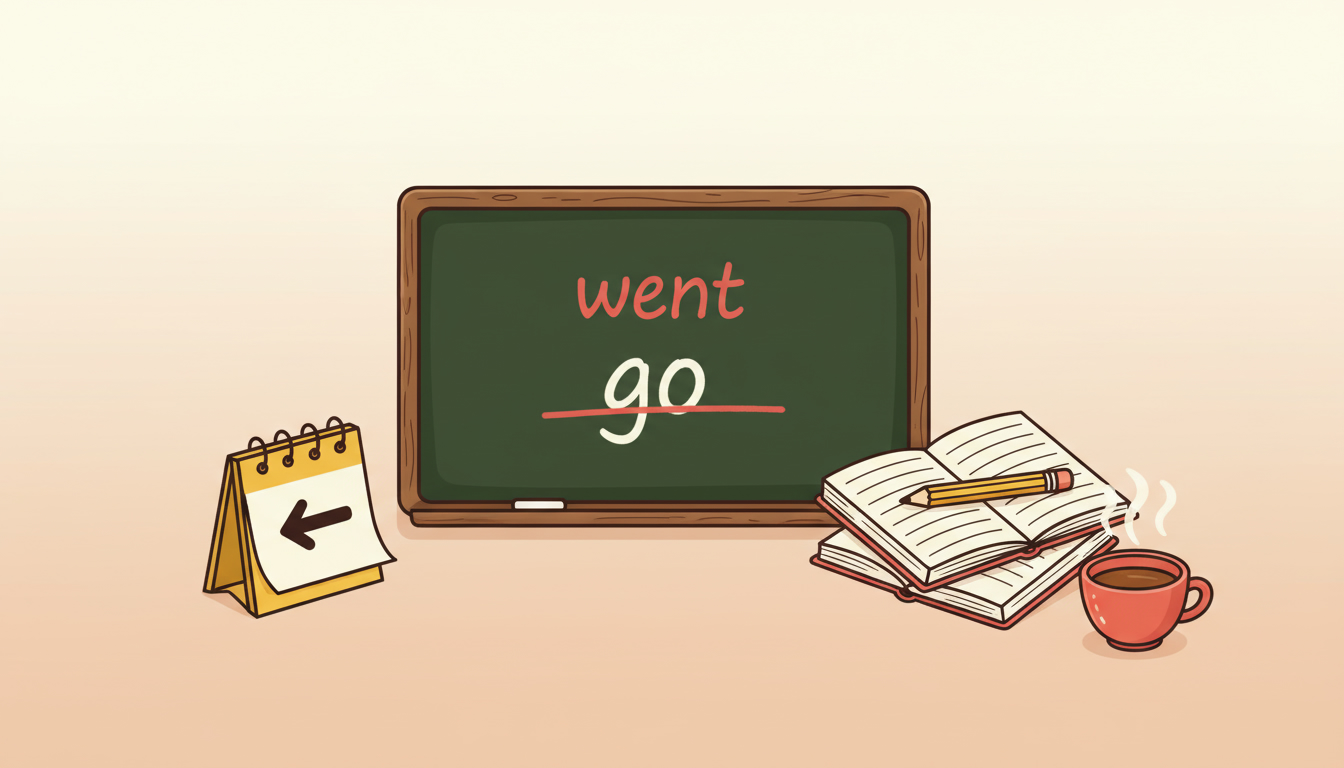
"Yesterday I go to the store." If you've ever said this in English, your teacher probably circled go and wrote went on top of it. If you're a Mandarin speaker, the correction felt a little arbitrary. The sentence already said yesterday. Why does the verb need to know too?
That feeling has a name: it's L1 transfer. Mandarin marks time with adverbs (昨天, 上周, 已经) and aspect with particles (了, 过). The verb itself stays in one shape forever. English is wired the opposite way: the verb has to agree with the time, even when an adverb already said it. Once you see the redundancy as a feature, not a bug, the rest of past tense gets a lot easier.
This post covers the four things Mandarin speakers actually need: why your brain wants to drop -ed, the three ways -ed sounds (it isn't one), why 了 is not English -ed, and the 30 irregular verbs that handle most real conversation.
Why "Yesterday I go" feels right
Look at the Mandarin sentence first: 我昨天去商店 (Wǒ zuótiān qù shāngdiàn), literally "I yesterday go store." The verb 去 (qù, go) is doing one job: naming the action. The time is the adverb's responsibility. There's no reason for 去 to change shape, and Mandarin grammar doesn't ask it to.
English doubles up. Yesterday I went to the store marks the past twice: once on yesterday, again on went. To a native ear this is the only way the sentence parses. To a Mandarin ear it sounds like saying "yesterday-yesterday I go." The redundancy is doing real grammatical work, but it doesn't feel that way at first.
This is the most-cited error in lists of common Chinese-ESL grammar mistakes, and the fix is conceptual before it's mechanical: in English, the verb has to carry the time too. Always. Even when it's redundant.
A few more from the same family, with the Mandarin originals:
- 我上周去北京 → "I went to Beijing last week." (not I go to Beijing last week)
- 去年我住在上海 → "Last year I lived in Shanghai." (not Last year I live in Shanghai)
- 她昨天跑步 → "She ran yesterday." (not She run yesterday)
Notice the last one: ran, not runned. That's the next problem.
The three sounds of -ed (and why nobody told you)
Walked doesn't sound like "walk-ed." Neither does played, and wanted sounds different from both of them. -ed makes three distinct sounds, depending on the consonant right before it. Get this wrong and you'll over-pronounce everything as "walk-ed" with two clear syllables, which is the textbook giveaway.
/ɪd/, extra syllable, after /t/ or /d/. This is the only case where -ed adds a beat to the word.
- wanted → /ˈwɒn.tɪd/
- needed → /ˈniː.dɪd/
- decided → /dɪˈsaɪ.dɪd/
- started → /ˈstɑːr.tɪd/
- waited → /ˈweɪ.tɪd/
/t/, sharp, no extra syllable, after voiceless consonants (p, k, f, s, ʃ, tʃ, θ).
- walked → /wɔːkt/
- kissed → /kɪst/
- washed → /wɒʃt/
- jumped → /dʒʌmpt/
- laughed → /læft/
/d/, soft, no extra syllable, after voiced consonants and vowels (b, g, l, m, n, r, v, z, and any vowel sound).
- played → /pleɪd/
- called → /kɔːld/
- lived → /lɪvd/
- opened → /ˈoʊ.pənd/
- moved → /muːvd/
The voicing rule in one sentence: if the final sound before -ed buzzes your throat, you say /d/. If it doesn't buzz, you say /t/. If it's already /t/ or /d/, you can't stack it, so you say /ɪd/ and add a syllable.
Practical test: put your hand on your throat and say walked, then played. Walked ends with /k/ (no buzz) plus /t/ (no buzz). Played ends with /eɪ/ (vowel, buzz) plus /d/ (buzz). The throat tells you which one you used. Grammar.cl and English Learning Tips both have audio if you want to hear the contrast. Once the throat test is automatic, the adjectives that keep the extra syllable are the part of this rule nobody teaches.
了 is not -ed
了 looks like a past-tense marker. It often translates as English past tense. So most Mandarin learners assume the equivalence runs both ways: if the sentence has 了, use -ed; if it doesn't, don't. That's not what 了 does, and the rule breaks the moment you leave the easy cases.
As Chinese Boost's grammar summary puts it, 了 marks aspect (is the action complete? has the state changed?), not time (did this happen before now?). The two often line up, which is why the false equivalence holds for a lot of sentences. But often they don't.
Three sentences where 了 has nothing to do with English past tense:
- 他是老师了 (Tā shì lǎoshī le): "He's a teacher now." Present tense in English. The 了 marks a change of state: he wasn't before, he is now.
- 她会走路了 (Tā huì zǒulù le): "She can walk now." Also present. New ability.
- 我卖了这些车以后,就有钱了 (Wǒ mài le zhèxiē chē yǐhòu, jiù yǒu qián le): "Once I've sold these cars, I'll have money." Future. The 了 is sitting inside a future frame, marking completion of a sub-action.
And the reverse: many English sentences with -ed have no 了 at all in their Mandarin equivalents.
- "I lived in Shanghai for ten years" → 我在上海住了十年, or 我以前在上海住过十年 (with experiential 过 instead of 了).
- "I knew her back then" → 那时候我认识她. No 了, no aspect particle, just a stative verb plus a time reference.
The cleanest mental rule: 了 answers "is it done / has something changed?" -ed answers "did this happen before now?" The same Mandarin sentence will sometimes need -ed without 了, sometimes need 了 without -ed, and often need both. They're separate tools for separate jobs. If you want a deeper map of what 了 actually does, the post on why 了 isn't past tense walks through the rules from the other direction.
The 30 irregular verbs that carry most conversations
Open any irregular-verb worksheet and you'll see 200 entries arranged alphabetically. Abide, arose, awoke, beheld, bereft. Don't memorize that list. Most of those verbs barely show up in real speech.
ESL Lounge's frequency list ranks irregulars by how often they actually appear. The top 50 cover roughly 87% of irregular verb use. The top 30 alone get you most of the way to fluent past tense, because the 30 you'd guess are also the 30 that appear:
| Base | Past | Past participle |
|---|---|---|
| be | was/were | been |
| have | had | had |
| do | did | done |
| say | said | said |
| go | went | gone |
| get | got | gotten/got |
| make | made | made |
| know | knew | known |
| think | thought | thought |
| see | saw | seen |
| take | took | taken |
| come | came | come |
| give | gave | given |
| find | found | found |
| tell | told | told |
| become | became | become |
| leave | left | left |
| feel | felt | felt |
| bring | brought | brought |
| begin | began | begun |
| keep | kept | kept |
| hold | held | held |
| stand | stood | stood |
| hear | heard | heard |
| let | let | let |
| mean | meant | meant |
| set | set | set |
| meet | met | met |
| run | ran | run |
| pay | paid | paid |
A few patterns worth noticing. Cost, cut, hit, hurt, let, put, set don't change at all. Bring, buy, fight, teach, think all share the -ought / -aught shape in the past. Keep, leave, mean, sleep, sweep all become -ept / -eft / -ept. The list isn't 30 random shapes; it's a few small families plus the very high-frequency oddballs (go/went, be/was).
Drill these 30. Skip the alphabetized 200. The British Council irregular verb reference has the full list when you want it, but for conversation, 30 is the working set.
Try it in Conversa
Practice with AI characters who adapt to your level and give real-time feedback.
Try Conversa FreeWhen -ed disappears (the listening trap)
Walked to the store in fast English speech often comes out closer to walk' to the store, with the /t/ reduced almost to nothing. I called you in casual speech can sound like I call' you: the /d/ is still there, but it's a flick, not a full consonant. This is connected speech, and it's the trap nobody warns Mandarin learners about.
Native speakers do this constantly, and it creates two problems for you. First, you start mishearing them as ungrammatical. They're not; they're reducing. Second, you over-pronounce -ed on your own words to compensate, which is technically correct but sounds textbook-clear in a way nobody talks. Walked with two clean syllables ("walk-ed") is the move that gives you away.
The fix on the production side: produce -ed clearly when you're learning, then let it relax once the form is automatic. The fix on the listening side: assume the morpheme is always there, even when your ear missed it. If a native speaker says "yesterday I walk to the store," the walked is in there somewhere; your ear just didn't catch the reduced /t/.
A drill that actually rewires the habit
Start with this sentence: 昨天我和朋友去吃饭. Translate it with the verb deliberately marked: "Yesterday I went to dinner with friends." Read it aloud. Then do the same with nine more Mandarin sentences that already have a time adverb (昨天, 上周, 已经, 去年, 以前) doing the heavy lifting. The instruction is simple: even when the adverb already said it, change the verb shape too.
A starter set:
- 昨天我和朋友去吃饭 → "Yesterday I went to dinner with friends."
- 上周她买了一辆新车 → "Last week she bought a new car."
- 我去年回老家 → "Last year I went back to my hometown."
- 以前我每天跑步 → "I used to run every day."
- 已经下雨了 → "It has already rained" (or "It's already rained").
The first twenty repetitions will feel like over-explaining. By the hundredth, the redundancy stops feeling redundant. Pair it with the throat-buzz test for whichever -ed sound the verb takes (walked /t/, played /d/, waited /ɪd/). When you start using an AI conversation partner like Conversa to practice, the same drill runs in real time, and the irregulars stop tripping you up after a few weeks.
Notice what sentences 1 and 3 above have in common. Both use went, an irregular. The top 30 verbs are the ones you'll reach for first, and a lot of them dodge the -ed rule entirely. That isn't a coincidence: high-frequency English verbs tend to be irregular, because frequent use seems to preserve the older shapes.
What rewiring sounds like
For one week, try this: every time you say a sentence with yesterday, last week, or 已经 running through your head, force the verb to change shape too, even if you're alone and nobody's grading you. Yesterday I ate. Last week she bought. Already, it rained. Out loud, in the kitchen, at the bus stop. By day five, the doubled time-marking will start clicking into place as one motion instead of two rules.
That's the moment the redundancy stops feeling redundant. Yesterday-went lands as one unit, the way a native speaker hears it, and -ed turns from a rule you remember into a shape your sentences come out in. The 30 irregulars do the rest of the work. The list of 200 is for crossword puzzles.