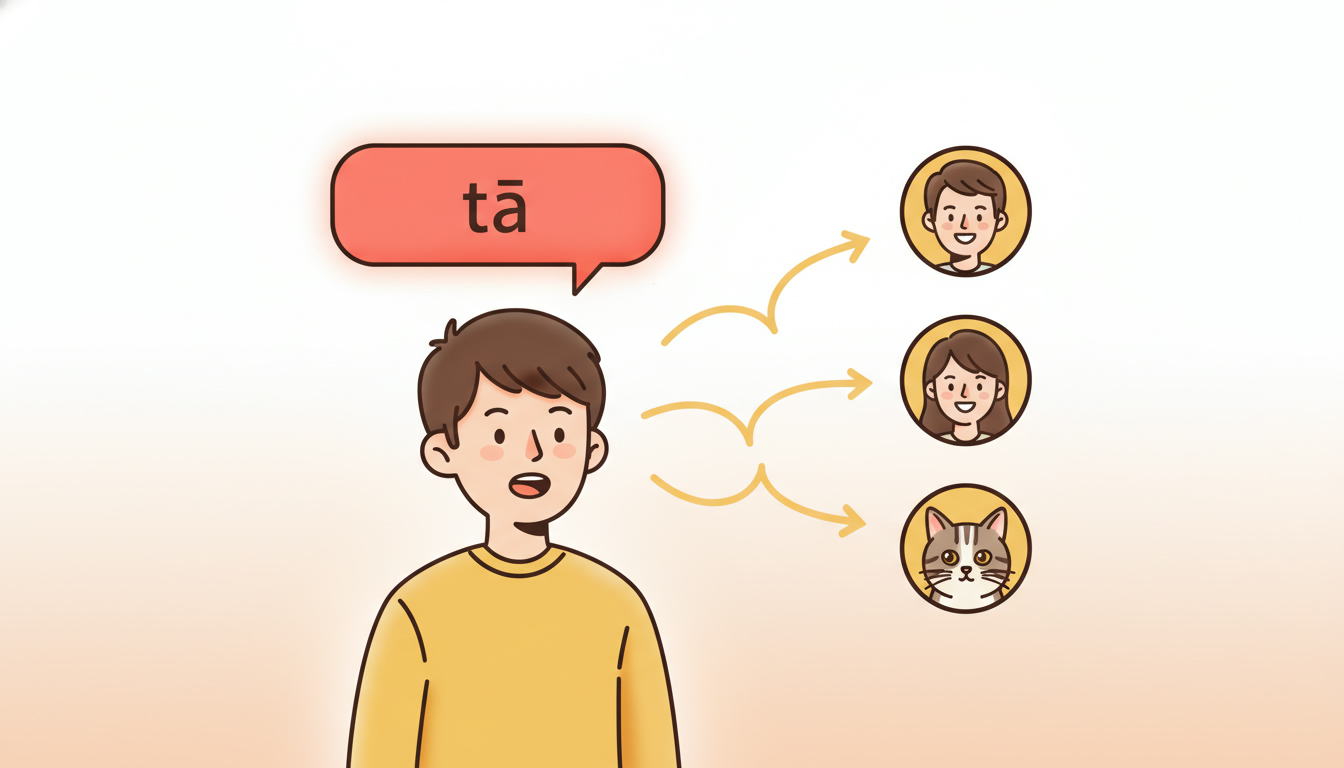
"My mom, he is a doctor." You've said it, or something like it. Your boss caught it. Your English teacher caught it. Your girlfriend's mother caught it, and now her face is doing a polite thing. You know perfectly well that your mother is a woman. Your mouth did not.
This is the most-recognized marker of Mandarin-speaker English, and it's also the most frustrating, because it doesn't go away when your grammar gets better. Fluent speakers slip. People who write she correctly in emails still say he about their female cousin five minutes later. The bug is not where you think it is.
In Mandarin, he, she, and it all sound the same
The characters look different on paper. 他 (he), 她 (she), and 它 (it) each have their own shape. In sound, all three are /tā/. So is the possessive 他的 / 她的 / 它的 (his, her, its). Tonally identical, segmentally identical. In a normal Mandarin conversation, the only thing that tells you the gender of the person being referred to is context: 我的妈妈,她很聪明 (my mom, she is very clever) is unambiguous because mom has already told you the answer.
This isn't a recent or regional quirk. It's the structure of spoken Chinese pronouns as documented across modern Mandarin. Your brain has spent your entire life speaking a language in which the pronoun never had to encode gender, because the noun already did, or context did.
The 1917 fix that didn't reach your mouth
Here is something most Mandarin speakers do not know: the character 她 is barely a century old. Before 1917, third-person singular in Chinese was 他 for everyone. Men, women, and inanimate referents all shared the same character and the same sound.
The poet and linguist Liu Bannong (劉半農) is the person who invented 她. He published an essay arguing for it in May 1917 and used the new character in his poetry from that year forward. He built it the same way you'd expect: take the existing 他, swap the person radical (人) for the woman radical (女), keep the phonetic part (也) so the pronunciation didn't change. The character was meant to mirror English she for translators of foreign literature, which was exploding in popularity during the May Fourth era. 它 for inanimate referents and 牠 for animals followed in the years after. (If you're learning Mandarin in the other direction, the same spoken-script split is the reason Mandarin tones trip beginners the hardest in conversation, not in textbooks.)
Here is the part that matters for English. The gendering only ever landed on paper. As Andrew Batson puts it, the spoken language "continued using the inclusive pronoun, which explains why native Chinese speakers often confuse English gendered pronouns." A hundred years of writing gendered pronouns has not changed the fact that nobody hears them. Your eyes can tell 他 from 她. Your ear cannot.
Why fluent speakers still slip
"I cannot find Mrs. Clemons. Do you know where he is?" That sentence comes from an iTalki writeup of common Chinese-speaker English errors, and the speaker who produced it knew Mrs. Clemons was a woman. This is not a knowledge gap. You know that he is for men and she is for women. If a teacher hands you a worksheet, you fill it out correctly. If you're typing an email, you self-correct.
The slip happens at production speed. In real-time conversation, your brain has half a second to retrieve a pronoun and put it in your mouth, and the conscious rule ("check the gender of the person I'm referring to") is slower than that. Whatever runs first wins. For Mandarin speakers, what runs first is the all-purpose /tā/-shaped slot, and when that slot has to commit to a gender in English, it usually picks the most-frequent default, which is he. The same iTalki piece quotes another version of the same bug: "I gave Jason her phone back." Subject pronoun right, possessive wrong.
A peer-reviewed study on this exact problem confirms what every Mandarin-speaking English learner already suspected: "even proficient Chinese speakers of L2 English tend to misuse he for she in production." Knowing the rule does not fix the bug. The bug is that the gender-check never made it into the production pipeline. (It is the same production-speed gap that hits past-tense endings for Mandarin speakers: you know -ed belongs on the verb, but your mouth has to be trained to put it there.)
Three drills that fix it
The fix is not memorization. It is teaching your mouth to slow down at pronouns just long enough for the gender-check to fire, and then teaching it to do that without slowing down. Three drills, in order.
Drill 1: The half-second pause
Before every he, she, his, or her you're about to say, stop for half a second and ask: man or woman? Then speak.
That is the entire intervention. It feels slow at first, the way putting your tongue behind your teeth for a clean /θ/ feels slow when you first learn it. After two or three weeks, the pause shortens to nothing and the gender-check fires on its own. The pause is scaffolding; it goes away once the building stands.
If an ESL teacher has ever told you to "speak slowly" and you've wondered what they actually wanted you to slow down on, this is it. Pausing at the pronoun specifically is the target.
Drill 2: Read 30 short biographies aloud
Write or paste 30 short biographies into a doc. Ten about men, ten about women, ten about families or couples. Two or three sentences each, packed with pronouns:
Maria is a chef. She runs a small restaurant in Brooklyn. Her husband helps on weekends. He does the dishes.
Read all 30 out loud, one after another, no skipping. The first five will be slip-heavy. By the time you reach biography 30, your mouth has learned to slow at he/she/his/her without you thinking about it. Repeat daily for two weeks.
The reason this works is that it forces gender-tracking under the only condition that matters, which is producing speech with your own voice. Reading silently does nothing. Listening does some good but not enough. The drill has to involve your mouth.
Drill 3: Pronoun shadowing
Pick a one-minute clip from a dialogue-heavy show. A Friends scene where Ross talks about Rachel, or a Modern Family scene where Phil talks about Claire, will give you ten she-referring-to-a-named-woman events in sixty seconds. Shadow the clip, which means speaking along with the audio, half a beat behind the speaker. Listen only for pronouns. For every he or she you say, mentally tag who it refers to: "she / Rachel / woman."
This is the listening half of the fix. You can think of it as the receiving end of drill 2. Shadowing trains your ear to register gender every time a pronoun goes past, and the ear training tightens the mouth training. The two drills compound.
If you want a tool to practice spoken production with, an AI conversation partner like Conversa will not get bored of correcting your fifth he-for-she slip in a row, which is what makes it useful for the part of language learning that is genuinely repetitive.
Try it in Conversa
Practice with AI characters who adapt to your level and give real-time feedback.
Try Conversa FreePossessives ride the same wave
His, her, and its are all 他的 / 她的 / 它的 in Mandarin, all pronounced /tā de/. The fix above will only hold if you put possessives into your drills. The bug doesn't stop at the subject pronoun. It follows you one word later, into his car or her keys, and the most common adult-Mandarin-speaker error is to get the subject pronoun right and then drop the gender one syllable later.
Watch for: "My dad lost her keys" or "My mom and his car went to the shop." The drill catches these only if your biographies include possessive forms. The example above ("Her husband helps on weekends") has them. Anything you write should.
The animacy trap: your dog isn't "he"
Mandarin has 它 (and Traditional 牠) for non-human animacy, but the distinction is script-only, and your spoken instinct never had to encode it. The result is a smaller second bug. When Mandarin speakers learn to track gender in English, they sometimes overshoot and call animals and objects he or she by reflex.
In English, calling a pet he or she if you know the animal's sex is fine. My dog Buddy is great, he loves the park. What sounds wrong is My car broke down, she needs new tires or That building, he is the tallest in the city. Native speakers default to it for non-human, non-pet referents. The rule is roughly: if it's a person, gender it; if it's a pet you know, gender it; otherwise, it.
If you find yourself reaching for he or she to describe a phone, a car, or your apartment, that's the same animacy gap showing up in the opposite direction. Pause for half a second, ask "person, pet, or thing," and pick the correct one.
When you can finally stop pausing
The half-second pause is not permanent. Most Mandarin speakers who run this drill report the same arc: week one is full of mid-sentence corrections ("my mom, he, she..."), week two is corrections becoming faster and quieter, week three is the pause shrinking to nothing. By a month in, she for a woman feels as automatic as he for a man.
The diagnostic that tells you it's working: you start catching yourself mid-slip. That's the gender-check arriving in the production pipeline, just a hair late. A few weeks after that, it arrives on time, and the slip stops happening at all.
The first time you say she for a stranger you just met, without thinking about it, you'll feel the fix land.