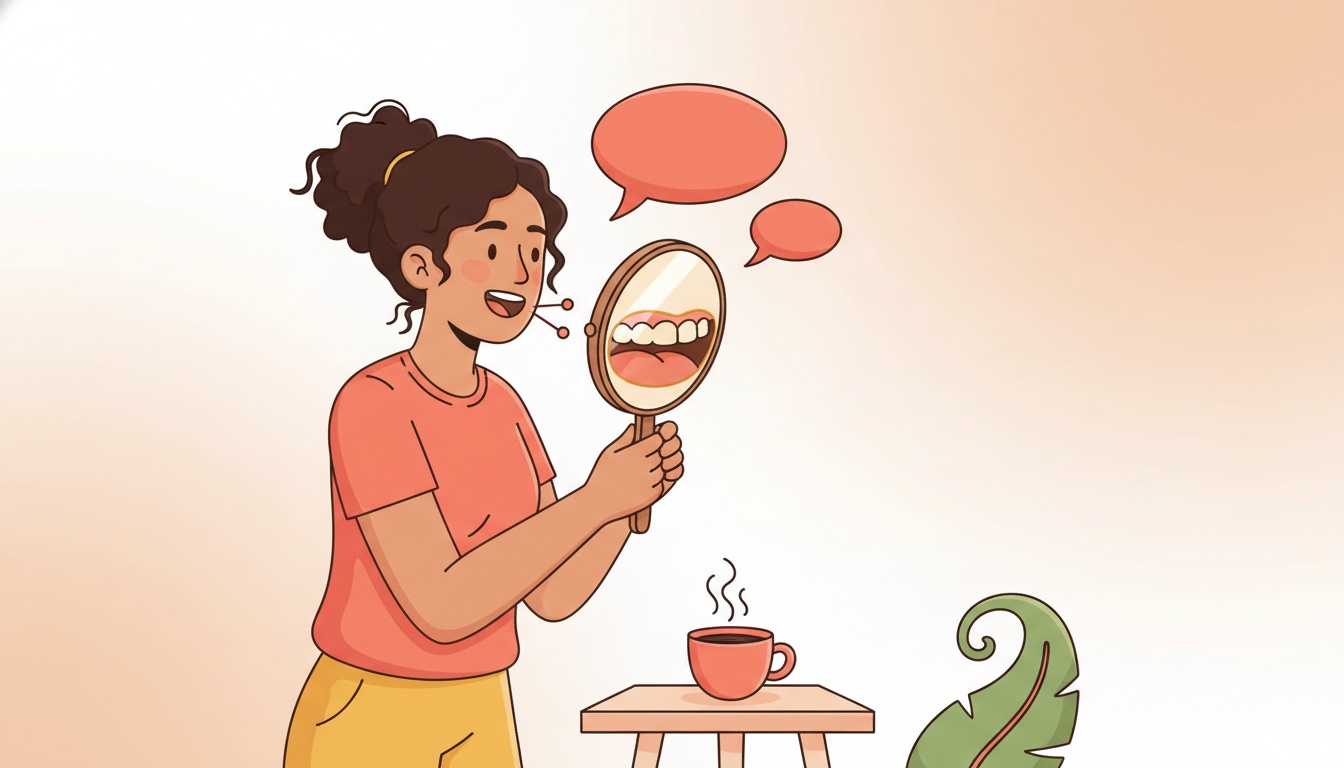
When a Carioca says "I'm on the team" in English, an American often hears "I'm on the cheam." The sound that comes out where the T should be is the same one English uses in chair and cheese, and it landed there by accident. The speaker didn't choose it. The Portuguese phonology fired the same rule it fires for tia and dia every day in São Paulo and Rio, and that rule doesn't switch off just because the next word is English.
This is the second of the three signature features that mark Brazilian English. The first is the /r/ that comes out as /h/ and the extra vowel that sneaks onto consonant endings. This post is about the third lever in the same system: what happens to /t/ and /d/ when they meet an /i/.
The rule: /t/ becomes /tʃ/ and /d/ becomes /dʒ/ before /i/
In most of Brazil, /t/ and /d/ are pronounced as affricates whenever the next vowel is /i/. That means tia (aunt) comes out [ˈtʃia], dia (day) comes out [ˈdʒia], and gente (people) ends in [tʃi] rather than [ti]. The IPA transcription on Wikipedia's Portuguese phonology page lists this as a default realization for Brazilian Portuguese.
The mechanism is mechanical. As your tongue prepares for the /i/ (a high front vowel), the body of the tongue rises and slides backward into the post-alveolar zone. The /t/ or /d/ that was supposed to be a clean stop at the alveolar ridge gets dragged along, picks up friction on release, and arrives at your listener's ear as an affricate. The English ear hears that affricate as ch or j.
The rule fires below conscious awareness. Most Brazilian speakers don't perceive their tia as starting with anything other than a normal T. The substitution is already baked in by the time the sound leaves the mouth.
How it ports to English
Team comes out "cheam." City comes out "sitchy." Pretty comes out "pritchy." Any English word where /t/ or /d/ sits in front of /i/ gets the same treatment Brazilian Portuguese gives tia, and the list of casualties is short and predictable.
- team /tiːm/ → [tʃiːm], approximately "cheam"
- city /ˈsɪti/ → [ˈsɪtʃi], roughly "sitchy"
- pretty /ˈprɪti/ → [ˈprɪtʃi], something like "pritchy"
- diet /ˈdaɪət/ → realizations vary, but the /d/ often comes out [dʒ], giving something like "jiet"
- did /dɪd/ → [dʒɪd] at the start, often nothing recognizable at the end
- dinner /ˈdɪnər/ → [ˈdʒɪnər], close to "jinner"
A study on Brazilian Portuguese/English interphonology tracked this exact pattern in BP-speaker English production. The takeaway from the data was that learners palatalize automatically without noticing, and that perception and production of the /t/–/tʃ/ and /d/–/dʒ/ contrast tend to improve together rather than independently. In plain language: you can't easily hear that you're doing it.
The double whammy: palatalization meets the extra /i/
Brazilian Portuguese also dislikes consonant-final syllables. It breaks them by sneaking a small /i/ onto the end. That's why Facebook in Brazilian speech tends to land with an extra syllable on the end (something like "fay-see-BOO-kee") and McDonald's picks up an extra syllable too. Learn English Sounds has a good plain-language walkthrough of this epenthesis pattern across Romance languages.
Now stack the two rules together. An English word ending in /t/ or /d/ first picks up the epenthetic /i/, which then triggers palatalization, because the /t/ or /d/ now sits in front of an /i/.
- wanted → "wanted-i" → "wantchi-dgi"
- needed → "needed-i" → "needji-dgi"
- visited → "visited-i" → "visitchi-dgi"
This is the reason past-tense /-ed/ endings sound especially Brazilian. The /t/ or /d/ in walked, played, finished would already be reduced in fast American English, because English fuses and drops sounds at word boundaries for every speaker, not just for you. Add an epenthetic /i/ and the palatalization rule fires, and a single English past-tense form arrives with two interleaved Brazilian phonological processes on it.
If you only fix the palatalization, you still sound Brazilian because the epenthetic /i/ is doing half the work. If you only fix the epenthetic /i/, you still sound Brazilian on city, pretty, team. The two have to be drilled together.
The regional caveat: not every Brazilian does this
Palatalization rates run around 7% in Recife and around 85% in Salvador, according to studies cited on Wikipedia's Central Northeastern Portuguese page. That is not a small range. Brazilian phonology is not one thing.
Carioca (Rio de Janeiro), Paulistano (São Paulo), and most southeastern and southern dialects palatalize heavily. If you grew up in those regions, the rule fires on practically every /ti/ and /di/ in your speech.
A large stretch of the Northeast doesn't, or does it much less. In parts of Pernambuco, Paraíba, Alagoas, Sergipe, and Rio Grande do Norte, tia really does start with a clean alveolar [t], and a speaker from those regions exports that clean [t] straight into English with no fix needed.
Here is a quick self-test. Say presidente out loud. If the last syllable lands as [tʃi], the rule is active in your speech and your English /t/ before /i/ is at risk. If it lands as [ti], the rule is not fully active and team and city are probably already pretty close to native English. Knowing which group you are in tells you whether this is a problem you actually need to drill.
The tongue-position fix
English /t/ and /d/ are alveolar: the tip of your tongue touches the bony ridge directly behind your upper teeth, makes a clean closure, and releases without friction. The Wikipedia article on alveolar consonants describes the place of articulation in detail and is worth a one-minute read for the diagram alone.
Brazilian Portuguese [tʃ] and [dʒ] are post-alveolar: the tongue body raises and pulls back, the closure happens further into the mouth, and the release scrapes out friction. That friction is the ch sound the English ear hears.
The proprioceptive cue I give learners is: think "ridge", not "palate". Open your mouth in front of a mirror, say tia, and watch the tongue. Now try to say tea with the tongue tip kept forward, hitting the ridge directly behind the teeth, and releasing clean. There should be a tiny puff of air on release and no scrape. If you feel friction, the tongue moved back too far.
Five minutes a day in front of a mirror does more for this than half an hour of repeating words without watching where your tongue lands.
Minimal pairs to drill
Once the tongue-position cue clicks, drill it on minimal pairs. These are word pairs where the only difference is the contrast you are working on. EnglishClub's /d/ vs /dʒ/ list has more, but a few cover most of the territory.
For /t/ vs /tʃ/:
- tick / chick
- tin / chin
- tip / chip
- talk / chalk
- tap / chap
For /d/ vs /dʒ/:
- deep / jeep
- dim / Jim
- do / Jew
- dear / jeer
- debt / jet
Protocol: read the list slowly out loud. If the /t/ in any of the left-column words affricates, restart from the top. If the /d/ in any of the left-column words affricates, restart from the top. After two weeks of this for five minutes a day, the affrication stops being automatic and you start choosing the alveolar version on purpose.
Try it in Conversa
Practice with AI characters who adapt to your level and give real-time feedback.
Try Conversa FreeThe listening payoff
Once your production starts to fix, your perception tends to catch up with it. The interphonology study cited above found that learners' perception of /t/–/tʃ/ and /d/–/dʒ/ in English correlates with their production: the two skills move together, not in isolation.
While the rule was firing on your own /t/ and /d/, your ear had quietly trained itself to merge English [t] and [tʃ] into the same category. Team and cheam sounded almost identical because your phonology said they were the same word in two contexts. After a couple of weeks of mirror drilling and minimal pairs, you will start hearing the contrast in podcasts and movies that previously sounded blurred. Words like city, did, and wanted will resolve into something you can transcribe again, instead of melting into a single Brazilian-shaped blob.
Brazilian English is built out of three rules layered on top of each other: the /r/, the extra /i/, and the palatalization. If you want a guided way to drill these against an AI partner that calls out the affrication the moment it slips, Conversa is the closest thing to a patient native-speaking friend with a phonetics degree. Pick one of the three rules, drill it for two weeks, and the other two get easier to hear in your own speech. The fastest sequence is to fix the palatalization first, because the moment you stop hearing your own team as "cheam," everything else gets less mysterious.