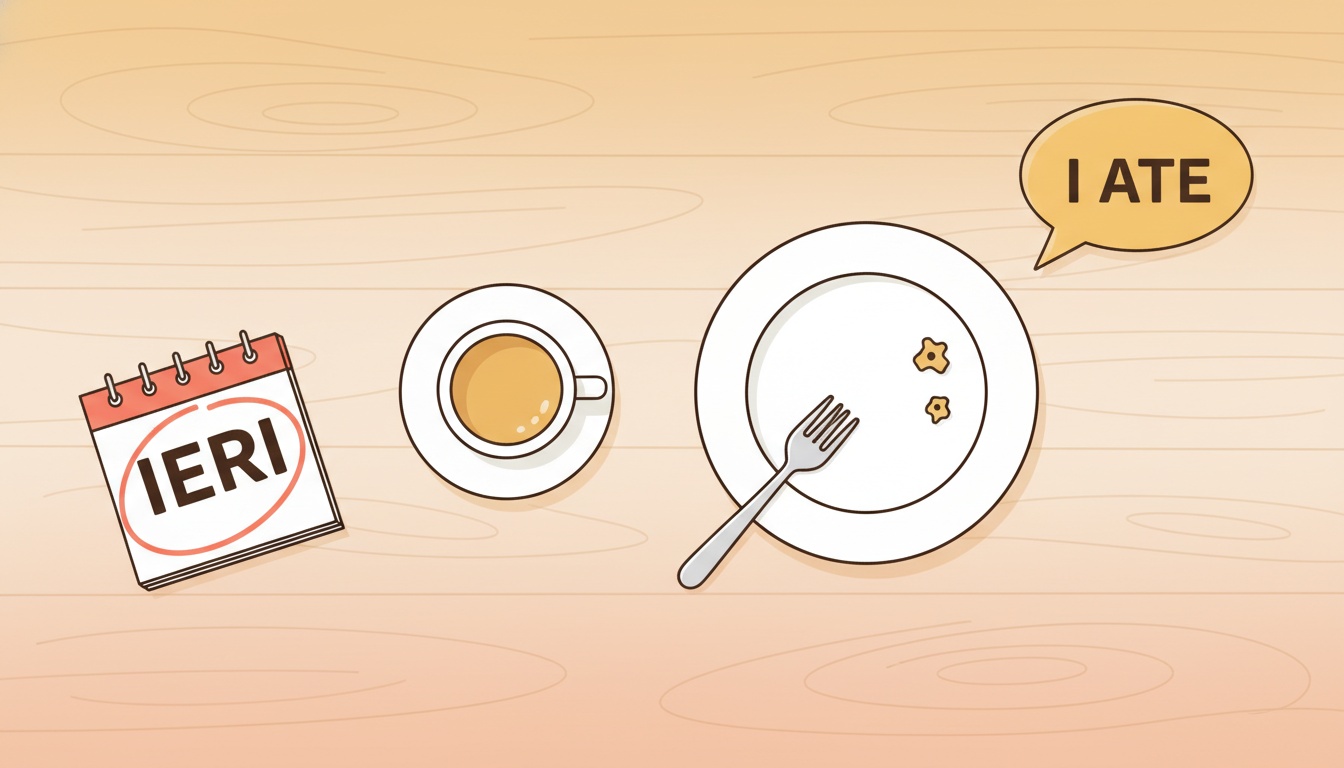
"I have seen this movie yesterday." If that sentence sounds completely fine to you, you are an Italian speaker and your brain is about to learn something it has been quietly getting wrong since your first English lesson. That single construction, perfect English present perfect form plus a specific past time, is the fastest-recognized marker of Italian English. It isn't a vocabulary or grammar gap. It's the right rule applied to the wrong language.
Once you see the rule, the fix is one question long.
The sentence that gives you away
"When I was a child I have lived in Rome." "Yesterday I have gone to the gym." "I have called you two days ago and you didn't answer." These are sentences a fluent Italian speaker can produce in English under no pressure at all, and they sound wrong to a native English ear within the first three words. The original Italian is the giveaway: Quando ero piccolo ho vissuto a Roma. Ieri sono andato in palestra. Ti ho chiamato due giorni fa. Three sentences in passato prossimo. Three sentences that map word-for-word onto English present perfect. And three sentences that, translated that way, break the English they land in.
The form is parallel. Ho mangiato is auxiliary plus past participle. I have eaten is auxiliary plus past participle. Once your brain locks that onto a shape, every passato prossimo wants to come out the other side as English present perfect. The trouble is not the form. The trouble is what the form is for.
Same shape, opposite job
Italian passato prossimo is the default conversational past for completed actions. Treccani describes it as the standard past tense of modern spoken Italian. When you say ieri ho mangiato la pizza, the passato prossimo is doing the job that English assigns to the simple past. Yesterday I ate pizza. Past, done, anchored to a specific time.
English present perfect, despite the structural twin, is doing a different job entirely. Cambridge Dictionary is explicit about this: present perfect connects a past event to the present moment, and it is incompatible with specific past-time adverbials. I have seen this movie yesterday fails because yesterday anchors the event to a specific past point, and English refuses to let present perfect anchor that way. The same restriction is laid out in the British Council's simple past vs. present perfect reference: if you have a specific past time, you take simple past, every time.
So your Italian sentence ieri ho mangiato and the English sentence I have eaten yesterday look like translations of each other. They aren't. They are two different tenses that share a haircut.
A note on the form itself: Italian and English are structurally similar here but not identical. English always uses have as the auxiliary; Italian splits between avere and essere depending on the verb (ho mangiato but sono andato). The structural cousinhood is real. The functional gap is the bigger story.
Why your brain has no simple-past reflex
Italian does have a simple past form. It's called passato remoto: mangiai, andai, vissi, vidi. If you have read Manzoni or Calvino in school you know it. The catch is that in modern conversational Italian, especially in the north and center, passato remoto is mostly literary or formal. Southern speakers, especially in Sicily and Calabria, still use it in everyday speech, but for most Italian learners arriving at English, the conversational simple past is not a tense they had to reach for in their own language.
This is the structural reason the error is so persistent. Your L1 trained you to use one tense, passato prossimo, for the bulk of the conversational past (Italian imperfetto handles habitual or ongoing past, which is a separate problem). English splits that territory in half and asks you to choose between simple past and present perfect every time you talk about something that already happened. It's a category your Italian instincts didn't build. Mandarin speakers run into something similar from the opposite direction: their L1 doesn't conjugate verbs for time at all, so the question of which past tense never came up. Two L1s, two different gaps, same English-side fix.
The one-question test
The diagnostic is this: is there a specific past time mentioned or clearly implied?
If yes, use simple past. Not sometimes. Always. Yesterday, last week, two days ago, in 2020, when I was little, last summer, an hour ago, on Monday all force simple past. The instant one of these is in the sentence, present perfect is off the table.
If no, present perfect is on the table, depending on what you actually mean. Ever, never, already, just, yet, so far, for ten years, since 2015 are the markers that lean the other way.
A short reference:
| Time marker | Tense |
|---|---|
| yesterday, last week, two days ago, in 2020, when I was 10 | Simple past |
| ever, never, already, just, yet, so far | Present perfect |
| for + duration, since + start point (ongoing now) | Present perfect (or continuous) |
The one-question test catches the majority of Italian transfer errors before they leave your mouth. The remaining cases turn on whether the action is connected to now, which is the next section.
Try it in Conversa
Practice with AI characters who adapt to your level and give real-time feedback.
Try Conversa FreeWhen the present perfect is actually right
I have visited Rome. That sentence is doing one of the three things present perfect is actually for in English: naming a life experience with no specific time attached. The other two jobs are recent action with current relevance, and ongoing-from-past-to-present. Outside those three, simple past wins by default.
The first job is life experience with no specific time. I have visited Rome. Have you ever tried tiramisu? She has never flown before. No when. The point is whether the experience happened at any point up to now.
The second is recent action with current relevance. I have just finished. He has already eaten. They haven't called yet. The action sits in the past but matters right now.
The third is ongoing from past to present. I have lived here for ten years. We have been waiting since 8 a.m. The action started in the past and is still going.
Outside these three jobs, default to simple past. Ieri ho cenato con Marco is not life experience, not current relevance, not ongoing. It's anchored to ieri. So in English: Yesterday I had dinner with Marco. Simple past. No exceptions.
A drill that rewires the reflex
Take ten Italian sentences in passato prossimo with explicit time markers and translate each as English simple past. Read each pair aloud once. Five minutes a day. Two weeks.
- Ieri ho mangiato la pizza. → I ate pizza yesterday.
- L'anno scorso sono andato in Italia. → I went to Italy last year.
- Due giorni fa ho visto questo film. → I saw this movie two days ago.
- Nel 2020 ho finito la scuola. → I finished school in 2020.
- La settimana scorsa ho iniziato il nuovo lavoro. → I started my new job last week.
- Stamattina ho bevuto un caffè. → I had a coffee this morning.
- Tre anni fa ho conosciuto mio marito. → I met my husband three years ago.
- Quando ero piccolo ho vissuto a Roma. → When I was little, I lived in Rome.
- L'estate scorsa ho imparato a nuotare. → I learned to swim last summer.
- Ieri abbiamo cenato insieme. → We had dinner together yesterday.
What the drill does that grammar-rule memorization doesn't: it forces your mouth to break the form-to-form mapping that Italian built. Every time you say the English version aloud and notice it isn't I have eaten yesterday, the link weakens. After enough reps the question "is there a specific past time?" runs in the background, and the right tense comes out before you think about it.
Conversa is an AI conversation partner you can rehearse this with at your own pace, and it'll catch the slip in real time. The drill works without any tool though. The drill is the point.
The pronunciation tag-along
When you fix the tense, watch the -ed. Italian phonotactics like to add a small vowel after a final consonant, so walked often comes out walk-ed-a even when you have the right tense. That is the paragogic vowel, and it's the partner problem to this one. The grammar fix and the pronunciation fix click together: get both, and your past-tense English sounds like English, not like a translation.
The day ieri ho mangiato stops translating to I have eaten yesterday
The moment the rule lands is the moment you stop translating the form word-for-word and start matching the function. Ho mangiato ieri is one tense in your head and I ate yesterday is a different tense, and the bridge between them is the question about specific time. Ask it once before you speak. After a few weeks you stop asking, because the answer is already there.