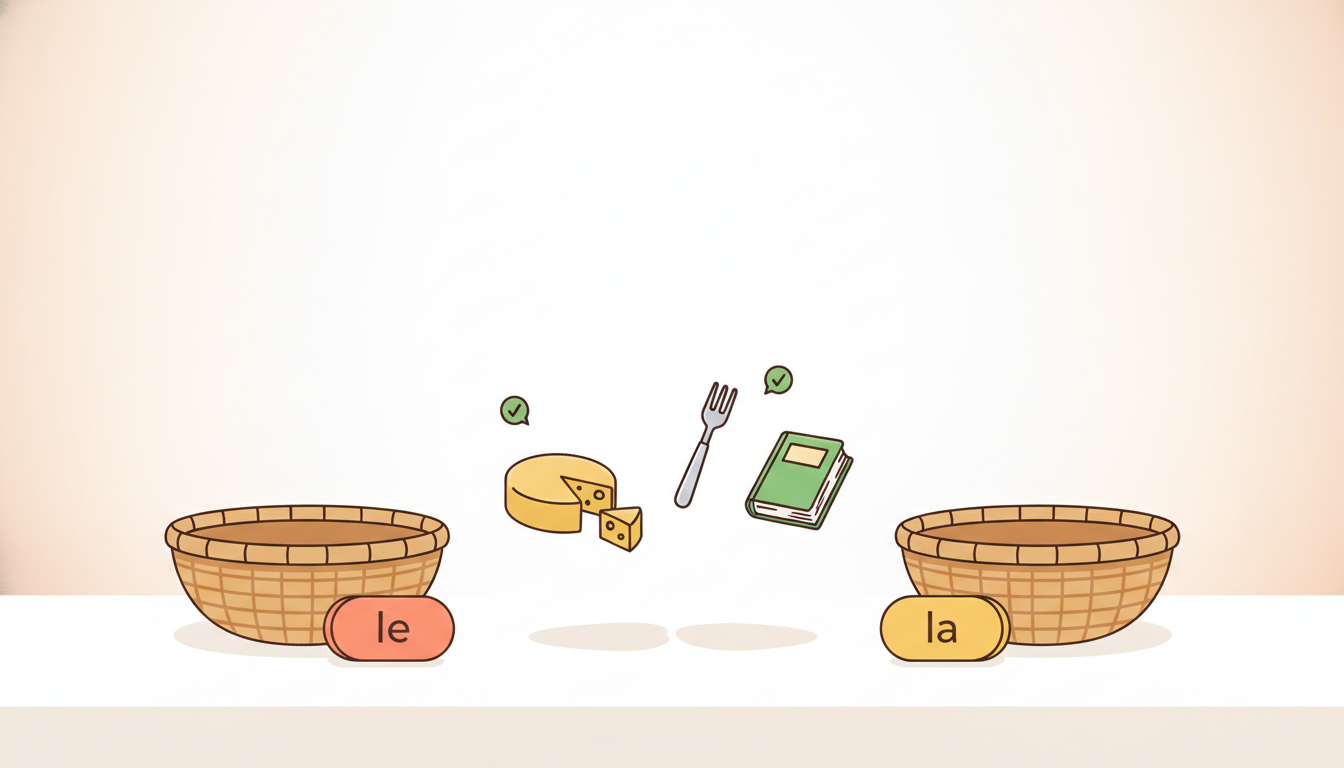
Say le livre and you mean a book. Say la livre and you mean a pound. Same letters, one different article, completely different word. French makes you bet le-or-la before you've even finished reaching for the noun, and every now and then the bet decides which word you actually said.
The advice you've probably heard is to memorize the gender of every noun, one by one. There are tens of thousands of them. Nobody does this, including French people, who simply absorbed it as toddlers over several years. You don't have several years and a French preschool. What you have instead is a set of word endings that predict gender most of the time, a short list of exceptions that actually show up in real life, and one habit that quietly does most of the work.
Learn the article with the noun, every single time
Here's the habit, and it's the whole game: never store a French noun by itself. Don't learn table. Learn une table. Don't learn fromage, learn le fromage. When the word and its article live in your memory as one chunk, you don't recall the noun and then panic about its gender. The gender comes free, glued to the front.
This sounds too simple to matter. It's the single piece of advice that experienced teachers repeat most often, and the one beginners ignore most often. The French Today team, run by native teacher Camille Chevalier-Karfis, makes the same point: stop writing vocabulary lists of bare nouns and always record the word with its article. Your flashcards should say une fourchette, not fourchette. Your notes should say le couloir, not couloir. It costs you one extra word now and saves you a guess every time you use it later.
The endings that lean feminine
A noun ending in -tion is almost always feminine: la nation, la question, la décision, la télévision. So is one ending in -té: la liberté, la santé, la beauté, la vérité. Add -ette (la fourchette, la baguette, la cigarette) and -ence or -ance (la patience, la science, la chance, la distance), and you've covered a big slice of everyday vocabulary.
The broad version of the rule: nouns ending in -e, and nouns ending in -ion, run feminine roughly 80% of the time. That last word matters. Roughly. Not always. But four times out of five is a very good bet when the alternative is a coin flip.
The endings that lean masculine
Flip to the other side. A noun ending in -age is usually masculine: le fromage, le voyage, le garage, le message. So are the ones ending in -ment (le gouvernement, le moment, le bâtiment), -eau (le bureau, le château, le couteau), -isme (le tourisme, le capitalisme, and yes, le féminisme, masculine despite what it means), and -oir (le couloir, le miroir, le devoir).
The strongest pattern of all hides in a single letter. Nouns ending in -t are masculine about 99% of the time: one source counted 2,723 masculine out of 2,754 -t nouns in the Dictionnaire de l'Académie française. Le chat, le lit, le climat, le restaurant. If you guess masculine on a word ending in -t, you will almost never be wrong.
The exceptions worth memorizing, and the ones to forget
Patterns that work 80% of the time break 20% of the time, and the trap is trying to learn every break. Don't. Learn the handful you'll actually trip over and let the obscure ones go.
The -age rule has a small club of feminine renegades, and they're common words: une page, une image, une plage (beach), une cage, une nage, une rage. Six words. Memorize those and the -age = masculine rule holds for everything else you'll meet for a long time.
Plage is one of the six feminine -age words: page, image, plage, cage, nage, rage.
The reverse happens with -ée, which is normally feminine (la journée, l'année, l'idée) but turns masculine in two words you'll use constantly: le musée (museum) and le lycée (high school). Two more to pocket: l'eau and la peau are feminine even though -eau is a masculine ending. And le silence is masculine even though -ence is feminine. On the -t side, the famous feminine exceptions are about half a dozen: la nuit, la mort, la part, la plupart, la forêt, la dent. That's a short enough list to learn in an afternoon.
Notice what just happened. You learned fewer than twenty exception words, not five thousand genders. That's the trade the "memorize everything" crowd never tells you about.
Try it in Conversa
Practice with AI characters who adapt to your level and give real-time feedback.
Try Conversa FreeWhy le vs la can change the whole word
Gender isn't only grammatical bookkeeping. Sometimes it's the difference between two unrelated meanings, and the ending won't help you because both versions look identical.
We started with le livre (book) and la livre (pound). There are more, and they're not rare:
Same letters, one different article, two unrelated words.
- le tour is a turn, a lap, or a trick; la tour is a tower.
- le mode is a method or a grammatical mood; la mode is fashion.
- un poste is a job or a TV set; une poste is a post office.
- le voile is a veil; la voile is a sail.
These are the words that punish a lazy guess. You can't pattern your way out of them, because the pattern points both directions at once. The only fix is the habit from the top of this post: you learned la tour as a unit the first time you met it, so the tower and the lap never get confused. French has plenty of other small traps that flip a word's meaning, including the false friends that look like English but aren't.
Your ear won't rescue you either
You might hope that listening to enough French will let you absorb gender without studying it. There's a catch built into the language: French hides the article exactly when you'd most want to hear it. Before a vowel or a silent h, both le and la collapse into l'. So l'eau, l'heure, l'arbre, l'ami, and l'hôtel all sound gender-neutral. The water (feminine), the hour (feminine), the tree (masculine), the friend, and the hotel (masculine) give your ear nothing to grab.
This is why you can't simply wait for gender to soak in. The spoken language erases the clue right at the words that begin with vowels, which are some of the most common words you'll use. You have to know that eau is feminine before you ever need to say de la bonne eau, because the moment you say l'eau, the sound stops telling you. If connected speech blurring word boundaries is eating your words in general, that's its own listening problem, the same way Korean's batchim liaison makes spelling stop predicting sound, but for gender specifically, the lesson is simple: learn it from the page, with the article attached, up front.
You don't need to be perfect
Here's the honest target. With the dozen endings above and a short exception list, you'll predict French noun gender correctly something like four times out of five. You will still get une page wrong the first time, and you'll second-guess le silence. That's fine. Native speakers occasionally hesitate on rare words too.
The goal was never a perfect score. It's to stop freezing before every noun and to make a fast, educated bet that's usually right, then learn the real answer the next time you meet the word with its article attached. Pick up new nouns as un/une + word from day one, lean on the endings when you're caught without one, and pocket that short exception list. Then go use them out loud with someone who'll correct you, because the gender you get wrong in a real conversation is the one you'll never forget again.