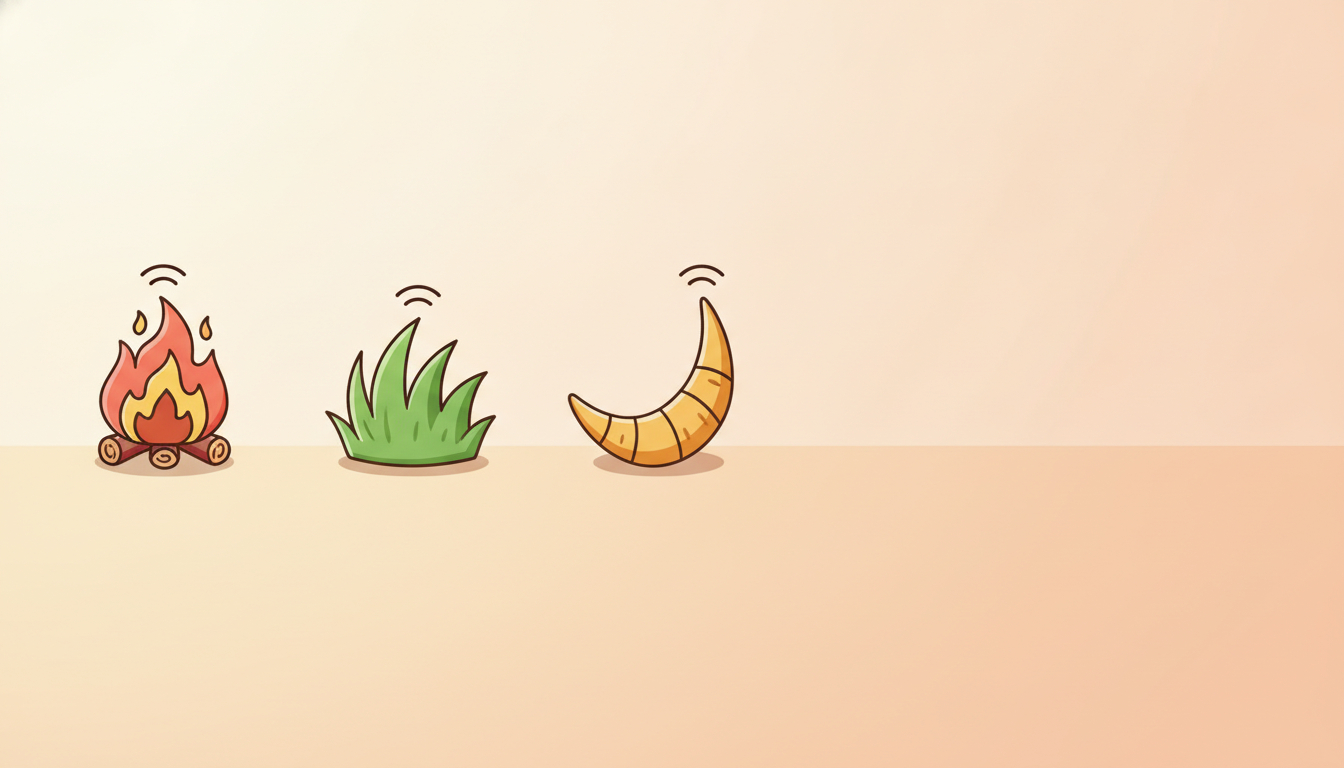
불 means fire. 풀 means grass. 뿔 means horn. Three different words, three different objects, and to an English-speaking ear they are the same word said three times with slightly different moods. You are not being careless. Your ears were trained on English, and English only sorts these sounds into two bins. Korean uses three: plain, aspirated, and tense.
Here is the part nobody tells beginners. The cue your textbook hands you for telling them apart is the wrong one. The breath you are told to listen for is the least reliable signal in the bunch. There is a better one, and Seoul has been quietly switching over to it for decades.
Why English ears only hear two of the three
English has a two-way split: b versus p, d versus t, g versus k. We call it voicing. The thing English speakers never notice is that aspiration, the little puff of air after a consonant, rides along automatically and means nothing to us. Say "pin" with your hand in front of your mouth, then "spin." The p in "pin" blasts air; the p in "spin" doesn't. Same letter, same meaning, and you have used the difference your whole life without once hearing it.
Korean took that puff of air you ignore and made it a difference that changes the word. It also has no voicing contrast at all. Instead it runs three voiceless categories: plain, aspirated, and tense. So 발 (bal) is foot and 팔 (pal) is arm. 방 (bang) is room and 빵 (ppang) is bread. The consonant is the whole story, and English gave you no slot to file it under.
The three series in sixty seconds
Plain consonants (ㅂ ㄷ ㄱ ㅈ) are light and slack. Low effort, almost lazy. Aspirated consonants (ㅍ ㅌ ㅋ ㅊ) come with a real puff of breath. Tense consonants (ㅃ ㄸ ㄲ ㅉ) are tight and sharp, the throat squeezed, no breath at all.
Most guides, like 90 Day Korean, teach this with a hand test, and it works for your mouth: hold a hand in front of your lips and say 풀. You'll feel air. Say 불. Barely a flutter. Say 뿔. Also barely a flutter, but it comes out harder and more clipped.
The hand test is a fine way to check what you're producing. It is a terrible way to hear what someone else is producing, because you can't put your hand in front of a stranger's mouth on the subway.
The cue your textbook skipped
The breath is unreliable, and there is an acoustic reason. The standard measure here is voice onset time: how long after the consonant the vocal cords start buzzing. For Korean plain stops that's roughly 20 to 50 milliseconds; for aspirated stops, roughly 90 to 125 (Wikipedia's voice-onset-time tables list the numbers). Those ranges sit close enough that in fast speech the plain and aspirated versions blur into each other. Your ear isn't broken. The signal genuinely overlaps.
Korean speakers, especially in Seoul, solved this for you by moving the contrast somewhere clearer. That somewhere is pitch. Linguists comparing Seoul recordings from 1935 with recordings from 2005 found the distinction shifting from voice onset time to pitch on the following vowel, and the change is close to complete among speakers born in the 1990s (Wikipedia's tonogenesis entry summarizes the study). Plain consonants start the next vowel low. Aspirated consonants start it high.
So stop straining for breath. Listen to where the vowel takes off. 불 dips in low. 풀 jumps up high. Once you hear the pitch instead of hunting for the puff, the plain-versus-aspirated wall starts to come down. Many learners find this pitch difference far easier to catch than the breath they were told to chase.
Romanization is what broke your ear
Look at how the triplet gets written in Roman letters: bul, pul, ppul. The first two look like opposites. The third looks like somebody leaned on the p key. Two of the three Revised Romanization spellings (the official system) make the tense consonant look like a typo of the plain one, when it is a completely separate sound.
Hangul does not lie to you the way romanization does. Plain is ㅂ. Add a stroke and you get the aspirated ㅍ. Double it and you get the tense ㅃ. Three shapes, three sounds, no guessing. Read 불, 풀, 뿔 from the start and the writing system does half the teaching for you. Read bul, pul, ppul and you've handed your ears a lie before you even hear the word.
Try it in Conversa
Practice with AI characters who adapt to your level and give real-time feedback.
Try Conversa FreeTrain your ears before your mouth
Most pronunciation advice puts production first: say it, record it, compare. For a three-way contrast your ears can't yet parse, that's backwards. You can't reliably make a sound you can't reliably hear.
Flip the order. Start with forced-choice listening. Get audio of the triplet (the Preply minimal-pairs guide uses this listen-choose-check-repeat loop), have it play 불, 풀, or 뿔 at random, and guess which one before you check. Get it wrong, note which pair fooled you, and run it again. Then move to 달 (dal), 탈 (tal), 딸 (ttal): moon, mask, daughter. Then 자다 (jada), 차다 (chada), 짜다 (jjada): to sleep, to kick, to be salty.
On the plain-versus-aspirated calls, listen for the pitch, not the breath. Did the vowel start low or high? Only once you can hear the contrast cold should you start producing it, and at that point this is the kind of thing an AI conversation partner like Conversa is genuinely useful for, because it'll let you fire off 불 and 뿔 a hundred times without a human getting bored. Drill 가 (ga) into 까 (kka), 방 into 빵, back and forth, until your mouth stops defaulting to the English halfway sound.
까다 is not 가다 said louder
Plain and aspirated at least map loosely onto sounds English already makes. The tense series is the one with no English hook at all, and it's where most learners give up and just say the plain version a bit louder.
Tense consonants are not "more breath." They're the opposite. The air gets held back while the throat tightens, what phoneticians call increased glottal tension (Wikipedia's fortis-consonant entry describes the mechanism). The result is short, hard, and a little explosive. 가다 (gada) is to go; 까다 (kkada) is to peel. 자다 is to sleep; 짜다 is to be salty. One informal trick that helps some people: say the syllable clipped and tight, the way you'd bite off a word when you're a little annoyed. It's not a textbook rule, but the tension it puts in your throat is close to the real thing.
What to do the next time you can't tell them apart
The next time 불 and 풀 sound identical, don't reach for the breath. Reach for the pitch: low start or high start. That single switch does more for your listening than another week of staring at romanization tables. Pull up the triplet right now and run ten forced-choice reps before you do anything else.
When the consonants start to click, the next layer waiting for you is what happens when those sounds bump into each other inside real words, the territory of batchim and liaison, where written Korean and spoken Korean stop matching up. That's the reason you can read a sentence perfectly and still miss it when a Korean says it out loud. One sound layer at a time.