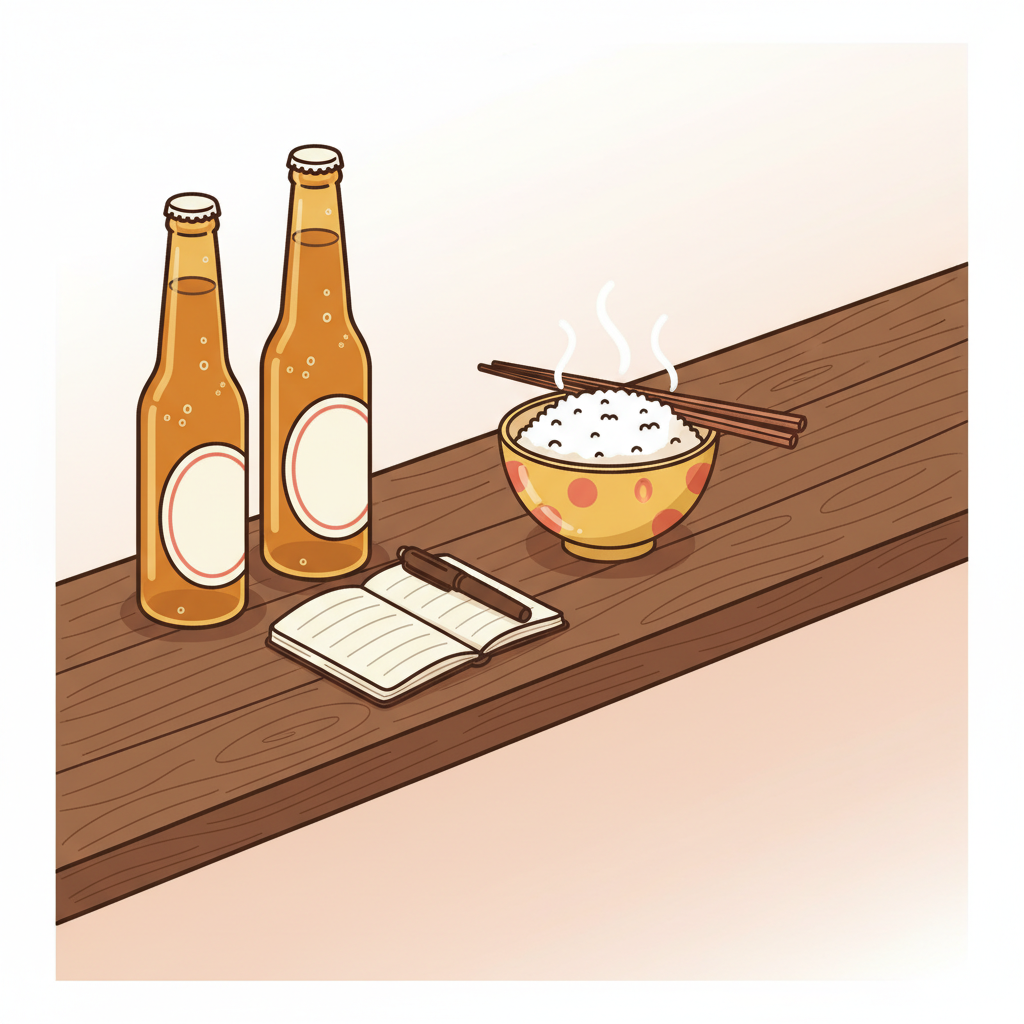
ビールを二本ください (biiru wo nihon kudasai) means "two beers, please." Say ni-hon instead of nihon and you've just asked for "two Japans." The counter 本 (hon), used for long, cylindrical things, fuses with the number and changes its pronunciation, and your first-year textbook probably buried this in a 30-row table you skipped.
That table is the problem. Counter sound changes look like chaos when you see all of them at once, but they run on three rules. Learn those three rules (plus one escape hatch) and you'll pronounce counters correctly more often than not.
The 12 counters that handle most everyday counting
Japanese classifies objects by shape. English does something similar in rare cases ("a sheet of paper," "a head of lettuce") but Japanese does it for everything. You can't just say "two" and point. You need a counter word between the number and the thing. (If you've studied Mandarin, you've seen a parallel system with measure words; Japanese counters work similarly but add pronunciation mutations. Korean runs the mutation the other way round, reshaping the number instead of the counter.)
Here are the twelve you'll use most:
- 本 (hon): long, cylindrical: pens, bottles, umbrellas, bananas
- 枚 (mai): flat, thin: paper, tickets, plates, T-shirts
- 個 (ko): small, compact: apples, eggs, boxes, candies
- 匹 (hiki): small animals: cats, dogs, fish, insects
- 頭 (tou): large animals: horses, cows, elephants
- 台 (dai): machines/vehicles: cars, computers, bicycles
- 人 (nin): people (irregular on 1 and 2; more below)
- 冊 (satsu): bound volumes: books, notebooks, magazines
- 杯 (hai): cups and bowls: coffee, rice bowls, glasses of beer
- 着 (chaku): clothing: suits, dresses, kimonos
- 軒 (ken): buildings: houses, shops, restaurants
- 回 (kai): occurrences: times, rounds, meetings
You don't need all twelve right away. 本, 個, 枚, and 人 carry you through most beginner conversations. The rest fill in as you encounter them.
Three rules that predict the sound changes
Counter mutations follow the initial consonant of the counter, and they cluster around the same numbers: 1, 6, 8, and 10. Those four positions are where the trouble is. Everything else stays regular.
p-row counters: 本, 匹, 杯
Counters starting with h (like 本 hon, 匹 hiki, 杯 hai) change the most. On 1, 6, 8, and 10, the h hardens into a doubled p (this doubling is called gemination). On 3, the h softens into b: a voiceless consonant gains voicing after ん, a change that looks a lot like rendaku, the voicing that turns かみ into the がみ of 手紙.
Here's 本 across all ten:
- ippon (いっぽん): not ichi-hon
- nihon (にほん)
- sanbon (さんぼん): h becomes b
- yonhon (よんほん)
- gohon (ごほん)
- roppon (ろっぽん)
- nanahon (ななほん)
- happon (はっぽん)
- kyuuhon (きゅうほん)
- jippon (じっぽん)
The identical pattern holds for 匹 (ippiki, sanbiki, roppiki, happiki) and for 杯 (ippai, sanbai, roppai, happai). One rule, three counters.
1, 6, 8 and 10 harden the h of 本 into a doubled p: ippon, roppon, happon, jippon.
k-row counters: 個, 回, 軒
Counters starting with k (個 ko, 回 kai, 軒 ken) geminate on the same four positions (1, 6, 8, 10) but skip the rendaku step. Three stays clean.
個 at the key numbers:
- ikko (いっこ)
- sanko (さんこ): regular, no voicing
- rokko (ろっこ)
- hakko (はっこ)
- jikko (じっこ)
You'll hit this pattern when counting how many times you've been somewhere: 一回 is ikkai, not ichi-kai. 映画を3回見ました (eiga wo sankai mimashita), "I watched the movie three times." No sound change on three, because k-row skips rendaku.
s-row counters: 冊, 歳
Counters starting with s (冊 satsu, 歳 sai) have the narrowest trigger set: gemination only on 1, 8, and 10. Six doesn't cause a change here.
冊 at the key numbers:
- issatsu (いっさつ)
- rokusatsu (ろくさつ): stays regular
- hassatsu (はっさつ)
- jissatsu (じっさつ)
You'll run into 歳 (sai) the moment someone asks your age. 一歳 is issai, not ichi-sai. 二十歳 (hatachi, twenty years old) is its own special reading entirely (its old native はた, "twenty," also turns up in はつか, the 20th of the month), used because twenty is the age of majority in Japan.
That's it. Three consonant rows, one shared principle: the numbers 1, 6, 8, and 10 are where sounds collide. If you can flag those four positions in your head, you'll hear the mutation coming before you say it.
The people exception and the rabbit loophole
Not everything follows rules. The people counter 人 uses native Japanese readings for one and two (一人 hitori and 二人 futari) then flips to Sino-Japanese from three onward: 三人 sannin, 四人 yonin, 五人 gonin.
Notice that four is yonin, not shinin. The word 死人 (shinin) means "dead person." Four and nine both carry superstitious baggage in Japanese: hospitals skip floor 4, hotels dodge room numbers with 4 and 9. The number avoidance bleeds into counter pronunciation.
And then there are rabbits. In Japanese, rabbits get counted with 羽 (wa), the counter for birds. The popular story: Buddhist monks, forbidden from eating four-legged animals, reclassified rabbits as birds so they could keep eating them. Whether that's the real origin is debated (Tofugu notes nobody knows for sure) but the counter stuck. うさぎ一羽 (usagi ichiwa): one rabbit, counted like a sparrow.
No pattern covers hitori and futari. You memorize them the way English speakers memorize "children" instead of "childs."
The 〜つ escape hatch
Blanking on which counter to use for oranges? Use 〜つ. The native Japanese counting system (hitotsu, futatsu, mittsu, yottsu, itsutsu, muttsu, nanatsu, yattsu, kokonotsu, too) works as a generic fallback for almost any object from 1 to 10.
りんごを3つください (ringo wo mittsu kudasai, "three apples, please") sounds completely natural at a convenience store. Nobody will correct you for using 〜つ instead of 個. It's the safe choice when your brain freezes on the specific counter.
Two limits to know: 〜つ only goes to ten, and it sounds odd for people or animals where the specific counter is strongly expected. You can't swap hitori for hitotsu when asking for a table at a restaurant; people always get 人.
Try it in Conversa
Practice with AI characters who adapt to your level and give real-time feedback.
Try Conversa FreePutting it together at a restaurant
You're at an izakaya with three friends. Here's the first two minutes:
You: 4人お願いします。(Yonin onegai shimasu.: "Four people, please.")
Waiter seats you. Menus appear.
You: ビールを2本ください。(Biiru wo nihon kudasai.: "Two beers, please.")
Friend: 枝豆を1つと、唐揚げを1つ。(Edamame wo hitotsu to, karaage wo hitotsu.: "One edamame and one fried chicken." Using 〜つ because who knows the counter for a plate of karaage?)
You, two rounds later: 二本目のビールお願いします。(Nihonme no biiru onegai shimasu.: "A second beer, please." The suffix 目 -me turns the counter into an ordinal.)
Four counters in one scene: 人 for people, 本 for bottles, 〜つ as a fallback, 目 for "the second one." If you're working on Japanese particles too, が and を play different roles in those sentences; that's covered in this particles guide.
人 for people, 本 for bottles, 〜つ when you don't know the counter.
Next time you order a drink in Japanese, try ビールを2本ください. If nihon rolls off your tongue without hesitation, the p-row rule has already stuck. The irregular ones (hitori, futari, the rabbit-birds) just take repetition. Three rules and one escape hatch beat a table you'll never memorize.