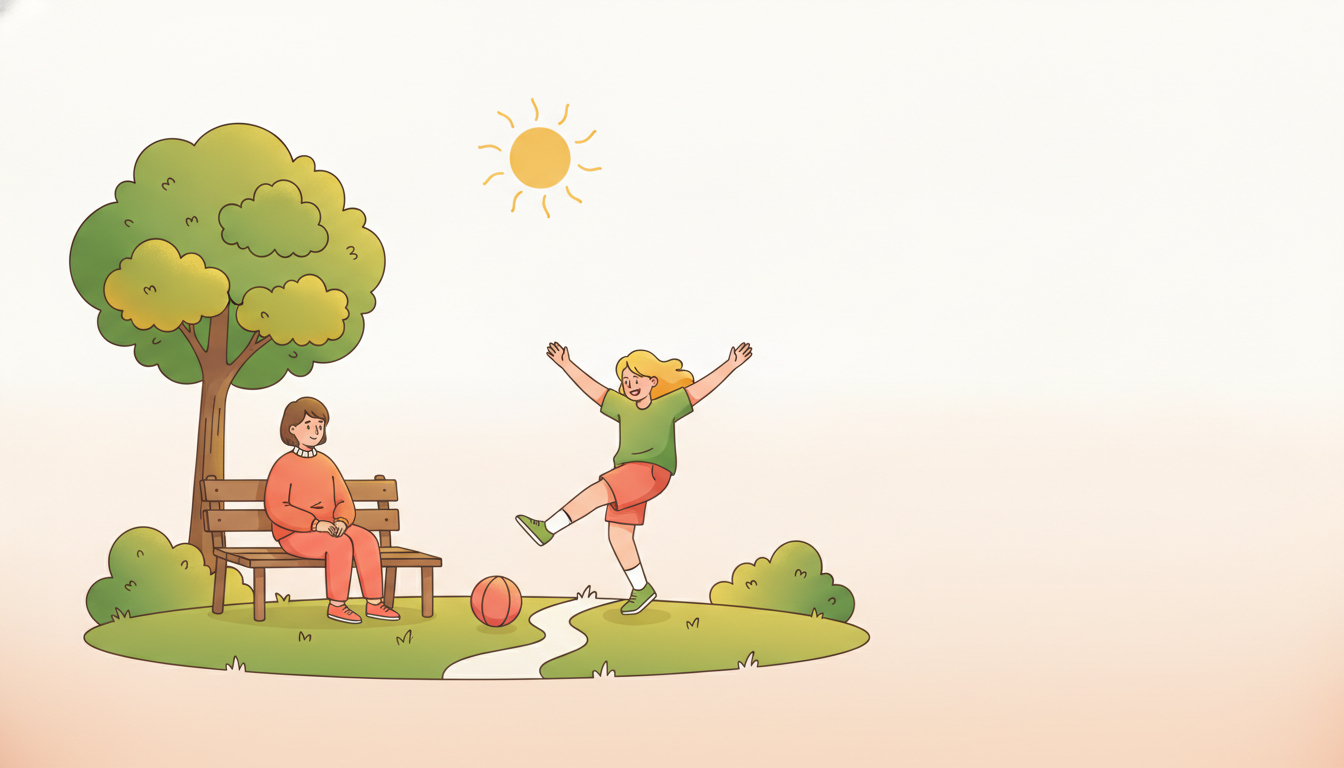
公園にいる and 公園で遊ぶ both come out as "at the park" in English. Kouen ni iru. "I'm at the park." Kouen de asobu. "I play at the park." Same noun, 公園, same little English word "at," and two different Japanese particles that are not interchangeable. Swap them and a Japanese speaker will understand you, then quietly file you under "still guessing." Most beginners do guess, and they get it right about half the time.
There is a rule underneath, and it is almost embarrassingly simple. You don't need eleven use-cases. You need one test, plus a short list of cases that sit just outside it. If you've already wrestled は and が into place, this is the same kind of fix: stop translating the particle and start reading the verb.
The one test: does something exist, or does something happen?
に marks where something is or where it is headed. で marks where an action gets done.
That's it. Run it on the pair above. いる ("to exist, to be") isn't an action, it's just being somewhere, so 公園にいる. 遊ぶ ("to play") is something you actively do, so 公園で遊ぶ. The noun never changed. The verb decided everything.
English hides this because "at," "in," and "on" are about space, full stop. Japanese particles aren't about space. They're about the job the noun is doing in the sentence. Wikipedia's particle reference states the split directly: に for location is used with stative verbs like いる "to be, exist," while で is used with action verbs to mark the place of the action. Tae Kim's grammar guide draws the same line with the same kind of examples. Once you hear "exist vs. happen" instead of "at vs. at," the fog lifts.
に: where something sits or is going
Start with the verbs that lock in に no matter what. The existence verbs, いる (for living things) and ある (for objects), always take に for location:
猫は部屋にいる。 Neko wa heya ni iru. "The cat is in the room." 駅の前に銀行がある。 Eki no mae ni ginkou ga aru. "There's a bank in front of the station."
住む ("to live somewhere") behaves the same way, and this is the one that trips people:
東京に住んでいる。 Toukyou ni sunde iru. "I live in Tokyo." ✓ 東京で住んでいる。 ✗
"Live" feels like an activity in English, so で is tempting. But 住む describes a state of existing in a place, not an action you perform there, so it wants に. Write 東京で住んでいる and that's exactly the sentence a teacher will circle in red.
The same に also marks where you're headed. Destination and direction:
学校に行く。 Gakkou ni iku. "I go to school." 日本に来た。 Nihon ni kita. "I came to Japan."
If you squint, "exists somewhere" and "moving toward somewhere" are the same idea: に points at the spot, whether you're sitting in it or aiming at it. That same "point at the endpoint" feeling is why に also marks the person you give something to (友達にあげる, "give to a friend"). You don't need to memorize that as a separate rule. It's the same arrow.
で: where the action happens, and what you use to do it
公園で遊ぶ again. で plants the action in a place:
図書館で勉強する。 Toshokan de benkyou suru. "I study at the library." 映画館で見た。 Eigakan de mita. "I watched it at the movie theater."
Here's the part the other guides treat as a separate chapter, and shouldn't. The exact same で also marks the means, the tool, the material, the language. Watch how it's all one idea:
バスで帰る。 Basu de kaeru. "I go home by bus." 箸で食べる。 Hashi de taberu. "I eat with chopsticks." 日本語で話す。 Nihongo de hanasu. "I speak in Japanese." 木で作る。 Ki de tsukuru. "I make it out of wood."
The thread tying location and instrument together: で marks the setting the action runs on. A park is the setting. A bus is the setting. Japanese is the setting. Wood is the setting. Tofugu's に vs で guide walks through the same range of で uses. English splits these into "at," "by," "in," "out of," and four other prepositions, which is exactly why it never clicks if you translate word for word.
The pair that makes it stick: 黒板に書く vs ペンで書く
Take one verb, 書く ("to write"), and watch both particles show up in the same breath:
黒板に書く。 Kokuban ni kaku. "Write on the blackboard." ペンで書く。 Pen de kaku. "Write with a pen."
The blackboard is where the writing lands, the surface it ends up on, so に. The pen is what you're using to do it, the instrument, so で. Now put them together:
黒板にペンで書く。 Kokuban ni pen de kaku. "Write on the blackboard with a pen."
One sentence, both particles, zero conflict, because they're answering two different questions: where does it land (に) and what does it run on (で). If you can feel why this sentence needs both, you've got the rule.
Try it in Conversa
Practice with AI characters who adapt to your level and give real-time feedback.
Try Conversa FreeThe て-いる trap
Beginners see 公園で遊んでいる and start second-guessing. The verb's in its -ている form now, so does the particle change? No.
公園で遊んでいる。 Kouen de asonde iru. "I'm playing at the park." 公園にいる。 Kouen ni iru. "I'm at the park."
-ている doesn't touch the particle. 遊ぶ is an action whether it's happening once or right now in progress, so the location stays で. いる is existence, so it stays に. The verb decides, every time. The ending you bolt onto it doesn't get a vote.
に for clock time, but not for "tomorrow"
7時に起きる. Shichi-ji ni okiru. "I wake up at seven." に anchors a specific point on the clock or the calendar:
月曜日に会う。 Getsuyoubi ni au. "I'll meet you on Monday." 3月に卒業する。 Sangatsu ni sotsugyou suru. "I graduate in March."
But relative time words, the ones that float depending on when you say them, take no particle at all. 今日 (today), 明日 (tomorrow), 来週 (next week):
明日行く。 Ashita iku. "I'll go tomorrow."
Not 明日に行く. A clock time is a fixed slot you can point に at. "Tomorrow" isn't a fixed slot, it's relative to right now, so there's nothing to anchor. When you can name the exact time (7時, 月曜日, 3月), use に. When the word just means "soon-ish relative to now," drop the particle.
The two に's that aren't about place at all
医者になる, "I'll become a doctor," uses に for something that isn't a place at all. Two more uses look like neither existence nor destination, but follow the same "endpoint" logic once you see it:
医者になる。 Isha ni naru. "I'll become a doctor." コーヒーにする。 Koohii ni suru. "I'll go with the coffee." (ordering)
〜になる is "become," and 〜にする is "decide on" or "I'll have." In both, に marks the result you land on, the doctor you turn into, the coffee you settle on. It's the same に from 学校に行く, just pointed at an outcome instead of a place. You arrive at being a doctor the way you arrive at school.
Your ten-second check
Before any sentence with a place, a tool, or a time in it, ask in order:
- Does the verb just say something exists or is going somewhere? に. (いる, ある, 住む, 行く, 来る)
- Does the verb do an action in that place? で. (遊ぶ, 食べる, 勉強する)
- Is the noun a means, a tool, a material, or a language? で. (バス, 箸, 木, 日本語)
- Is it a clock time or a calendar date? に. (7時, 月曜日)
- Is it the result of becoming or deciding? に. (医者, コーヒー)
That covers what an N5 or N4 learner actually runs into. The edge cases exist, and you'll meet them later, but you don't need them to stop guessing today.
Try this: take the last three Japanese sentences you wrote and find every に and で in them. For each one, say out loud whether the verb is existence-or-direction or action. If the particle disagrees with the verb, you just caught the error yourself. Do that for a week and the test stops being a checklist and starts being a reflex.