학교에 가요. Hakgyo-e gayo. "I go to school." 학교에서 공부해요. Hakgyo-eseo gongbuhaeyo. "I study at school." Same school, same polite -요 ending, and one extra syllable that Korean beginners spend months putting in the wrong place. English translates both sentences with prepositions so small you have never once thought about them. That's the whole problem.
Most textbooks handle the two Korean location particles with a table: 에 gets five bullet points, 에서 gets four, and you're left to memorize nine facts. You don't need nine facts. You need one question, and this post is about learning to ask it.
Why English never prepared you for this
"I'm at school." "I'm going to school." "I studied at school." Three sentences, one preposition doing almost nothing. English lets "at" and "to" blur into the background because English marks who-did-what with word order, and location is an afterthought.
Korean makes you commit. Is the school a place you exist at or arrive at? That's 에 (e). Is the school a place where an action plays out? That's 에서 (eseo). The language forces a distinction your brain has been ignoring since you learned to talk, and that's why the mistake survives long after you've "learned the rule." You're fighting a habit, and the fix is a question fast enough to outrun the habit.
The one question that picks between 에 and 에서
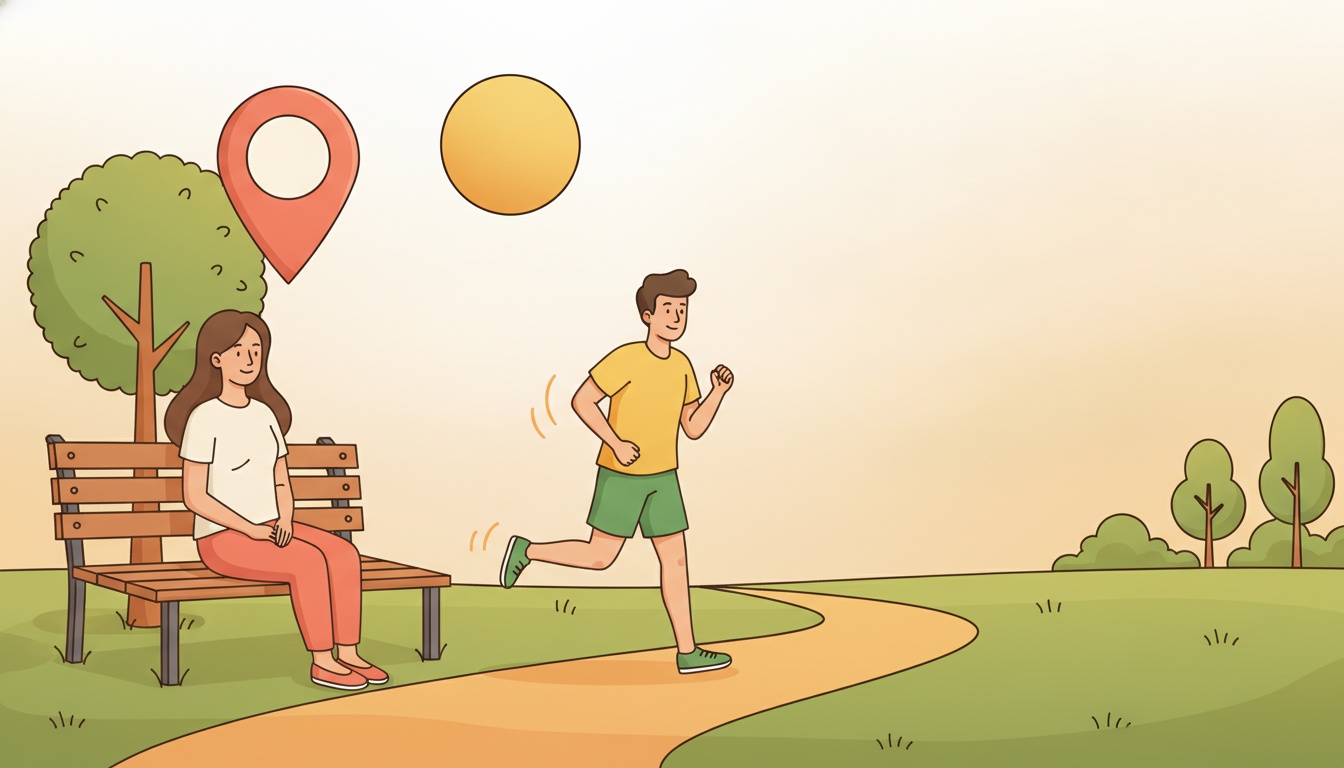
그는 집에 있어요. Geuneun jib-e isseoyo. "He is at home." 그는 집에서 요리를 해요. Geuneun jib-eseo yorireul haeyo. "He cooks at home." Same man, same home. In the first sentence he just exists there. In the second, something is happening: knife sounds, oil in the pan, an event in progress.
So before the particle leaves your mouth, ask: is something happening at this place?
- Something is happening there (studying, eating, meeting, working) → 에서
- Something just is there, or is headed there → 에
Run it across the standard cases and watch it hold:
- 우리는 공원에 있어요 = We're in the park. (Existing. Nothing unfolds. 에)
- 우리는 공원에서 운동해요 = We exercise in the park. (Exercise unfolds. 에서)
- 친구가 한국에 왔어요 = My friend came to Korea. (Arrival, an endpoint. 에)
- 식당에서 친구를 만났어요 = I met a friend at the restaurant. (The meeting happened there. 에서)
- 택시가 호텔에 도착했어요 = The taxi arrived at the hotel. (Arriving is landing, and landing is 에)
This is the same functional split that 90 Day Korean describes as action location versus simple location, and the rule HowToStudyKorean teaches in Lesson 12. The difference is that as a question, you can actually use it mid-sentence. Tables don't fit in working memory. One question does.
The 있다 trap
있다 and 없다, the verbs of existing and not existing, take 에 every single time. 집에 있어요, "I'm at home." 집에서 있어요 is flatly wrong, and it's probably the particle mistake you'll hold onto longest, because English intuition fights you hardest right here.
Here's why. When you say "I'm at home," you picture yourself doing things: lounging, snacking, watching something. To an English speaker, being home feels active. But 있어요 doesn't say any of that. It only says you exist there, and existing is not a happening.
Run the question honestly and the trap disappears: is anything happening in the sentence 집에 있어요? No. Just being. 에.
If you want to talk about what you're actually doing at home, the verb changes, and the particle follows it: 저는 집에서 일해요, "I work at home."
살다, the verb that refuses to choose
서울에 살아요 and 서울에서 살아요 both mean "I live in Seoul," and both are completely natural. Living is the one verb where Korean lets you have it either way, which makes sense once you notice that living is genuinely both things: you exist in Seoul, and your life happens there. A TOPIK prep guide lists 살다 as the standard exception.
Some Korean teachers describe a shade of difference, with 에 pinning your address on a map and 에서 leaning toward the day-to-day living you do there. Miss Elly Korean frames it as a spot versus a space. Treat that as a tendency natives feel rather than a rule you'll be graded on. Either particle is correct, and no one will blink.
The same two particles moonlight
3시에 만나요 = Let's meet at 3 o'clock. 월요일에 = on Monday. 여름에 = in summer. The particle 에 also marks points in time, and the mental picture is the same one: a point you land on. A moment on the clock works like a spot on the map.
A handful of time words refuse the particle, and you'll meet three of them in your first week: 오늘 (today), 내일 (tomorrow), and 어제 (yesterday) all stand alone. 오늘에 is a mistake every beginner makes about a week in. Just 오늘 뭐 해요?, "What are you doing today?"
에서 has a second job too: "from." 저는 미국에서 왔어요, "I came from America," which is in the first ten sentences of nearly every Korean course. The picture still works if you squint: 에서 marks the zone an event unfolds in, or comes out of. So the full map is two images, a point (에) and a zone (에서), instead of nine memorized bullet points.
Try it in Conversa
Practice with AI characters who adapt to your level and give real-time feedback.
Try Conversa FreeError autopsy: the two sentences every beginner breaks
First: 집에 공부해요, intended as "I study at home." Ask the question. Is something happening at the house? Yes, studying, an event with a beginning and an end. So it has to be 집에서 공부해요. The error happens because "at home" is frozen as a chunk in your English brain, and the chunk arrives carrying 에 from sentences like 집에 있어요 where it was correct.
Second: 파티에서 가요, intended as "I'm going to the party." It feels right because parties are the most happening-ish places you can name. But the question applies to the sentence, never to the place on its own. What does 가요 say is happening at the party? Nothing. Going only points at a destination; the party is the arrow's endpoint, and endpoints take 에. 파티에 가요.
The eating and the dancing come later, with their own verbs, and those verbs will take 에서, the same pattern as 우린 공원에서 타코를 먹었어요, "We ate tacos at the park." Same kind of place, both particles, depending on what the verb claims is going on. That's the entire system.
Make the question a reflex
Take ten Korean sentences you already know, strip the particles out, and re-pick each one by asking the question out loud: is something happening there? You'll get most of them right immediately, and the ones you miss (있다 sentences, usually) are exactly the ones worth drilling. Then do it at speaking speed, because reading speed isn't where particles fail.
Speaking speed is hard to practice alone, though. An AI conversation partner like Conversa is useful precisely here: you can burn through dozens of 에/에서 decisions in a ten-minute conversation about your day, and a mistake costs you nothing. Particles only become automatic through volume.
One honest warning: this question covers location particles, and Korean has many more particles beyond these two. If 은/는 versus 이/가 is your current wall, that pair needs a different set of tests, because it marks information flow rather than place. But 에 versus 에서 is the rare grammar point you can genuinely finish. One question and two pictures, and the table you were dreading turns out to be optional.