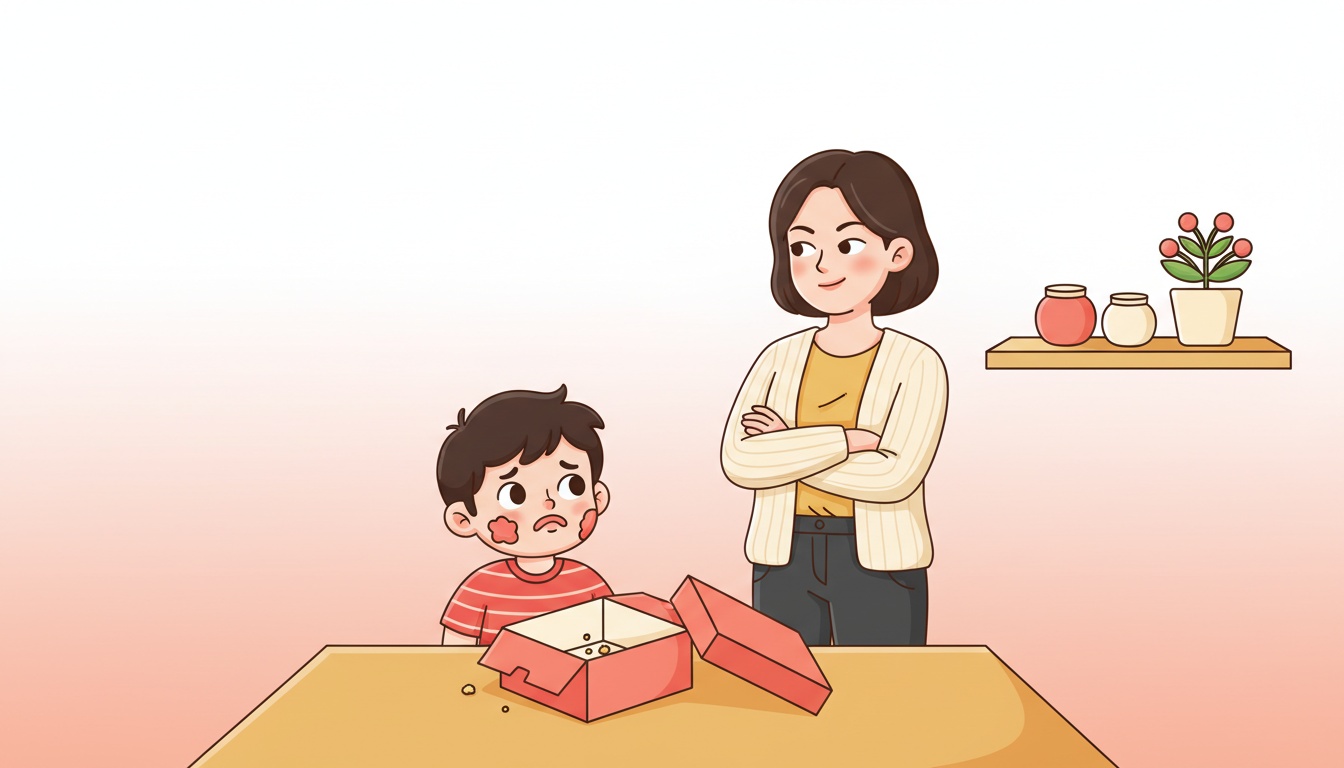
"형아가 먹었어?" the mom asks. Hyung-a-ga meogeosseo?: "Did your older brother eat it?" The kid, half-frosting on his chin, answers 나는 안 먹었어. Na-neun an meogeosseo. Mom walks into the kitchen, opens the empty cake box, and deadpans: 내가 먹었어. Nae-ga meogeosseo. Three sentences, same pronoun in two of them, two different particles. The kid picks 는. Mom picks 가. Neither is wrong, because the particle isn't doing the thing your textbook said it was doing.
Your textbook probably told you 은/는 is a "topic particle" and 이/가 is a "subject particle." Some posts will tell you they're almost interchangeable. They are not. The rule that actually predicts native usage is simpler and weirder than either: 은/는 marks information the listener already knows about, and 이/가 marks information that's new to the conversation. Every other distinction, including the contrast feeling, the "who did it" test, and the embedded-clause rule, falls out of that one principle.
The kid uses 는 because he's not the new information; his innocence is. Mom uses 가 because her identity as the cake eater is the news. Same sentence shape, different discourse job.
Here are the four tests you can run on any sentence you're about to say. Each one comes from the same underlying idea, so once they click, you stop memorizing rules and start hearing the particle the sentence wants.
The core: 은/는 is what we're already talking about, 이/가 is what's new
Take the canonical minimal pair that every Korean grammar book eventually reaches for. 제이슨은 의사예요 (Jeiseun-eun uisa-yeyo) and 제이슨이 의사예요 (Jeiseun-i uisa-yeyo) both translate into English as "Jason is a doctor."
In the first, Jason is what the conversation is already about, and his job is the news. Answer to What does Jason do?
In the second, being a doctor is already on the table, and Jason's identity is the news. Answer to Who's the doctor?
English has to strain to show this. We'd say "Jason is the doctor" with stress on Jason, or use a cleft: "Jason is the one who's a doctor." Korean just swaps one syllable. Fluent in Korean describes it as 이/가 pointing to what precedes the marker and 은/는 pointing to what follows, which is the same idea in different words: the new information lives on the 이/가 side.
If you already fought this battle in Japanese, the parallel is exact. は and が do the same job in Japanese that 은/는 and 이/가 do in Korean. Koreans and Japanese didn't copy each other; the two languages independently grew the same information-flow distinction that English never developed.
Test 1: The "where did that come from?" test
동네에 새로운 식당이 생겼어요. 그 식당은 인기가 많아요. Dongne-e saeroun sikdang-i saenggyeosseoyo. Geu sikdang-eun ingi-ga manayo. "A new restaurant appeared in the neighborhood. That restaurant is really popular." First mention of the restaurant takes 이. Second mention, now that it's known, takes 은. If a noun is showing up in the conversation for the first time, walking onto the stage, it takes 이/가. LTL Korea's particle guide walks through this exact presentational flip.
The clean case is weather. 비가 와요 (Bi-ga wayo). "It's raining." The rain is new. It just started falling into the conversation. You would not say 비는 와요 to report the weather, because 는 implies the rain is something the listener was already tracking. Saying 비는 와요 would mean something like "the rain, yes, it's coming, as opposed to something else," which is a contrast the listener didn't ask for. Natural phenomena live on the 이/가 side of the fence.
Test 2: The "who question" test
Q: 누가 1등 했어? Nuga ildeung haesseo? "Who got first place?" A: 지수가 1등 했어. Jisu-ga ildeung haesseo. "Jisoo got first."
Never 지수는. If you hear a learner answer 지수는 1등 했어, they're telling you something subtly off: "as for Jisoo, she got first," which carries the implication that someone else didn't. Any question built around 누가 (who), 뭐가 (what), or 어디가 (where) forces 이/가 in the answer. The whole point of the question is to identify who the actor is, and the actor's identity is, by definition, the new information. Miss Elly Korean lays this out as a dedicated rule, but it's really just the core principle in disguise.
The mirror case: when the question is about the predicate, not the actor, the actor takes 은/는. Someone asks what you do. 저는 학생이에요. Jeo-neun haksaeng-iyeyo. "I'm a student." You (the speaker) are not the news; your job is. Same logic, different side of the information flow.
Test 3: The "but..." test
어제는 더웠어요. 오늘은 추워요. Eoje-neun deowosseoyo. Oneul-eun chuwoyo. "Yesterday was hot. Today is cold." Or 바닥은 더럽지만 벽은 깨끗해요. Badak-eun deoreopjiman byeok-eun kkaekkeutaeyo. "The floor is dirty, but the walls are clean." Anywhere you'd reach for English "but" or "whereas," Korean reaches for 은/는 on both sides. The moment a sentence compares two things, even implicitly, 은/는 is forced.
The sneaky case is one-sided contrast. Someone asks what you think of 영희. You answer: 얼굴은 예뻐. Eolgul-eun yeppeo. Literally: "her face is pretty." What you've actually said, in Korean, is: "her face is pretty (and I'm implying something else isn't)." Rolling Korea and Ultimate Korean both point out that attaching 은 to a single noun invokes an unspoken counterpart. This is how Korean delivers backhanded compliments without ever saying a negative word. Good to know before you accidentally trash someone.
Test 4: Inside a clause, 이/가 is forced
떡볶이는 내가 좋아하는 음식이에요. Tteokbokki-neun nae-ga joahaneun eumsik-iyeyo. "Tteokbokki is the food I like." Main-clause topic: 떡볶이는. Embedded-clause subject: 내가. You cannot write 내는 좋아하는 음식. The embedded clause 내가 좋아하는 ("that I like") needs 이/가 on its subject, because the clause doesn't have its own conversational context to mark an "already known" topic against.
Relative and embedded clauses always take 이/가. No exceptions a beginner needs to worry about. This one feels mechanical, but it's not a separate rule you memorize. It's the same principle at work: 은/는 marks against a shared information state, and a subordinate clause doesn't have one.
A wrinkle: why "I like oppa" forces 이/가
One small extra pattern trips up every English speaker. 좋다, 싫다, 무섭다, 필요하다 are stative "experiencer" verbs. They look transitive in English (I like him, I need it), but Korean treats the thing liked or needed as the grammatical subject.
나는 오빠가 좋다. Naneun oppa-ga jota. Literally: "as for me, oppa is good." Not 오빠를 좋다. That's wrong Korean. The experiencer (나는) takes 은/는; the stimulus (오빠가) takes 이/가. Miss Elly Korean has a cleaner breakdown of the pattern if you want more examples.
Why? Info-flow again. The experiencer is the conversation's topic ("let's talk about me for a second"). The thing liked is the new content ("…and what's true about me is, oppa is good").
The only way this lands permanently is reps: hearing it, saying it, getting corrected when you swap a particle. Conversa is an AI conversation partner you can practice this kind of thing with at your own pace, especially the 누가 questions that force 이/가 in the answer.
Try it in Conversa
Practice with AI characters who adapt to your level and give real-time feedback.
Try Conversa FreeWhat real Korean actually sounds like: the dropped particles
Here's the coda no textbook includes. In casual speech, Koreans routinely contract or drop these particles altogether.
Contractions:
- 나는 → 난
- 저는 → 전
- 이것은 → 이건
- 너는 → 넌
These are not slang. They're what people say in normal conversation, and what you hear in almost every K-drama line and every lyric. Ultimate Korean notes the contraction, and if you've stared at a drama thinking "I've never seen 난 in my textbook," this is why.
Drops are even more common between intimates:
밥 먹었어? Bap meogeosseo? "Did you eat?" No subject pronoun. No 을 after 밥. Just two words. KoreanClass101's dropping-particles lesson walks through this, and a HiNative thread of native speakers confirms that in casual settings you can strip most particles if the meaning is clear.
One rule: never drop in formal settings. The drop itself signals intimacy. Dropping particles with your boss or your girlfriend's grandmother is the same faux pas as using 반말 when you should be using 존댓말. It tells the wrong person you're close with them. If you're in doubt, keep the particle in.
The one-line version you can carry around
Before you commit to 은/는 or 이/가, ask: what new information am I adding to this conversation?
- If the new thing is what comes after the particle (the predicate, the action, the description): 은/는.
- If the new thing is what comes before the particle (the actor, the identifier, the thing walking onto the stage): 이/가.
Honest caveat: Korean linguists themselves still debate whether 은/는 is fundamentally a topic or contrast marker. For daily Korean, the information-flow heuristic predicts almost every real sentence you'll hear. The test isn't whether you can name the rule. It's whether you can pick the right particle before the cashier in Seoul moves on to the next customer.