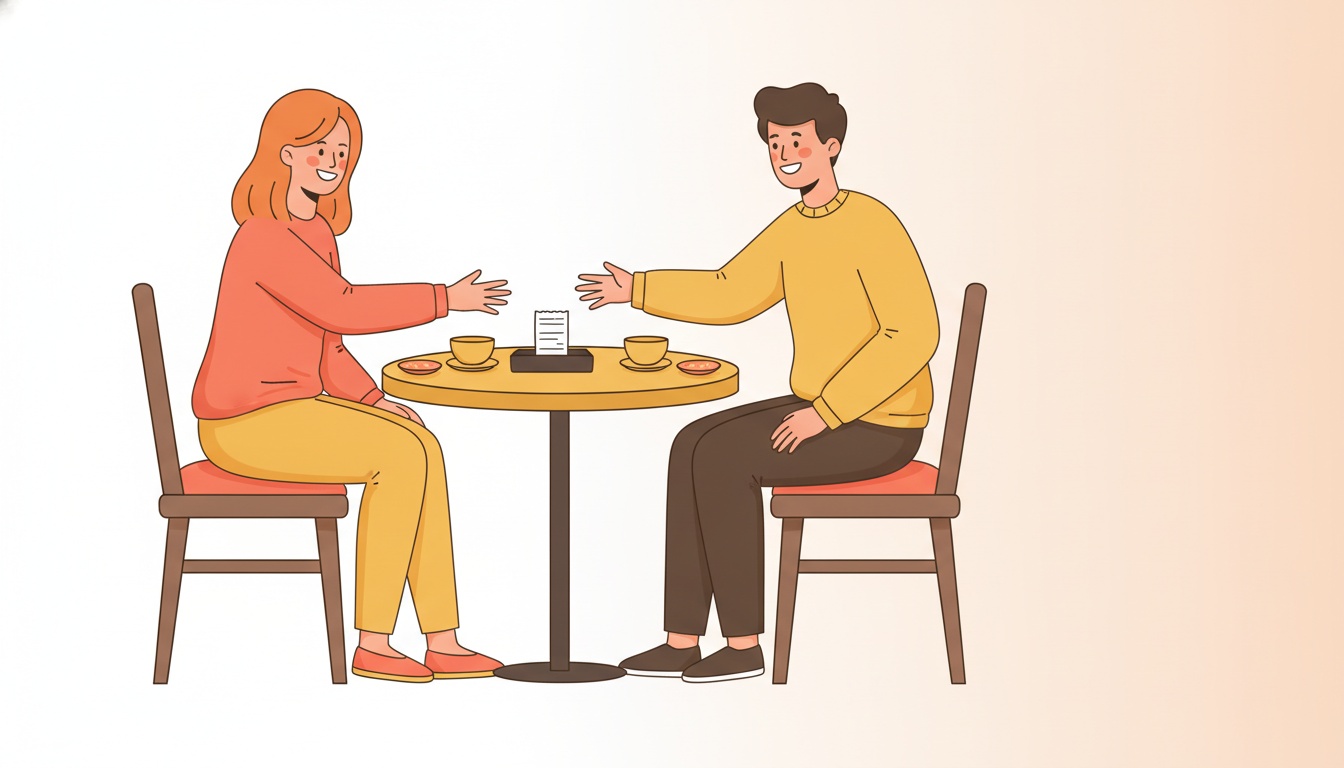
Your Chinese friend spends an hour helping you move boxes up four flights of stairs. You say 谢谢 (xièxie), thank you, and then thank you again, and maybe a third time for good measure. In English that's basic gratitude. In Chinese it can land as oddly distant, like you've quietly filed your friend under "acquaintances I owe a favor to." The grammar is perfect. The instinct is the problem.
Chinese politeness doesn't run on the English rule of "be warmer to people you like by thanking them more." It often runs on the opposite rule. The word that explains why is 客气 (kèqi), and English doesn't really have it. It means something like "standing on ceremony," treating someone with the careful, formal politeness you'd give a stranger. With strangers that's correct. With close friends, it builds a little wall. It's a quieter wall than the four tones, and it sits right next to the grid of names and titles you use to address people. Here are five places where your English politeness reflexes quietly backfire, and what native speakers do instead.
The 客气 trap: when being polite pushes people away
Say 谢谢 to a close friend for passing you the soy sauce and you might hear 你太客气了 (nǐ tài kèqi le), "you're being too polite." It sounds like praise. It isn't. It's a gentle flag that you're treating them like an outsider when you should be treating them like 自己人 (zìjǐrén), "one of us," your own people. The insider-versus-outsider line is one of the load-bearing distinctions in Chinese social life, and crossing into 自己人 status is exactly when the formalities are supposed to drop away (Chinese-Point on 自己人).
So the warm reply to a friend's thanks isn't a bigger thank-you. It's 别客气 (bié kèqi), literally "don't be polite," or 都是自己人 (dōu shì zìjǐrén), "we're all family here." When a friend helps you move and you start in with the third 谢谢, the native move is to wave it off: 谢什么谢 (xiè shénme xiè), roughly "what are you thanking me for." Among intimates, less thanking signals more closeness. The thank-yous don't disappear. They just migrate toward the people you're not close to (FluentU on 别客气).
Deflect the compliment, don't accept it
A coworker tells you 你中文说得真好 (nǐ zhōngwén shuō de zhēn hǎo), "your Chinese is really good." Your English brain says "thank you!" and reaches for 谢谢. To a lot of ears, that flat acceptance sounds faintly immodest, like you agree that yes, your Chinese is excellent.
The reflex native speakers grow up with is to deflect. The classic is 哪里哪里 (nǎlǐ nǎlǐ), literally "where? where?", meaning "not at all." There's also 过奖了 (guòjiǎng le), "you're over-praising me," which leans a bit formal and works well at the office, and the casual 还好啦 (hái hǎo la), "it's okay, nothing special." For praise that feels genuinely too big, there's 不敢当 (bùgǎndāng), "I don't dare accept that." None of these is false modesty in the English sense. Deflecting is just the reflexive, polite thing to do, and it protects everyone's 面子 (miànzi), their social face (Preply on Chinese compliments).
One honest caveat: this is loosening. Younger urban speakers increasingly just say 谢谢 to a compliment, sometimes with a softener attached (LC Chinese School). How warm or blunt all of this sounds also shifts by region, and Mainland and Taiwan Mandarin lean noticeably different ways. But in formal settings, or with anyone older than you, a quick 哪里哪里 still reads as the graceful answer, and reaching for it is rarely wrong.
Refuse sideways, not straight
Someone invites you to dinner Saturday and you can't make it. The English move is a clear, friendly "no thanks, I can't." A flat 不 (bù) in Chinese can land harder than you intend.
So natives go around it. 改天吧 (gǎitiān ba), "another day," is the workhorse. 再说吧 (zàishuō ba), "we'll talk about it later," sounds like a maybe and usually isn't. If you'd rather lean on an excuse, 有点儿不方便 (yǒudiǎnr bù fāngbiàn), "it's a little inconvenient," does the job without a hard wall. The thing to internalize is that these are real refusals, not open doors. Here's the tell: if 改天 isn't followed by an actual proposed day, often nobody is rescheduling anything (Mandarin Blueprint on indirect refusals). Learning to hear a soft 再说吧 as a polite no, rather than waiting around for the yes, saves a lot of confusion.
不好意思 vs 对不起: stop over-apologizing
You bump someone on the subway, or you need to squeeze past to reach the door, or you wave down a waiter. The word you want is 不好意思 (bù hǎoyìsi), literally "embarrassed," which is the all-purpose social lubricant for tiny frictions. It covers "excuse me," "pardon," "sorry to bother you," and "my bad" for anything minor.
Beginners reach instead for 对不起 (duìbuqǐ), the heavy apology, and it sounds disproportionate, like apologizing for a car crash when you tapped someone's elbow. 对不起 is for real wrongdoing: you broke something, you hurt someone, you let a friend down (Chinese For Living on saying sorry). Flagging a waiter with 对不起 isn't wrong exactly. It just sounds like you've done something to them. 不好意思 keeps daily friction light, which is the whole point of it.
The bill fight and the art of being less polite
The check arrives and two people lunge for it. 我请客 (wǒ qǐngkè), "my treat," says one. 下次你请 (xiàcì nǐ qǐng), "you get it next time," says the other, already pulling out a phone to pay. This is 抢着买单 (qiǎngzhe mǎidān), scrambling to pay the bill, and far from rude it's a warmth ritual. Insisting on paying shows generosity and gives 面子 (SN Mandarin on the bill battle). Letting someone quietly pay without any protest, the way you might in the US, can feel a little cold.
The same logic shows up at the same table in a word you'd expect to be safely polite: 请 (qǐng), "please." With strangers it's perfect, 请坐 (qǐng zuò), "please, sit." But layer 请 onto every small request to a close friend and it starts to sound stiff, like you're keeping them at arm's length (AllSetLearning on 请). There's even 请便 (qǐngbiàn), "suit yourself," which can come out downright curt depending on the tone. Sometimes the warm move is to drop the 请 entirely and just ask.
Try it in Conversa
Practice with AI characters who adapt to your level and give real-time feedback.
Try Conversa FreeThis is the kind of thing you can't really drill from a phrasebook, because it only shows up in live back-and-forth: someone thanks you, deflects your compliment, fights you for the bill, and you have to react in the half-second before it gets awkward. That's the gap an AI conversation partner like Conversa is actually useful for. You can run the same dinner-invite refusal or compliment exchange ten times until the right reflex beats the English one.
The real graduation marker
None of this is about memorizing more polite phrases. It's the reverse. Chinese politeness is mostly about knowing when to switch the ceremony off, when 客气 stops being warmth and starts being a wall. The day a Chinese friend looks at you mid-thank-you and says 别这么客气 (bié zhème kèqi), "don't be so polite with me," and you actually take the hint and stop, that's the moment your Chinese stops sounding like a careful translation and starts sounding like you belong in the room.