Jugaba al fútbol todos los días means "I played soccer every day," and every one of those games ended. They're finished. Over. Completed a few hundred times. And yet the verb sits in the imperfect, the tense your textbook swore was for actions that weren't completed. So either the rule is broken or you are, and I promise you it isn't you.
English hands you one past tense and lets you off easy. "I ate" covers a single bite at noon and a whole childhood of eating broccoli every Tuesday. Spanish makes you pick, every single time, between comí ("I ate," the preterite) and comía ("I ate," "I used to eat," "I was eating," the imperfect). Most learners get the completed-versus-ongoing rule, which holds up for about five minutes of real Spanish and then strands them. Here's the model that doesn't, the same way por and para collapse into one question once you stop counting rules.
Preterite vs imperfect is aspect, not time
Comí and comía can describe the exact same Tuesday afternoon. The difference between them isn't when you ate. It's how you're framing the action: as one sealed-off event, or as something that was simply going on around you. Grammar people call this framing aspect, and the Real Academia Española defines the preterite as the perfective, the form that views an action as complete and bounded.
That's exactly why completed-versus-ongoing feels almost right and keeps betraying you. It's pointing at aspect from across the room. Mandarin learners hit the same wall from the other side, where the particle 了 isn't past tense at all but aspect. Grab aspect directly and the strange cases stop being strange.
The camera test
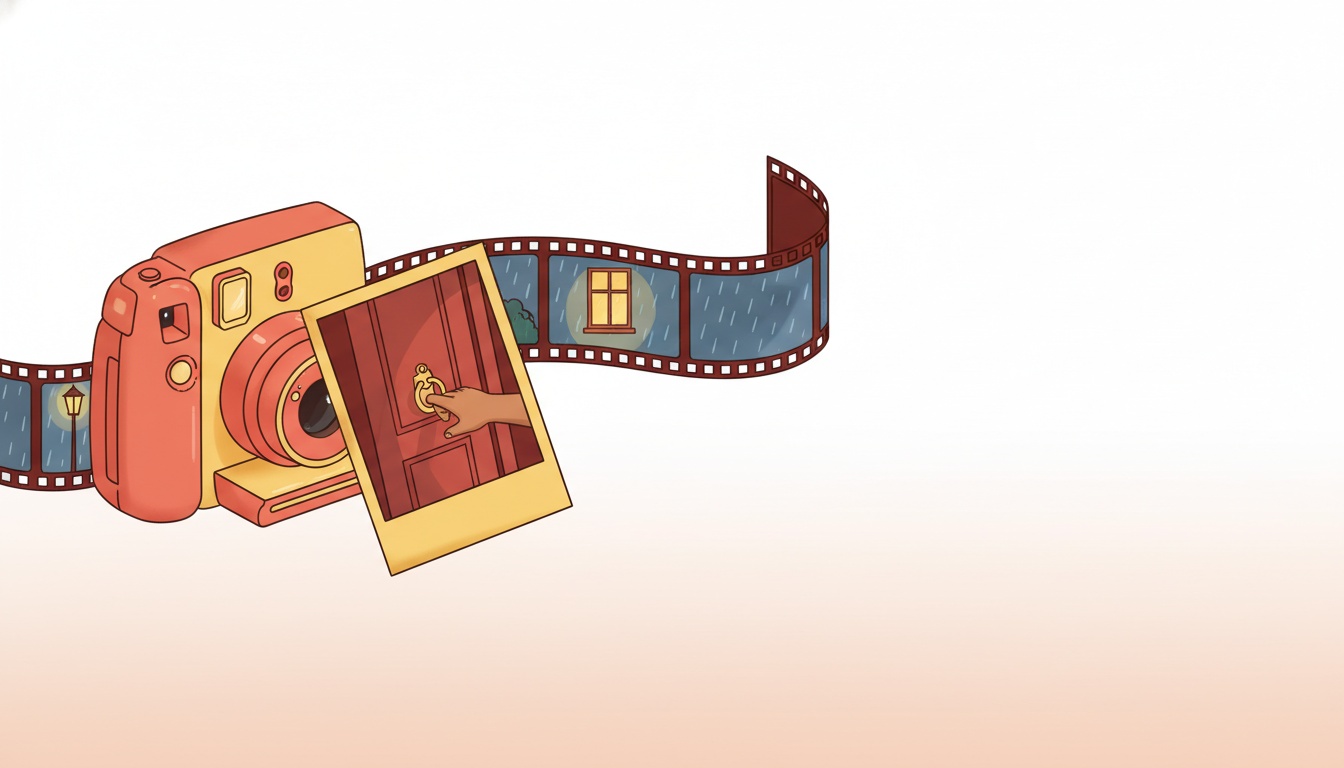
Era de noche y llovía cuando alguien llamó a la puerta: "It was night and it was raining when someone knocked at the door." Three verbs, two completely different jobs. Picture the sentence as a film. Era (it was night) and llovía (it was raining) are the footage running underneath: the scene that's already rolling. Llamó (knocked) is the snapshot, the single frame where something happens and the plot lurches forward. Flip the tenses and you get nonsense: one flash of nighttime sliced open by an endless, never-finishing knock.
The preterite is always that snapshot. The imperfect is always the footage: description, weather, the time on the clock, how old you were, what was already underway before the camera cut to the action.
The interruption pattern
Cocinaba cuando sonó el teléfono: "I was cooking when the phone rang." This is the most reliable shape in the whole language. An imperfect action already in progress, sliced by a preterite event that drops in. The cooking is footage; the ring is the snapshot. You'll hear the same frame constantly: Caminábamos por la calle cuando empezó a llover, "we were walking down the street when it started to rain." Once you spot the shape, half your tense choices make themselves.
Why habits hide in the imperfect
Back to jugaba al fútbol todos los días. Each game finished, so completed-versus-ongoing screams preterite at you. But a repeated habit isn't a single event sitting on the timeline. It's background. It's the footage of your childhood, not one frame of it, so it takes the imperfect. SpanishDict lists habitual past among the core jobs of the imperfect, right next to age, time of day, and weather.
The shortcut: if you can rewrite the English with "used to" or a habitual "would," reach for the imperfect. "When I was a kid, I would play soccer every day" becomes jugaba. One catch worth flagging, because it trips people: that's the habitual "would," not the conditional "would" in "I would play if you asked me." Only the habit maps to the imperfect.
The verbs that change their English meaning
Sabía means "I knew." Supe means "I found out." Same verb, two different English words, and the only thing that moved is the aspect. This is where completed-versus-ongoing doesn't bend, it snaps. A small set of very common verbs translate into a whole different English word depending on which past tense you choose, because the preterite squeezes them into one bounded moment. SpanishDict has the full list; these are the four you'll meet first:
- saber: sabía is "I knew" (you already had the information). Supe is "I found out." Lo supe ayer is "I found out yesterday," the instant the knowledge landed.
- conocer: conocía a María is "I knew María," was acquainted with her. Conocí a María is "I met María," the first handshake. La conocí en 2010.
- querer: quería llamarte is "I wanted to call you." Quise llamarte is "I tried to call you," one specific attempt. And no quise isn't "I didn't want to," it's "I refused."
- poder: podía nadar is "I could swim," was able to. Pude abrir la puerta is "I managed to open the door," and the door actually opened.
There's even tener, more quietly: tenía una carta is "I had a letter," while tuve una carta leans toward "I got a letter."
Notice the pattern under all of them. The preterite collapses a state into a single point: the instant you found out, met, tried, or managed. The English word changes because English happens to use a separate word for "the moment a state began." Spanish doesn't bother; it just changes the aspect. It's the same instinct behind why the Spanish subjunctive isn't really about doubt: the grammar is tracking something English smuggles into word choice instead.
Try it in Conversa
Practice with AI characters who adapt to your level and give real-time feedback.
Try Conversa FreeTables won't make this automatic. Reps with real sentences will. This is the kind of thing an AI conversation partner like Conversa is genuinely useful for: you narrate your weekend out loud, it nudges you when supe should have been sabía, and you start to feel the snapshot-versus-footage difference instead of reciting a rule about it.
The two-second question, plus a cheat sheet
Snapshot that moves the story, or footage running underneath? That's the only question you need mid-sentence, and it resolves most cases faster than scanning any rules table.
Time markers give you a backup hint. These pull preterite, because they point at a finished moment: ayer (yesterday), anoche (last night), de repente (suddenly), una vez (once), el lunes pasado (last Monday). These pull imperfect, because they sketch a backdrop: siempre (always), todos los días (every day), mientras (while), cada verano (every summer), de niño (as a child).
Treat the markers as hints, not law. Ayer usually points at the preterite, but ayer llovía todo el día mientras trabajaba is wall-to-wall imperfect, because you're painting the backdrop of an entire day, not snapping one event out of it. When a marker and the camera disagree, the camera wins.
So where does that leave you
The first dozen times, you'll stop mid-sentence and ask the camera question on purpose, and your spoken Spanish will stall while you do it. That's fine. That's the reps doing their job. Somewhere around the hundredth time it stops being a question you ask and turns into something your ear just hears, the way the difference between ser and estar eventually clicks and stops feeling like a coin flip. And the payoff is sharp: supe stops sounding like a slip you made and starts sounding like a different idea, which is exactly what it always was.