"Me alegro de que estés aquí." I'm glad you're here. The person is standing right in front of you. There's no doubt they're here, no uncertainty, no maybe. And yet that estés is the subjunctive, the same mood your textbook told you is for doubt and uncertainty. So either the textbook is wrong, or you're about to be confused for a very long time.
It's the textbook. The subjunctive trips up almost every intermediate Spanish learner, and most of that pain comes from two ideas that get taught on day one and quietly sabotage you for years: that the subjunctive is a tense, and that it's about doubt. Drop both. There's one principle underneath, and one test that handles most of your sentences. Here they are.
First, the subjunctive is a mood, not a tense
A tense tells you when: yesterday, now, next week. Comí, como, comeré. The subjunctive doesn't do that job. It's a mood, which tells you how the speaker is framing the clause, and it runs alongside the tenses rather than competing with them (Wikipedia: Subjunctive mood in Spanish).
That's why the subjunctive has its own present and past forms. Espero que vengas is present. Esperaba que vinieras is past. Same mood, two different time frames. So when you catch yourself asking "is this the subjunctive tense?", stop. The real question is never when the action happens. It's whether the speaker is presenting the clause as a fact or not.
The real split: are you asserting a fact, or not?
Compare Sé que viene (I know he's coming) with Quiero que venga (I want him to come). In the first, you're stating a fact: he's coming, and you know it. Indicative. In the second, you're not stating that anything is true. You're expressing a want, and the coming hasn't happened. Subjunctive. The verb form tracks one thing: is the clause being asserted as fact (indicative), or not (SpanishDict community answer on quiero que vs. creo que).
Now back to me alegro de que estés aquí. You know they're here. So why isn't it a fact you're asserting? Because that's not what the sentence does. The main clause isn't claiming the person is here. It's reacting to it. The being-here is presupposed, handed off, used as the thing you feel glad about, and the subjunctive marks exactly that: this clause is not what I'm asserting (SpanishDict: expressing emotions with the subjunctive). Emotion is where "it's about doubt" falls apart completely, which is why it's the fastest way to retrain your ear.
This is the framing language teachers and linguists tend to reach for once the doubt story runs out. It's a way of hearing the mood, not a rule handed down on a stone tablet, so treat it as your default question rather than a law.
One test that handles most sentences: que plus a new subject
Quiero que comas: a main clause, then que, then a new subject after it. Most everyday subjunctives announce themselves with that exact shape, and when the subject changes across the que, you're almost always in subjunctive territory (Tell Me In Spanish: subjunctive triggers). Watch the contrast. Quiero comer means I want to eat: one person doing both the wanting and the eating, so the second verb stays an infinitive, no que, no subjunctive. Add a second person and it splits into Quiero que comas, I want you to eat, with the subject jumping from "I" to "you" across the que. Same with impersonal openers: Es importante estudiar (important to study, in general) versus Es importante que estudies (important that you study).
This isn't airtight. Some triggers fire even without a clean subject change, and you'll meet edge cases. But run the question "is there a que with a new subject after it?" on a normal paragraph of Spanish and it resolves a surprising share of your calls on the spot. The rest fall out of the assertion question from the last section.
WEIRDO is the symptom, not the disease
You've probably met WEIRDO: Wishes, Emotions, Impersonal opinions, Recommendations, Doubt/denial, and Ojalá. It's a real, useful list, and every one of those categories does the same single thing. The main clause refuses to assert the que clause as fact.
- Wishes: Quiero que vengas mañana. (I want you to come tomorrow.)
- Emotions: Me sorprende que no haya venido. (I'm surprised he hasn't come.)
- Impersonal opinions: Es posible que llueva. (It's possible it'll rain.)
- Recommendations: Te recomiendo que estudies más. (I recommend you study more.)
- Doubt/denial: Dudo que sepa la respuesta. (I doubt he knows the answer.)
- Ojalá: Ojalá que gane el partido. (I hope he wins the match.)
Here's the part the acronym won't tell you: WEIRDO runs out. It says nothing about busco una casa que tenga piscina, or llámame cuando llegues, or para que lo leas. Those are subjunctive too, and none of them are a wish or an emotion or a doubt (SpanishDict: subjunctive trigger words). When the list runs out, you don't need a bigger list. You go back to the one question: is this clause being asserted as a fact?
Try it in Conversa
Practice with AI characters who adapt to your level and give real-time feedback.
Try Conversa FreeSame words, opposite verb
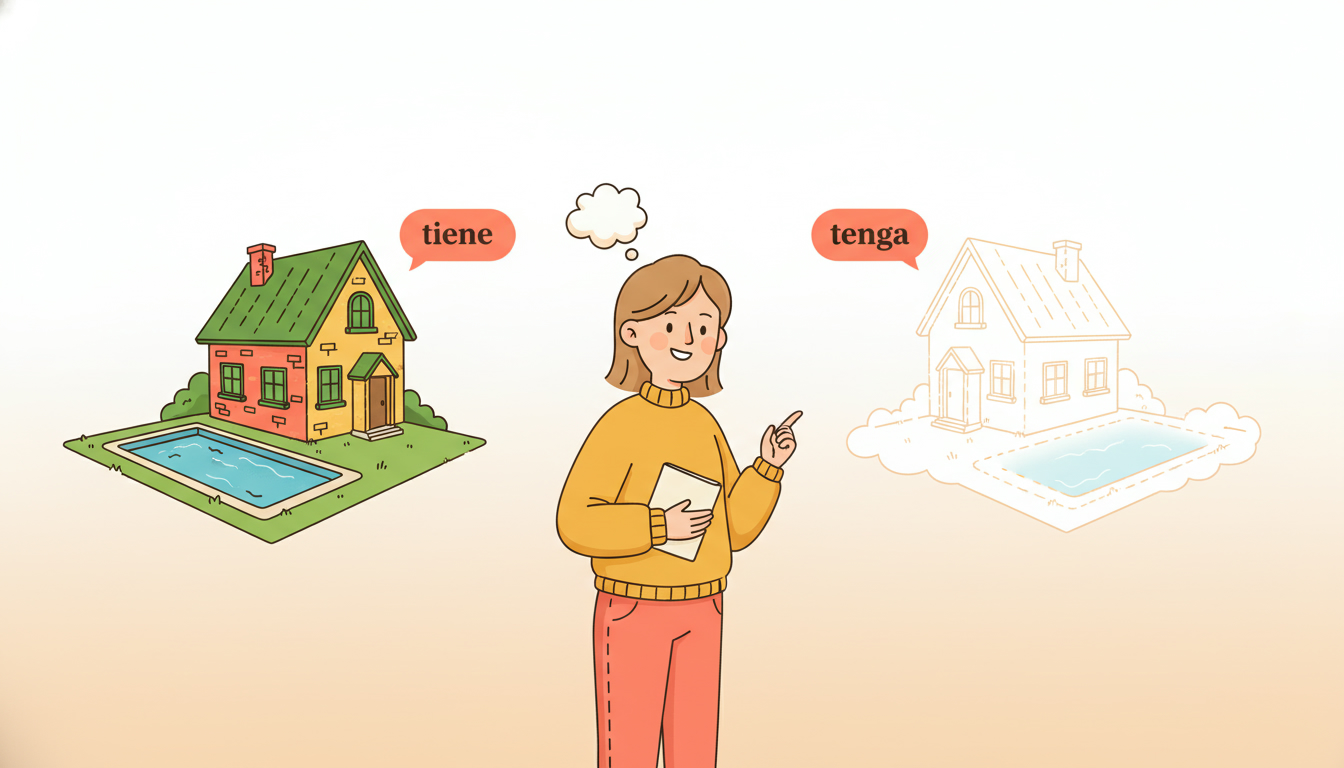
Busco una casa que tiene piscina and busco una casa que tenga piscina differ by a single letter, and they send you on two different house hunts. Keep every other word identical, flip only the mood, and the meaning moves with it. ...que tiene piscina means you have a specific house in mind and it has a pool: the house exists, you're asserting a fact about it. ...que tenga piscina means any house that happens to have one, and you haven't found it yet, so nothing is asserted to exist and the verb goes subjunctive (Inklingo: subjunctive in adjective clauses).
Time works the same way. Cuando llegas a la oficina, revisas el correo is a habit, something that reliably happens, so it's asserted and indicative: whenever you arrive, you check your mail. Llámame cuando llegues points at an arrival that hasn't happened yet, so there's nothing to assert and the verb is subjunctive (Kwiziq: cuando + subjunctive vs. indicative). This is also why cuando llegarás with a future tense is wrong here. The arrival hasn't happened, so there's nothing to assert, and Spanish hands the job to the subjunctive.
The cleanest demo is negation. Creo que es verdad, I think it's true: you're asserting it, so indicative. Negate the main verb and the assertion collapses. No creo que sea verdad. You're no longer claiming anything is true, so es becomes sea (Barcelona Spanish Online: el subjuntivo con "no creo"). One word flips the mood, because that one word is what kills the assertion.
How to build the reflex
Memorizing tables won't get you there, because the choice happens in real time, mid-sentence, faster than you can scan a chart. You need the trigger to fire on its own. So drill the openers, not the conjugations.
Take eight high-frequency openers and run a single verb through all of them out loud: quiero que… espero que… es posible que… no creo que… ojalá que… para que… antes de que… cuando (plus a future action). Use venir: quiero que venga, espero que venga, es posible que venga, no creo que venga, ojalá que venga, para que venga, antes de que venga, cuando venga. Now do it with salir, then poder. It feels mechanical. That's the point. After a few verbs the que arrives, your brain hears "not a fact," and the subjunctive comes out without a decision.
Then take it to your ears. Ojalá and no creo que show up constantly in real speech. Once the mood shift is automatic in your mouth, you start catching it in podcasts and shows without trying. For a deliberate version, point a listening routine at content full of opinions and wishes, where the subjunctive lives. Or run the same eight openers with an AI conversation partner like Conversa, where you have to produce the subjunctive yourself out loud instead of rehearsing a table in your head.
It helps to already be solid on ser and estar, since their subjunctive forms (sea, esté) are everywhere in these sentences. If those two still feel slippery, sort them out first and the subjunctive gets noticeably easier.
The one question to keep
Stop asking yourself "am I unsure about this?" That question will lie to you, because me alegro de que estés aquí has no doubt in it at all. Ask the other question instead: am I stating this clause as a fact, or am I doing something else with it, wanting it, fearing it, denying it, waiting for it? If it's anything but a flat assertion, reach for the subjunctive.
Try it on the next ten sentences with que that you read or hear today. Not in a workbook. In a real comment thread, a song, a message from a friend. You'll be right more often than the WEIRDO list ever made you feel you could be.