"I read three books last summer." Translate that into French and you have a problem, because there are two correct answers and they mean different things. J'ai lu trois livres if you're counting finished books, three covers closed. Je lisais trois livres if you mean it as the texture of the whole summer, three books you kept picking up and putting down. Same English sentence. Two French tenses. No word-for-word rule that tells you which.
This is the wall every English speaker hits with the past tense in French, and the usual advice makes it worse. Most guides hand you a list of trigger words: hier and soudain mean passé composé, toujours and d'habitude mean imparfait. Memorize the list, match the word, done. Then you try to tell an actual story and every sentence wants both tenses at once, and the list falls apart in your hands.
The real fix is to stop thinking about when and start thinking about how you're looking at it. That's a grammar concept called aspect, and once it clicks, the whole thing stops feeling random.
Why English gives you no instinct here
"I walked to school" can describe one specific walk on one specific morning, or a thing you did every day for six years. The English verb doesn't change. You lean on context and move on, because English mostly stopped marking the difference and lets you sort it out later.
French refuses to let you blur it, the same way it makes you commit to le or la before every noun. You have to decide, before the verb leaves your mouth, whether you mean je marchais (the daily walk, the routine, the movie of your childhood) or j'ai marché (one walk, start to finish, done). That decision is aspect: not when the action happened, but whether you're viewing it as a finished whole or as something still in progress.
English speakers don't have a ready mental slot for this, because English rarely forces the choice. So the goal isn't to memorize French rules. It's to grow an instinct English never gave you.
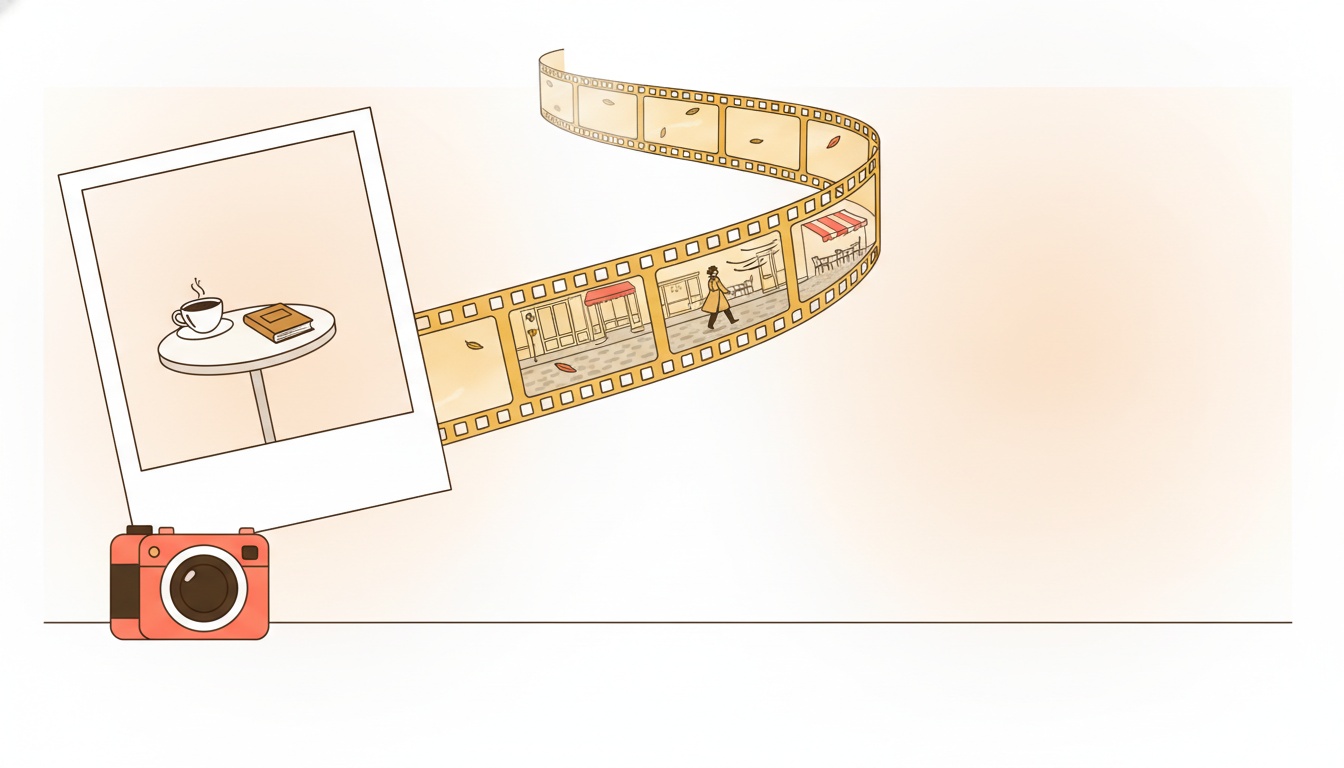
The snapshot and the movie
J'ai fermé la porte. I closed the door. Click. That's passé composé: a snapshot, one complete event with edges. Elle a mangé une pomme. She ate an apple, and the apple is gone. Nous avons parlé pendant une heure. We talked for an hour, and the hour is complete. You can put a frame around each of these.
Imparfait is the footage running behind the snapshot. The scene, the weather, the mood, the thing that was already happening and had no clear start or stop. Il faisait nuit. Tout le monde dormait. It was night. Everyone was sleeping. There's no edge to "it was night," no moment it clicked shut. It's just the world the way it was, rolling.
When you can't decide, ask yourself: am I taking a photo of one finished thing, or am I describing the movie it happened inside?
The one sentence that shows both at once
Je dormais quand le téléphone a sonné. I was sleeping when the phone rang. That single sentence needs both tenses, and it's exactly where the trigger-word lists collapse. The sleeping is the movie, the ongoing background, so it's imparfait. The phone ringing is the snapshot, the event that cuts in, so it's passé composé. One sentence, both jobs.
Il faisait beau quand nous avons décidé de sortir. The weather was nice when we decided to go out. Il faisait beau is the scenery. Nous avons décidé is the click, the moment a choice got made.
The pattern that falls out of this is more reliable than any word list: the background goes in imparfait, and the event that interrupts it goes in passé composé. You don't need soudain in the sentence to know which is which. You need to know which part is the scene and which part is the thing that happened.
Habits and descriptions are always the movie
Quand j'étais petit, je jouais au foot tous les jours. When I was little, I played soccer every day. Every one of those games actually ended, hundreds of them, and the verb still sits in imparfait, because you're describing a routine, not pointing at one match.
This is the cleanest English shortcut you have, so hold onto it. "Was" or "were" plus an "-ing" verb almost always maps to imparfait: "I was reading" is je lisais. "Used to" and "would," when it means a repeated habit, also land in imparfait: "I used to play" and "I would play every day" are both je jouais. Pure description works the same way: il pleuvait et le vent soufflait fortement, it was raining and the wind was blowing hard, with no event in sight.
The shortcut breaks the moment "would" means something conditional instead of habitual ("I would help if I could" is a different grammar entirely), so use it for habits and scenery, not as a universal switch.
The verbs that change meaning in passé composé vs imparfait
Je savais means "I knew." J'ai su means "I found out." Same verb, two tenses, two different English words, and this is the strongest proof going that the choice is about aspect and not vocabulary. Je savais qu'il venait is "I knew he was coming," a state of knowledge you already had. J'ai su la vérité ce jour-là is "I found out the truth that day," the snapshot moment the knowledge arrived (Collins splits these into separate senses). The logic stays constant across the whole family: imparfait is the ongoing state, passé composé is the moment that state kicked in.
Take vouloir. Je voulais le voir is "I wanted to see him," an ongoing wish, while j'ai voulu l'appeler is "I decided to call him," the moment you acted. And je n'ai pas voulu flips all the way to "I refused," a hard no in a single moment. The same split runs through more of the verbs you use constantly (Lawless French lays out the full set):
- pouvoir: je pouvais courir vite is "I could run fast" (a general ability); j'ai pu réussir l'examen is "I managed to pass the exam," ability cashed in once.
- connaître: je connaissais Marie is "I knew Marie," I was familiar with her; j'ai connu Marie à l'université is "I met Marie at university," the moment we first met.
- avoir: j'avais une voiture is "I had a car"; j'ai eu une lettre ce matin is "I got a letter this morning," the moment it arrived.
Reach for the wrong tense here and the error isn't cosmetic. You say a different thing. Tell someone j'ai connu ta sœur and you've said you met your sister for the first time, not that you've known her for years.
Try it in Conversa
Practice with AI characters who adapt to your level and give real-time feedback.
Try Conversa FreeHow a real story braids them
Il faisait beau. Je suis allé au parc. Les enfants jouaient. Soudain, j'ai aperçu mon ami. Four short French sentences, and the tense flips with every one. The weather was nice (movie, the scene). I went to the park (snapshot, an event). The children were playing (movie, background already underway). Suddenly I spotted my friend (snapshot, the event that lands). Read it again and notice the tense switches every time the camera moves between what was already going on and what happened next.
Notice too that soudain sits in front of a passé composé here, exactly like the trigger-word list promised. But that's a side effect. The sentence right before it, with no time word at all, still needed imparfait because the children's playing was background. The narrative function decides the tense. The trigger word is just along for the ride.
Build the instinct
Narrate your day out loud in French: je me suis levé, j'ai pris un café, je suis sorti. Those are your snapshots, the events on one track. Now lay the scenery underneath them: il faisait gris, j'étais fatigué, la rue était vide. That's the movie. You will not build this from a table, and anyone who tells you to memorize one is setting you up to freeze mid-sentence. Aspect is a feel, and feels come from reps.
Every time you hit a verb, ask the one question that replaces the whole rulebook: could I film this as an ongoing scene, or is it one click of the shutter? If you're not sure, say it both ways out loud and notice how the meaning shifts. That noticing is the instinct forming.
This is hard to practice alone, because you need someone to catch the wrong call in real time. Conversa is an AI conversation partner you can tell past-tense stories to and get corrected as you go, which is most of the value: you find out you said j'ai connu when you meant je connaissais while the sentence is still warm. If you've worked through the Spanish preterite and imperfect, the snapshot-versus-movie instinct transfers almost directly; French runs the same aspect distinction with different verb endings.
So the next time you're mid-sentence and the verb won't come, don't hunt for a trigger word. Ask whether you're holding a photo or rolling the film. The tense follows from that, and so, it turns out, does what the verb even means.