押すと開く. Osu to hiraku. Push it and it opens. That little と is doing the work of the English word "if," and it works perfectly in that sentence. Now try to add a polite request to it, the way you would in English ("if you push it, please hold the door"), and a Japanese speaker will quietly wince. The と just broke.
That is the trap with Japanese conditionals. Your textbook hands you four words that all get translated as "if" or "when" (と, ば, たら, なら) and then lines them up as if they were interchangeable. They are not. (Japanese textbooks do this constantly; it's the same trap as teaching は and が as two words for "the subject".) Each one has a specific job, and using the wrong one ranges from sounding slightly off to being flat-out ungrammatical. The good news: you don't have to memorize four separate grammar lessons. You need one question.
The one question that picks your "if"
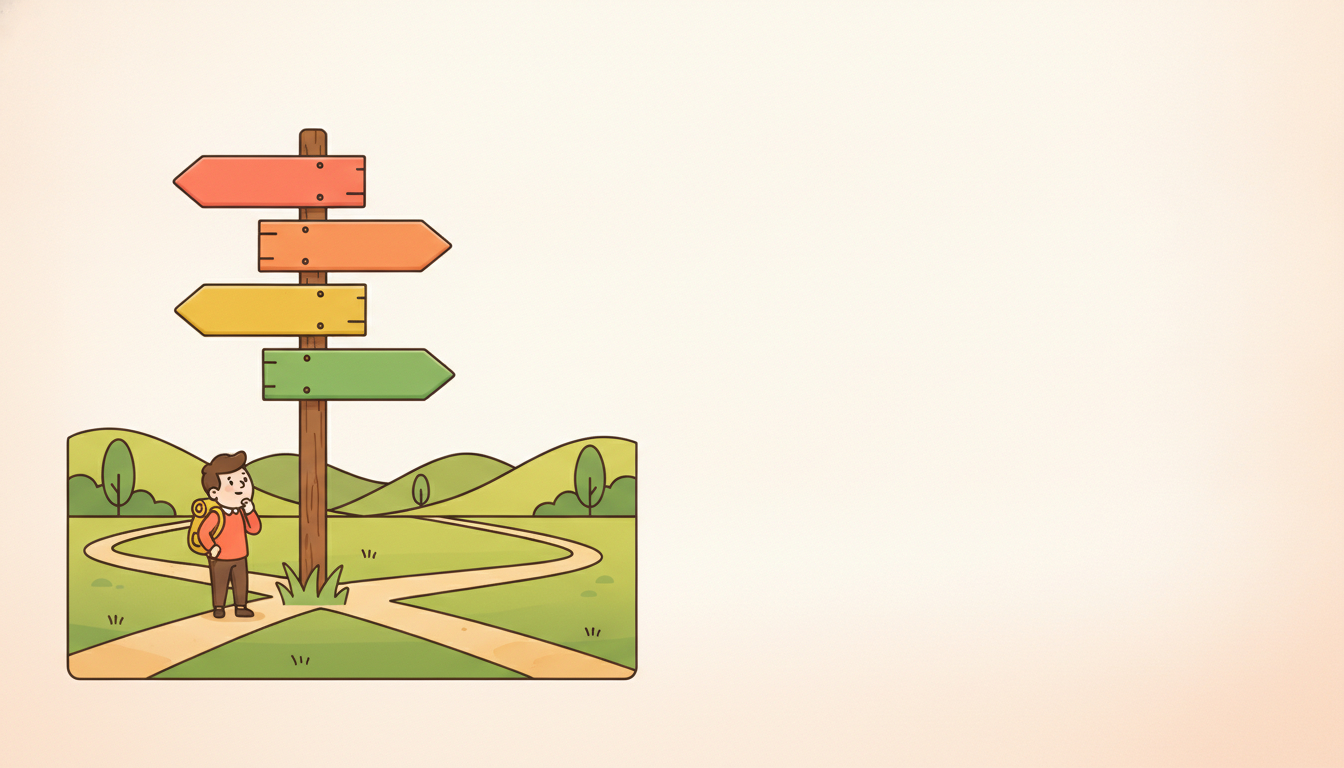
Before you reach for a conditional, ask yourself what kind of "if" you actually mean. There are four, and they map cleanly:
- Is the result automatic, a law of nature or a machine that always does the same thing? Use と.
- Is it a general truth or proverb, the kind of thing that's true in principle? Use ば.
- Is it a one-off "once this happens, then that"? Use たら. This is also your safe default when you're speaking and can't decide.
- Are you responding to something that was just said or already on the table? Use なら.
Watch the difference in two sentences. 春になると桜が咲く (haru ni naru to sakura ga saku), "when spring comes, the cherry blossoms bloom," is an automatic, every-year fact, so it takes と. But if a friend says they're craving sushi and you recommend a place, you say 寿司なら、あの店がいい (sushi nara, ano mise ga ii), "if it's sushi you're after, that place is good," because you're answering something they just put on the table. Same English "if." Completely different machinery underneath.
Here's each form, with the one rule per form that English speakers break most.
と: when one thing always triggers another
ボタンを押すと、ドアが開く. Botan o osu to, doa ga hiraku. "When you push the button, the door opens." と is for results that follow automatically, every single time. It's the "if" of cause and effect, switches and consequences, seasons and clockwork. 電気を消すと暗くなる (denki o kesu to kuraku naru), "turn off the light and it gets dark." 四月になると、桜が咲く. You're not hypothesizing. You're describing how the world reliably behaves.
Because と means "this always follows," it physically cannot carry anything you choose to do about it. No commands, no requests, no invitations, no wishes in the second half. This is the rule that catches everyone. You cannot say:
❌ 雨が降ると、傘を持ってください
You meant "if it rains, please bring an umbrella," but と turns it into nonsense, roughly "rain falling automatically causes you to please bring an umbrella." The fix is to switch the "if" to one that allows a request:
✅ 雨が降ったら、傘を持ってください (ame ga futtara, kasa o motte kudasai)
Tae Kim's guide and this breakdown of と both make the same point: the moment your result clause contains a will, a wish, or an order, と is the wrong tool. One bonus use worth knowing: in storytelling, と sets up a discovery. 部屋に入ると、電気がついていた (heya ni hairu to, denki ga tsuite ita), "when I walked into the room, the light was on." Same "one thing led to the next" feeling, pointed at the past.
ば: general truths, proverbs, "if it's cheap, I'll buy it"
塵も積もれば山となる. Chiri mo tsumoreba yama to naru. "Even dust, if it piles up, becomes a mountain." Japanese proverbs love ば, and that tells you what it's for: general, logical, if-this-then-that conditions that hold true in principle. 安ければ買う (yasukereba kau), "if it's cheap, I'll buy it." 押せば開きます (oseba akimasu), "if you push, it opens." For negatives, ば attaches to the なければ form: 行かなければ (ikanakereba), "if I don't go."
ば leans hypothetical and a little bookish. Tofugu notes it can sound a touch more formal than its cousins, though that's a tendency, not a hard line. The thing to watch: when the subject of both clauses is the same person and the second half is something you want or intend to do, ば starts to feel restricted, and たら is usually the more natural choice. If you're unsure in conversation, that's your cue to drop ば and reach for たら instead.
たら: the one you reach for when speaking
ご飯ができたら呼んで! Gohan ga dekitara yonde! "Call me when dinner's ready!" If you remember one conditional for daily conversation, make it たら. It's the spoken workhorse, it has the fewest restrictions, and unlike と it happily takes commands and requests in the second half. その本、読み終わったら貸してくれる? (sono hon, yomiowattara kashite kureru?), "when you finish that book, will you lend it to me?" 時間があったら、観光したい (jikan ga attara, kankō shitai), "if I have time, I want to sightsee." Form it by taking the plain past (た) form and adding ら. If those past-tense conjugations still trip you up, the same five-row pattern behind the te-form produces them.
たら has one more move that surprises learners. Because it's built on the past form, it can describe a past discovery: something you found out the moment the condition completed. 家に帰ったら、誰もいなかった. Ie ni kaettara, dare mo inakatta. "When I got home, nobody was there." You expected someone. They weren't. Tae Kim and this collection of discovery sentences walk through more of these. It's not really "if" at all here. It's "when I did X, I found Y," and only たら does it cleanly.
なら: answering what was just said
A friend says 「日本に行きたい」, "I want to go to Japan." You answer: 日本に行くなら、京都がいい (nihon ni iku nara, kyōto ga ii), "if you're going to Japan, Kyoto's the place." That's the whole personality of なら. It picks up information that's already on the table (something the other person said, something visible, something assumed) and builds your response on top of it. 寿司なら、あの店がいい. そういうことなら、聞かなくていい (sō iu koto nara, kikanakute ii), "if that's how it is, I don't need to ask."
This is why なら feels strange in a vacuum. Tofugu's guide to なら frames it as conditional-on-context: it needs something to respond to. You wouldn't open a conversation with a なら sentence out of nowhere any more than you'd start one in English with "if so." It's a reply, not an opener. When you catch yourself wanting to say "in that case…" or "if it's X you mean…," that's なら.
The fastest way to make these four feel automatic is to use them in real back-and-forth, where someone actually says 「寿司食べたい」 and you have half a second to answer. That live pressure is exactly what an AI conversation partner like Conversa is built for.
Try it in Conversa
Practice with AI characters who adapt to your level and give real-time feedback.
Try Conversa FreeThe mistakes English speakers actually make
The error I see most often is a request stapled onto a と clause: ❌ 押すと、開けてください, meant as "if you push it, please open it." と can't hold that request. Use たら instead: 押したら、開けてください (oshitara, akete kudasai). A few more that show up again and again:
と for a one-time plan. と is for things that always happen. If you're talking about a specific future event you intend ("if it's sunny tomorrow, let's go"), that's たら territory, not と.
なら with nothing to respond to. If you drop a なら sentence with no context behind it, it lands oddly, like answering a question nobody asked. Make sure there's something on the table for it to pick up.
ば where たら is more natural. ば isn't wrong in speech, but when the second clause is something you plan to do, it can sound stiff. In casual conversation, たら is almost always the smoother choice.
When in doubt, here's your fallback
If you take nothing else from this: when you're speaking and your brain stalls on which "if" to use, reach for たら. It's the most forgiving of the four, it takes requests and commands, and it rarely sounds wrong. And whatever you do, never put a please after と.
Want to test yourself? Try saying "once you get to the station, please call me" in Japanese. If you started with 駅に着くと, stop. と can't take that "please." 駅に着いたら、電話してください. That one swap, every time, will fix more of your conditional mistakes than any chart.