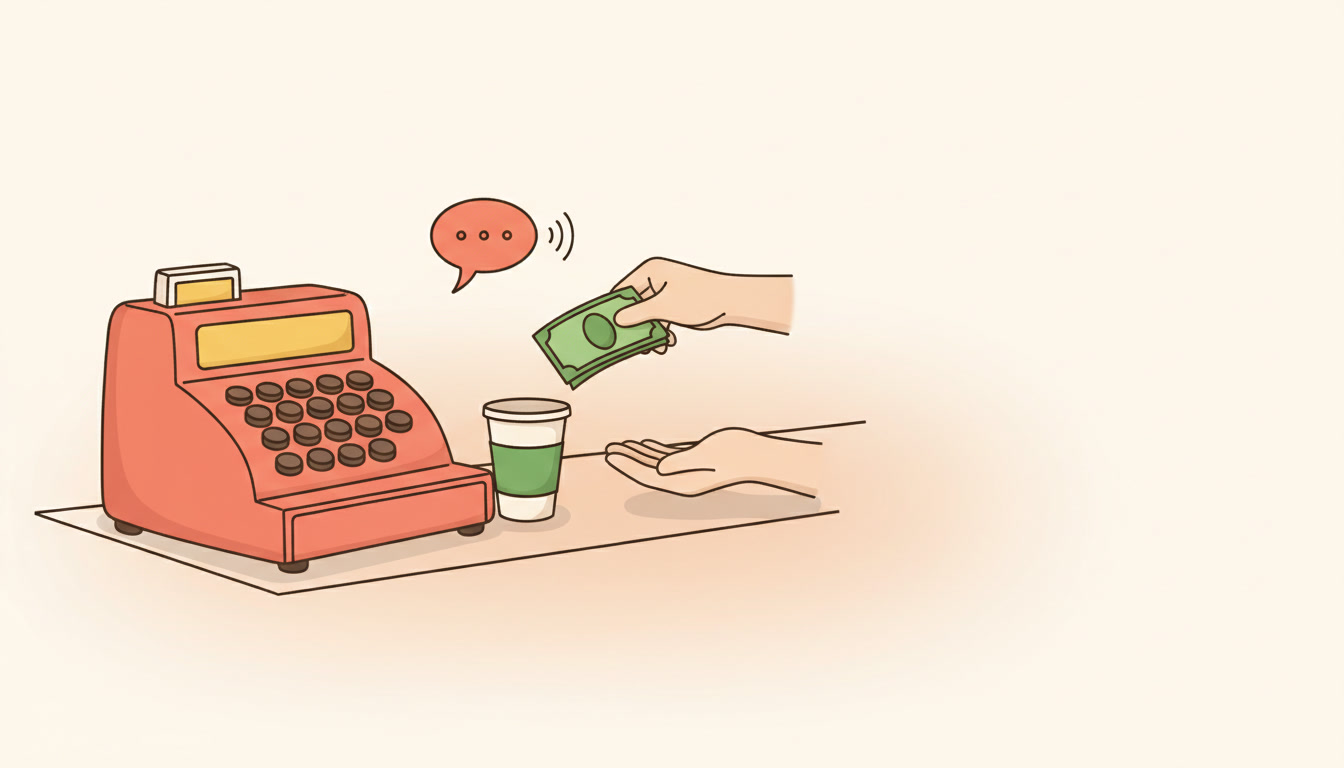
The cashier said "FIFteen dollars." You heard fifty, and you stood there digging through your wallet for more twenties while the line behind you waited.
You were taught a rule for this. Teens stress the end: thirteen is thir-TEEN. Tens stress the front: thirty is THIR-ty. The rule is correct about the word said on its own, and it stops working the moment a noun follows, which is where almost every number you need to catch actually sits: dollars, minutes, people, years.
Here is why the stress moves, which sounds are still there to catch once it has, and the other number traps in American English that no pronunciation drill covers: prices that sound like years, "twelve hundred", "quarter of nine", and a date that means different days on either side of the Atlantic.
Why thirteen and fifteen lose their stress before a noun
"The twins just turned thirTEEN." "There were THIRteen candles on the cake." That pair comes from Pronuncian's episode on teens and tens, which puts it plainly: "If the teen is used before a noun, it is more likely to be stressed on the first syllable."
The reason is rhythm. English dislikes two stressed syllables side by side, so a teen hands its stress back to the front when a stressed word follows. John Wells explains why teens in particular do this, on his phonetics blog: they "are all lexically double-stressed, and therefore susceptible to 'stress shift' in running speech." Two stresses are built into the word, and the sentence picks which one survives.
A teen keeps its final stress at the end of a phrase and gives it up before a stressed word.
It isn't occasional. José Mompean went through ten years of British news broadcasts and found the shift in 329 of the 343 places it could happen. It was near-universal in compounds and still showed up in about 88% of the teen-plus-noun phrases, like "fifteen minutes a day" and "eighteen months ago." Those were newsreaders, among the most careful speakers on the air. The person ringing up your coffee is not going to shift less.
So the stress rule is reliable in one place: the end of a phrase. "How old is she?" "Thirteen." The other time you'll hear -TEEN come back is when someone corrects you: "No, fif-TEEN." Everywhere else, you need a different cue.
Thirteen vs thirty: the t or d cue that survives
Say thirty the American way and the t turns into something close to a quick d: "thirdy." Hadar Shemesh describes the contrast: in thirteen, "it's a strong aspirated T because it's at the beginning of a stressed syllable," and in thirty, "it's a flap T. So it sounds like a D."
That difference outlives the stress shift because of where the t sits. American English flaps a t between a vowel or an r and an unstressed vowel, as in party, water and thirty. The -teen syllable keeps its full "ee" even after it loses the main stress, so the t in front of it doesn't qualify. Pronuncian's version is the one to remember: "all of the teens keep their t sound. It does not change for any of them."
For 30, 40 and 80: a d and no final n is a ten. A real t and a final n is a teen, wherever the stress landed.
Wells adds a caveat in the same post. Some speakers swallow the teen t into a glottal stop, the catch in the middle of "uh-oh." That still isn't a d, so the test holds: does the middle of the word go soft and voiced like ladder, or does it stop?
This is an American cue. A British speaker usually doesn't flap thirty, so there the contrast sits in the n and the vowel. The flap belongs to a bigger system, covered in what actually separates British and American pronunciation.
Fifteen vs fifty: where the flap cue runs out
Try it: fifty. The t comes straight after an f, and a flap needs a vowel or an r in front of it. So fifty keeps a real t, and Pronuncian says as much: "the number fifty is probably more likely to keep the t sound because it follows an f sound." Wiktionary transcribes fifty as /ˈfɪfti/, with no flapped variant at all. Sixty has the same problem, its t buried in a k-s-t cluster. For 15/50 and 16/60 there is no d to catch.
Seventy and ninety fail differently. They do get a d: in American speech their n-t is frequently pronounced as [nd] ("sevendy," "ninedy"), or squeezed further into a nasal tap in fast talk. But that d comes with an n right in front of it. Listen for "any n at all" and 70 passes for a teen. With 17/70 and 19/90, the only n that counts is the one at the very end.
So for these four pairs, what you're really listening for is the end of the word:
- a final n on the teen, where the ten ends on a vowel
- the length of that last vowel: fifteen ends in a long "ee" /iː/, fifty in a short, clipped one
Neither is loud. Pronuncian admits the n "does not seem to be adequate in always distinguishing the numbers in actual speech," and after "fifteen dollars" the n runs straight into the d of dollars. With 15/50 and its three cousins, you're allowed to stop guessing and ask.
How to check a number without sounding lost
Pilots mostly avoid words like "fifteen" on the radio. The FAA's Aeronautical Information Manual tells them to transmit most numbers "by pronouncing each digit," so 10 is "one zero." You can borrow that at a counter.
Your 'fifty?' can sound like 'fifteen?' to them, so a yes confirms nothing. Split into digits, they can't collide: one starts with 'one', the other ends in 'zero'.
Nobody hears this as a weakness. Pronuncian's own example is a stranger at a bus stop checking "70, 7-0?", with the advice: "don't take it personally if people ask you to repeat numbers for clarity; it happens even among native speakers all the time." If the trouble is less the number and more what to say when a whole sentence slips past you, the repair phrases English speakers actually use cover that.
How to say prices in English: $19.99, 1999 and twelve hundred
"Nineteen ninety-nine" is the price of a shirt ($19.99) and the year Prince told everyone to party like. English says both the same way, in pairs: Wikipedia's article on English numerals lists 1999 as "nineteen ninety-nine," and prices drop "dollars" and "cents" to land in the same shape.
Bigger prices bring a different surprise. In the US, the same article notes, four-digit numbers are "often named using multiples of 'hundred'": twelve hundred, forty-seven hundred. British speakers do this between 1,100 and 1,900 and mostly stop there. So an American landlord says the rent is "twelve hundred," a guy selling his old Honda wants "twenty-five hundred," and the word thousand never shows up.
Between 1,100 and 9,900, Americans often count in hundreds. Round thousands stay thousands: 2,000 is 'two thousand'.
When you're the one saying it, "one thousand two hundred dollars" is correct, and nobody will misunderstand you. It just sounds formal, next to the version everyone else uses.
In US speech the hundreds form is the everyday one, and 'dollars' drops out when it's obvious.
Try it in Conversa
Practice with AI characters who adapt to your level and give real-time feedback.
Try Conversa FreeSix fifty can be a price, a time or a room
"Six fifty" is $6.50 at a sandwich shop, 6:50 on a train platform, and room 650 at a hotel desk. Americans read room and house numbers in chunks ("one-fifty-two" for 152), a style Wikipedia calls "used much more often in American English than British English."
The frame can even change the size. Numblr's guide to spoken prices points out that "fifteen fifty" is $15.50 at a café, and at a car dealership it can mean $1,550. The only hint in the sound, Numblr notes, is a slight pause between the halves when it's dollars and cents, and that's easy to miss.
So decide the frame before the number arrives. At a counter, it's dollars and cents. On a platform, it's the clock. In a hallway, it's a door. Once you've set the frame, the string has only one reading left.
Quarter of, quarter till, ten till: what time is it?
"It's a quarter of nine" means 8:45. So does "quarter till nine," and so does "quarter to." Wikipedia's page on US time notation lays out the pattern: times from :31 to :59 are "given subtractively with the words 'to', 'of', 'until', or 'till'," and 9:45 "is often pronounced 'fifteen till ten'." By the same logic, "ten till" is ten minutes before the hour, 8:50 if you're waiting on a nine o'clock.
The of is the one that throws people, because nothing in it says before or after. It means before. Merriam-Webster gives "quarter of ten" as its example of that sense, and Grammarphobia quotes an Oxford English Dictionary citation from 1817: "At 15 minutes of 10 a.m." It skews older, and no survey has mapped where it's said: Arika Okrent points out that the Harvard dialect survey never asked.
The British trap runs the opposite way. "Half ten" means 10:30 in the UK, and the same page warns that this can confuse non-native speakers, because in German halb zehn, "half ten," means 9:30. Americans rarely say it at all. Lynne Murphy, an American linguist living in England, puts it simply: "Americans generally call it ten-thirty."
'Half ten' is British and informal, and a German speaker may hear 9:30. In the US, the plain clock reading is the one everyone gets.
3/4/26 is March 4 in the US
Americans write dates month first, so 1/21/24 is January 21 and 3/4/26 is March 4. In Britain and most of Europe, 3/4 is the 3rd of April.
Speech follows the same order. An American says "March fourth," where British English says "the fourth of March" or "March the fourth." Wikipedia's article on calendar dates flags the famous exception: the Fourth of July, which Americans say the British way.
Then the ordinals shrink. Merriam-Webster lists "fith" among its pronunciations of fifth, and gives "twelth" for twelfth in rapid speech. Wiktionary notes that sixth often comes out as plain "six" before a consonant.
So "on the sixth" can sound exactly like "six." When it does, the "the" in front and the month nearby are your evidence that it's a date. The same squeezing happens all over fast English; connected speech is the general version.
A drill where your answer is either right or wrong
You wrote 15 or you wrote 50. Numbers are one of the few listening targets where you can't half-understand, which makes them one of the few kinds of practice you can honestly score.
Take an NPR segment with a transcript, like this one on the price of eggs, which is full of prices ("$8 for six") and ends in a quiz round of billions. Play it once. Write down only the numbers, as digits, nothing else. Then open the transcript. Mark every miss by type: teen or ten, a hundreds number, or the wrong frame. For year practice, NPR's "How Do You Say 2010?" has real radio clips saying the same year two different ways.
Miss more than a third on the first pass? Slow the audio and go again before you blame your ears. After a week the misses will cluster. If yours cluster on 15/50 and 16/60, blame the numbers: those pairs have no d to catch.
For those, ask out loud. "One-five?"