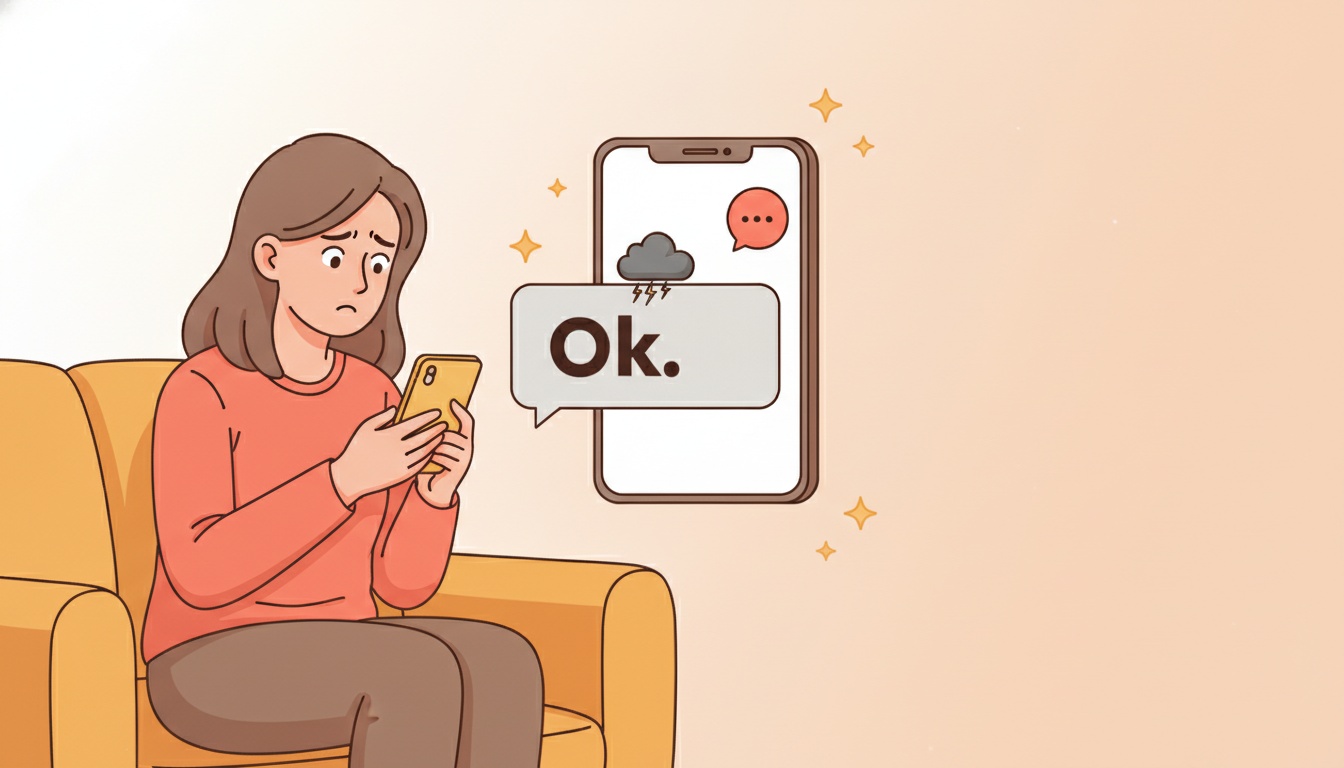
Your classmate texts: "Dave gave me his extra tickets. Wanna come?" You want to go, so you type the answer your English teacher would mark correct: "Okay." Ten minutes later your phone buzzes again. "are you mad at me??"
You weren't. You wrote a complete, punctuated reply. To a lot of American readers, though, a period at the end of a one-word text reads as annoyed, cold, or done with the conversation. Grammar books rarely mention this, because on paper the period just ends a sentence. In a text it works like a tone of voice.
Below: why the period does this, the replies where it hurts most (ok, k, sure, fine), how Americans use "!" and "lol" to sound normal, where periods are still fine, and what to send when someone asks if you're mad.
Why does "Ok." with a period sound angry?
That invitation about Dave's tickets comes from a real experiment. Celia Klin's lab at Binghamton University showed 126 undergraduates short exchanges where the reply was Okay, Sure, Yeah or Yup, with or without a period. The replies ending in a period were rated less sincere.
The researchers also ran the same exchanges as handwritten notes, and "no such difference was found for handwritten notes." On paper, "Okay." is just okay. The period only turns cold in a chat window.
Texting made the period optional. A new bubble already shows where your sentence ends, so when you add one anyway, the reader looks for a reason. The linguist Mark Liberman put it this way to The New Republic: "choosing to add a period also adds meaning because the reader(s) need to figure out why you did it."
The reason most readers land on is finality. Gretchen McCulloch, the linguist who wrote Because Internet, told NPR the period now "adds a note of solemnity or finality or seriousness."
On a one-word reply, the last character carries the tone.
The period only bites at the end of a short reply
"Running late. Be there in 10." Nobody reads that as angry. The first period separates two sentences, which is its old grammar job, and a 2025 study from the same Binghamton lab treats those between-sentence periods as grammatical rather than emotional. The tone signal lives at the very end of a message. It's loudest when the message is one or two words long.
A 2018 follow-up found the effect wasn't limited to positive words. It held for yeah and yup, for nope and nah, and for in-between answers like maybe and alright. Short replies in general get heavier with a period on them.
Stack them and it gets louder. In the 2025 study, "No. Just. Go" was rated more emotionally intense than the same words with no periods at all. Sending No, Just and Go as three separate bubbles pushed the intensity up too, by less.
So keep your punctuation. Periods inside longer messages are fine. Drop the last one on a short reply, or swap it for something warmer.
k, ok, okay, okie: which one sounds friendly?
"k" is the shortest reply you can send, and the riskiest. I couldn't find anyone who has measured the ok family in a lab, so read this ladder as how the forms commonly land in American texting, not as a rule:
- k: curt. Often read as "I'm done talking."
- Ok. / Okay.: final and a little cool. This is the one with research behind it.
- ok / okay: neutral. A safe default.
- ok! / okay!: friendly.
- okie, okayy, okk: playful and warm.
Those stretched spellings are people typing a tone of voice with extra letters. McCulloch's summary of the new rules of internet writing is exactly that question: "How are other people going to interpret your tone of voice?"
Is okay more polite than ok? Barely. The spelling matters far less than what comes after it. The easiest fix of all is to add a few words, because a longer reply reads as interest however you punctuate it.
Three extra words show you read the message and you're happy about it.
Try it in Conversa
Practice with AI characters who adapt to your level and give real-time feedback.
Try Conversa FreeWhy "!" became the normal friendly setting
"Thanks!" in a work email doesn't mean the writer is thrilled about your spreadsheet. Carol Waseleski analyzed 200 exclamation points from two professional email lists and found they "rarely function as markers of excitability." The most common use was friendly interaction, like thanks and greetings.
If "!" is the everyday friendly mark, then "." sits a step below friendly. When Binghamton announced the result in 2015, the university's release also mentioned follow-up work finding the reverse for exclamation points: a reply with "!" seemed more sincere. I couldn't find that follow-up in print, so treat it as unconfirmed.
This is why "Sure." and "Fine." feel so heavy. Fine is already a giving-in word, and the period shuts the door behind it. Ben Crair, who wrote that New Republic piece, has a matching pair: "we could do that" sounds open, and "we could do that." sounds like a sigh.
Fine. sounds like giving in. That works! sounds like agreeing.
How many exclamation points? As a rule of thumb, one is the baseline. Two or three ("yes!!") read as excited, which suits "I got the job" and looks odd on "the meeting moved to 3." Past that, match whatever the other person does.
How to use "lol" and "haha" when nothing is funny
Take "you look good in red lol". It isn't a joke. McCulloch told NPR that lol "became more a marker of irony or softening", and Americans tack it onto sentences that might land too hard on their own.
That makes it useful for the two messages learners find hardest to send: saying no, and asking twice.
- "I can't come." → "can't make it tonight lol, next time?"
- "Did you see my email?" → "did you see my email? no rush haha"
The softener has an edge, though. McCulloch says lol "hints toward some sort of double meaning, which could be good or bad." "you forgot again haha" is gentler than "You forgot again." and the reader still hears the complaint. Leave it off bad news, off apologies that need to sound serious, and out of any thread where your manager is upset.
Should you use periods in Slack, email, or with older Americans?
"Thanks for the update. I'll review it today." is a perfectly normal work email. Email still runs on full sentences, so punctuate the way you were taught.
Slack and Teams are slipperier, because a one-line chat message behaves like a text. "ok." to a coworker can read as curt, while "ok, will do!" or a 👍 reaction reads fine. Nobody has studied workplace chat the way Klin's lab studied texts, so take this as practice from the field, and expect every team to have its own habits. Watch how your manager writes and copy the temperature.
Age changes the reading too. McCulloch's point is that "people read Internet writing differently, depending on when they first went online." Daniel Bürkle's piece in The Conversation collects a familiar example: young people baffled by their parents' "chronic ellipsis overuse," where a mom's loving text trails off into dots and sounds ominous.
So weigh who sent it. "OK." from your 60-year-old landlord may just be how they learned to type. From the 22-year-old in your study group, the same three characters are more likely to be a choice.
The safest rule across all three: mirror. Match the other person's length, their punctuation, and roughly their number of exclamation points.
Your full stop isn't rude where you learned it
"Thank you for your help." is how your textbook taught you to end a message, period included, and in written English that's correct. You're applying a real rule in a place where Americans quietly suspended it.
You're also not the only culture having this argument. In Japan, younger people have a word for the chill they feel when older people end LINE messages with 「。」: マルハラ (maruhara), "period harassment", which Toyo Keizai covered in 2024. In Korean texting a lone ㅋ reads as a brush-off, as our guide to Korean texting slang explains. Each time, a mark that became optional starts carrying feelings.
If your English also sounds blunt out loud, punctuation won't fix that part. Softer phrasing will: see the softener stack for German speakers and indirect English for Japanese speakers.
What to send when someone asks "are you mad?"
"no not at all!! sorry, I text like I'm writing an email lol. I'd love to come, what time?"
That reply answers the question with warm punctuation and names your habit once, so your friend can read your future periods correctly. Then it goes straight back to the plan. You don't need to apologize for your English.
Before your next short reply, check the last character. If it's a period, delete it, turn it into "!", or add three more words. Your longer messages can keep every period they have.