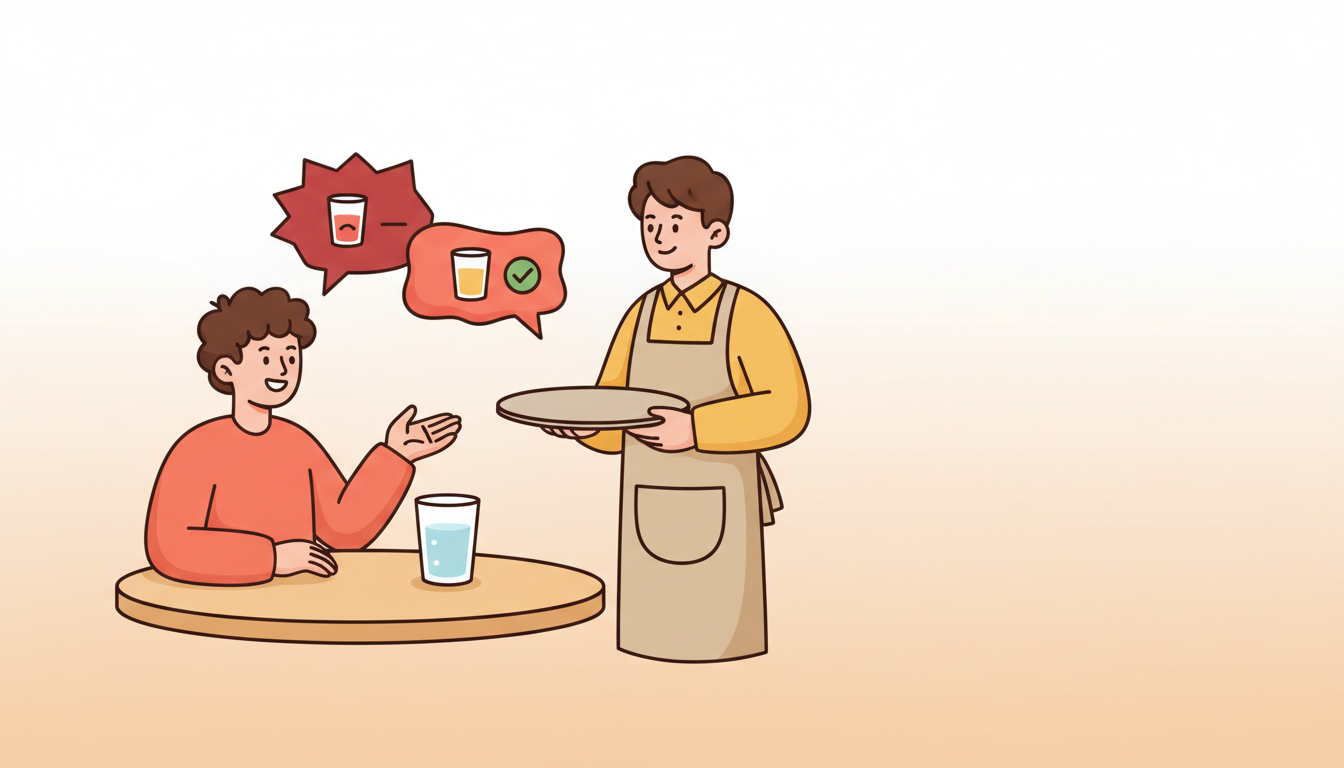
水をください. Mizu o kudasai. You'd say it to a waiter, a colleague, a stranger at a conference, and every one of them would hear it as polite. Now translate it word for word: "Water, please give me." Trim it to what actually comes out of most learners' mouths, and you get "Give me water." Or worse: "I want water."
Nobody means to sound rude. You came from a language with a whole grammatical system for politeness, and somehow your English keeps landing like a text from your landlord. This is the paradox that trips up Japanese speakers more than articles, more than /r/ and /l/, more than anything on a grammar test: the more carefully you were taught to be polite in Japanese, the blunter your literal English can sound.
It isn't an attitude problem. It's an architecture problem. Both languages soften what you say. They just keep the softener in completely different places. (German speakers hit the same wall from the opposite side: blunt-sounding English, different native cause.)
Where politeness actually lives
です and ます: two little endings that turn any Japanese sentence polite without touching what you're actually saying. In Japanese, politeness rides on the verb, and you know this in your bones even if you've never named it. Swap する for なさる and you've elevated the person you're talking about (sonkeigo). Swap it for いたす and you've humbled yourself (kenjougo). The respect is welded into the word. You can be devastatingly polite without ever changing your actual request, because the politeness lives in the conjugation. (If that three-layer system still feels fuzzy, we broke it down in our guide to keigo.)
English barely has any of this. There's "please," and after that the grammatical politeness machinery is close to empty. So English hides its politeness somewhere else entirely: in indirectness. Instead of changing the verb's ending, English changes how directly you point at the thing you want. Linguists Penelope Brown and Stephen Levinson called this negative politeness: you soften a request by phrasing it as a question, hedging it, and giving the other person an easy out, all to avoid imposing (politeness theory overview). English is also what researchers call a low-context culture, the kind that spells things out and states them plainly, which is exactly why it leans so hard on these softening moves to take the edge off (high- and low-context cultures).
So here's the trap. You translate the content of a polite Japanese sentence and it arrives in English carrying none of the politeness, because the politeness was never in the content. It was in the verb ending you left behind.
The five sentences that make you sound blunt
水をください in Japanese is polite; translated flat, it becomes "Give me water." Here are five everyday sentences that make the same trip from careful to curt.
水をください (mizu o kudasai) is polite in Japanese. Literal English: "Give me water." Natural English: "Could I get some water?"
教えてください (oshiete kudasai), when you're asking someone to explain something. Literal English: "Please teach me." Natural English: "Could you show me how this works?"
レポートを出してください (repōto o dashite kudasai), a normal work request. Literal English: "Give me the report." Natural English: "Could you send me the report when you get a chance?"
直してください (naoshite kudasai), when you want a correction. The version that often comes out: "You must fix this." Natural English: "Could you take another look at this part?"
ちょっと待ってください (chotto matte kudasai), asking someone to hold on. Literal English: "Wait." Natural English: "Could you give me one moment?"
Notice that "please" is doing the heavy lifting in all the Japanese, but "Please teach me" and "Please fix this" don't actually soften much in English. English "please" bolted onto a command still sounds like a command, sometimes a more impatient one. The softening you need is structural, not a word you sprinkle on top.
The English softening toolkit
"Fix this" and "Could you take a look at this?" carry the exact same request and land in completely different places. That gap is what these four moves control.
Turn commands into questions. This is the single biggest one. English strongly prefers asking over telling. "Send me the file" becomes "Could you send me the file?" Same information, completely different temperature. A request shaped like a question hands the other person the option to say no, and that offered choice is the politeness.
Reach for the past tense. English uses past-tense verb forms to sound more polite, not to talk about the past. "Can you" becomes "could you." "Will you" becomes "would you." "I want to ask you something" becomes "I was wondering if you could help me." It feels illogical, but the distance the past tense creates is read as respect (Cambridge: politeness). This is worth drilling on purpose, because a corpus study of Japanese learners found they underuse exactly these past-tense modals and rarely mark the tentative, "maybe" quality that carries politeness in English (modal verbs in Japanese EFL learners' conversation).
Hedge and downtone. English speakers pad requests and opinions with small softeners: "maybe," "I think," "a bit," "just," "kind of." "This is wrong" becomes "I think there might be a small issue here." To a Japanese ear this can sound almost evasive. To an English ear it sounds considerate.
Learn "would you mind." "Would you mind sending that again?" is one of the most useful polite request frames in English (Cambridge: requests). One quirk worth memorizing: the polite answer to "Would you mind…?" is "No" (as in, no, I don't mind), which feels backwards for exactly one week and then never again.
Try it in Conversa
Practice with AI characters who adapt to your level and give real-time feedback.
Try Conversa FreeParticles you already use have English cousins
ね and でしょう, the endings you tack on all day to soften a statement and fish for a nod, have rough English cousins you can borrow. You already do this move constantly in Japanese; English just relocates it.
Those particles invite the listener to agree and take the hard edge off what you said. English does the same job with tag questions and a rising tone: "It's due Friday, right?" or "That's the new version, isn't it?" These aren't exact grammatical matches, but they scratch the same itch. The British Council notes that in English, intonation can decide whether the same words come across as polite or rude (requests, offers and invitations). A flat "Could you do this" can still land wrong; the same sentence with a warm rising lilt lands fine.
Where it bites hardest, beyond requests
"You are wrong" is grammatically perfect English and socially radioactive. Requests are the obvious battleground, but the blunt-translation problem shows up anywhere English expects indirectness:
- Disagreeing: not "You are wrong," but "I see what you mean, but I'm not sure that works here."
- Declining: not "I can't," but "I'm afraid I can't make that work" or "Unfortunately, that's tricky for me."
- Giving feedback: not "Change this," but "It might be worth revising this section."
- Suggesting: not "We do it this way," but "Maybe we could try it this way?" or "How about we start here?"
The pattern underneath all of them is the same one from the water example: state it less directly, and let the softening come from the structure.
Don't overcorrect into stiffness
"Would you be so kind as to send me the report?" Please don't. Once you learn that English politeness means indirectness, it's tempting to pile it on, and this is where it tips over the other side. Lines like "I would be most grateful if you could possibly assist me" don't read as extra polite in a normal office or café. They read as stiff, or like you're being sarcastic, or like you learned English from a 1950s etiquette book. Everyday polite English is lighter than that. "Could you send me the report?" is already plenty. You're aiming for warm and easy, not formal and elaborate. More is not better; right is better.
Softening is a habit, not a personality
Pick one move: every time you're about to give a command in English, turn it into a question that starts with "Could you." Run it for a week. That single swap fixes most of the bluntness, and it's small enough to actually stick. The rest layers on later.
The tricky part is that you can't feel this working from a grammar sheet. Politeness in English is a live, in-the-moment reflex, and the only way to build the reflex is to use it on someone and notice how they respond. That's the whole reason Conversa exists as an AI conversation partner you can practice with: somewhere to try "I was wondering if you could" out loud thirty times until it stops feeling like a costume and starts feeling like you.