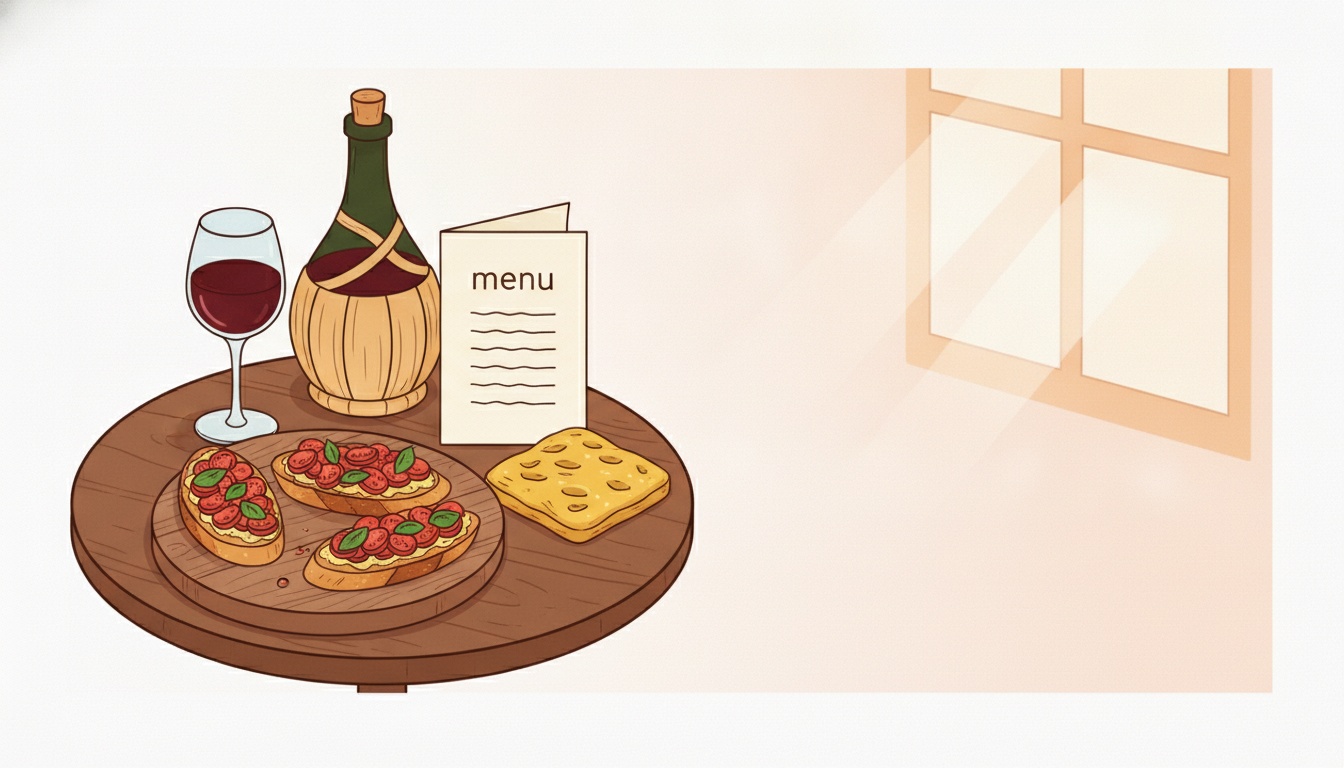
Order bruschetta in an American restaurant and there's a good chance you'll hear "broo-SHEH-tuh" from the next table. In Italian the word is /brusˈketta/: brus-KET-ta, with a hard k and a long t. Wikipedia's article on hard and soft C puts it flatly: in Italian, ⟨sch⟩ "always represents /sk/, not /ʃ/."
The slip isn't random, and it explains most of what goes wrong with Italian c pronunciation. English taught you that an h after c or s makes the sound softer. Italian uses the same letter for the opposite job. Below is the one grid that covers c, g and sc, the two letters that flip them, the over-correction that catches people who learn the rule too well, and a menu to read aloud at the end.
Why the h makes Italian c hard (and English ch soft)
Chianti is /ˈkjanti/: KYAHN-tee. No "ch" as in cheese anywhere in it.
In English, h is a softener. Put it after c and you get chicken, or chef, or occasionally choir with a k, which the Wikipedia article lists as the three English values of ch.
Put it after s and you get ship. Put it after sc and English can't decide: Wiktionary gives schedule with "sh" or "sk" in the UK and only "sk" in the US, and schnapps only with "sh". So by the time you meet an Italian menu, your reflex says h means hiss.
In Italian the h after c or g is silent. It has one job, which is to keep the consonant hard before an e or an i. Without it, chi (who) would be read "chee".
Same two letters. In Italian the h is silent and keeps the c hard.
How e and i decide the sound of c and g
Cina is China. china is India ink. The only difference is the h, and it changes the first sound from /tʃ/ to /k/. Wikipedia's Italian orthography article uses that pair, along with giro (a lap, a stroll) and ghiro (a dormouse).
The rule underneath is short. Before a, o or u, c is a k and g is the g in go: casa, cucina, gatto, gusto. Before e or i, they go soft: c becomes the ch in church (cena, dinner) and g becomes the j in jet (gelato, giro).
Then two letters override the vowel. An h forces the hard sound back in front of e or i. An i in front of a, o or u forces the soft sound and usually goes quiet itself. Spanish solves the same problem with a silent u instead of an h, writing gue and gui to keep the g hard before e and i.
Here is the whole system on one screen. sc follows the same logic, with "sh" as its soft sound.
| + a, o, u | + e, i | + h + e, i | + i + a, o, u | |
|---|---|---|---|---|
| c | k: casa, cucina | ch: cena, Cina | k: che, Chianti | ch: ciao, focaccia |
| g | g: gatto, gusto | j: gelato, giro | g: spaghetti, funghi | j: giorno, Gianni |
| sc | sk: scala, scuola | sh: pesce, sci | sk: bruschetta, schiena | sh: sciarpa, prosciutto |
The right-hand two columns are the ones English speakers get wrong, and in opposite directions. Column three gets read soft because of the h. Column four gets read with an extra vowel because of the i.
How to pronounce bruschetta: sce vs sche
pesce is fish. Add an h and you get pesche, peaches. The sc in pesce is "sh" (/ˈpeʃʃe/), and the sch in pesche is "sk" (/ˈpɛske/). The e changes quality too, so it isn't a perfect minimal pair, but the h is what moves the consonant.
bruschetta sits in the same cell of the grid as pesche: b-r-u, then sch, then e-t-t-a. Hard k, long t, stress on the second syllable.
sch before e is always sk in Italian: brus-KET-ta.
Is "brushetta" wrong? In English, not quite. Dictionary.com lists "-shet-uh" as an American variant, and its Collins British entry gives /bruˈʃɛtə/ alongside the sk version. Wiktionary records the same "sh" form and labels it "often proscribed".
The Cambridge Dictionary lists only sk. So at a diner in Ohio you are within English. In Rome you said a word Italian doesn't have.
The name comes from bruscare, to toast, plus the diminutive -etta, according to Dictionary.com. Toasted bread, small. The k sound is part of the root.
When the i is silent: ciao, giorno, focaccia
ciao has two syllables, not three. The i after c is a spelling device, there to make the c soft before an a, and you don't say it: /ˈtʃao/.
Same with giorno (JOR-no), Gianni, and the scarf, sciarpa (SHAR-pa).
focaccia is /foˈkattʃa/: fo-KAT-cha. Read it letter by letter and you get "fo-KAH-chee-a", with the i taking its own beat. The cci is one long ch sound, and the i only tells you which ch it is.
The exception is a stressed i. In farmacia the stress falls on that i, far-ma-CHEE-a, and the orthography article notes that in this case "⟨ci⟩ is not a digraph."
sciare, to ski, works the same way: Wiktionary splits it into three syllables, sci-à-re, because it comes from sci, ski. Put it next to sciarpa and the same four letters, s-c-i-a, sound different. When the i gets the stress, you say it. When it doesn't, it is a silent marker.
Try it in Conversa
Practice with AI characters who adapt to your level and give real-time feedback.
Try Conversa FreeDon't over-correct: focaccia and cappuccino keep the soft sound
macchiato and cappuccino sit on the same café board, and they go in opposite directions. macchiato has an h: mak-KYAH-to. cappuccino has none: kap-poot-CHEE-no.
Once "ch is k" lands, it is tempting to harden every c in sight, and that road ends at "fo-KAK-ya" and "kappu-KEE-no". The h is the only thing that makes c hard before i or e. No h, no k.
Look for the h. If it's there, the sound is hard. If it isn't, e and i make it soft.
Tuscany has a flatbread that tests both rules in one word: schiacciata. sch is hard, cci is soft. skyat-CHAH-ta. If you can read that one cold, you have the system.
Why amico becomes amici but lago becomes laghi
lago is a lake. Two lakes are laghi, with an h, because without it the plural would be read "LAH-jee". Italian spelling changes to keep the sound: fungo becomes funghi (mushrooms), gioco becomes giochi, and the verb cercare gives you cerchi (you look for), pagare gives you paghi (you pay).
Then there are the words that let the sound change instead. amico (friend) becomes amici, ah-MEE-chee, soft. Gymglish's plural rules list nemico → nemici and porco → porci with it, and note that feminine words always keep the hard sound: amica becomes amiche, with an h.
The spelling still tells you the truth every time. What you can't always predict is which way a masculine -co noun will go. One tendency helps: when the stress falls three syllables from the end, as in medico, the plural usually goes soft, medici. amico is stressed in the middle and goes soft anyway, so it is a word to memorize, not derive.
Read this menu aloud
Cover the right-hand column and say each one, then check. Several of these have a double consonant as well, and Italian holds those longer; how to hold Italian double consonants has its own post.
| Menu | Say it |
|---|---|
| bruschetta | brus-KET-ta |
| Chianti | KYAHN-tee |
| focaccia | fo-KAT-cha |
| spaghetti | spa-GHET-tee |
| funghi | FOON-ghee |
| radicchio | ra-DEEK-kyo |
| porchetta | por-KET-ta |
| prosciutto | pro-SHOOT-to |
| zucchine | dzook-KEE-neh |
| macchiato | mak-KYAH-to |
| schiacciata | skyat-CHAH-ta |
gnocchi is half in scope. The cchi is a long k, NYOK-kee, and the gn at the front is its own sound, closer to the ny in canyon than to a g or an n.
Reading slowly off a table is the easy half. Saying porchetta with a k while a waiter is waiting for your order is the part that takes practice, and it helps to say these words out loud in conversation a few times first, with an AI conversation partner if there's no Italian speaker handy.
The next menu that lists something you've never seen, cicoria or pici or bocconcini, you can read before anyone tells you how. Start with the h.