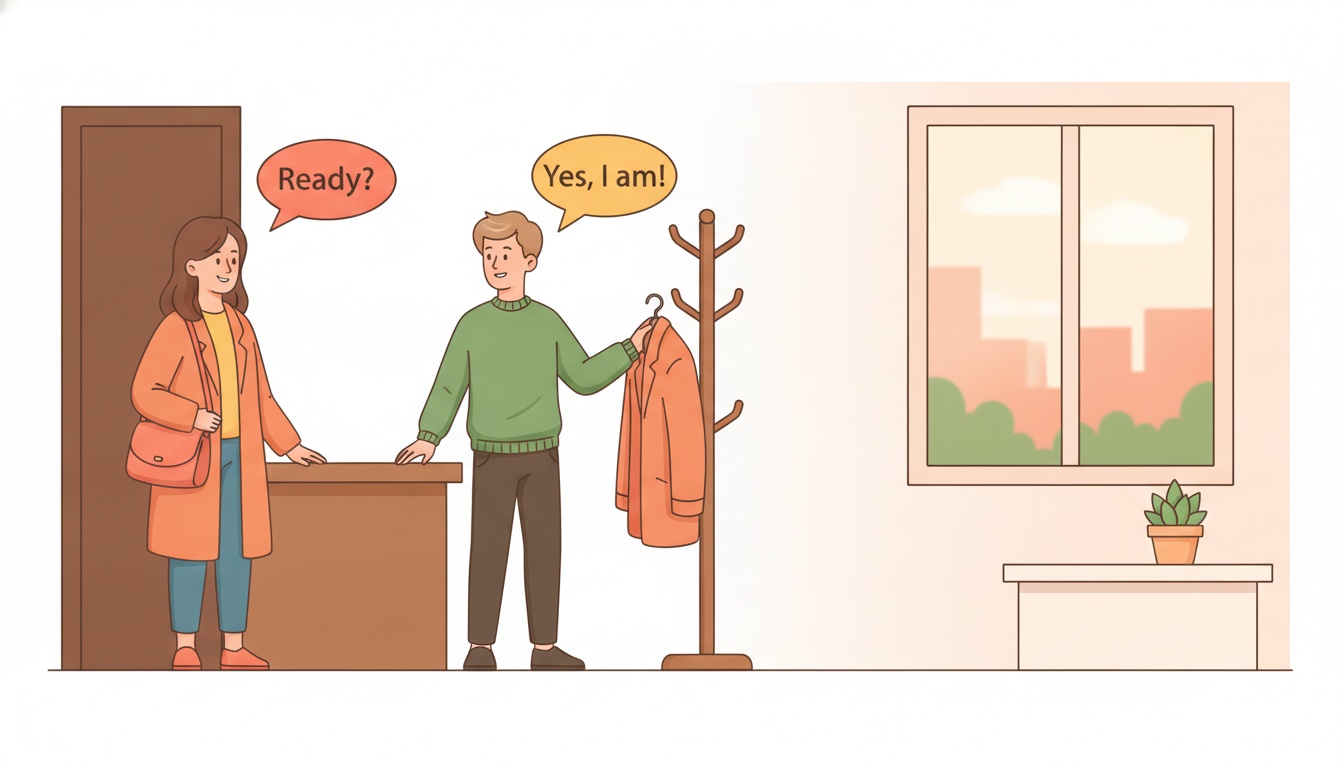
"Are you ready?" your coworker asks, coat already on. You've spent months making your English sound less stiff, so you contract like a native speaker: "Yes, I'm." There's a tiny pause. You were understood, but something sounded off, and nobody will tell you what.
Here's what: English allows contractions almost everywhere, and forbids them in a few exact spots. "Yes, I'm" is one. "Do you know where the station's?" is another.
Textbooks tend to file contractions under "informal, optional," which leaves you guessing. Below is one test that catches the banned spots, why "No, I'm not" passes it, when the full form is a choice you make, and a one-minute drill.
Why can't you say "Yes, I'm"?
Cambridge's learner grammar puts it in one line: "We don't use affirmative contractions at the end of clauses." Its example is "Yes, I think we are," never "Yes, I think we're." The same goes for every short answer:
- "Is that your dog?" "Yes, it is." (not it's)
- "Have you eaten?" "Yes, I have." (not I've)
- "Will you be there?" "Yes, I will." (not I'll)
When am is the last word left, it takes the stress, and 'm can't carry stress.
The usual classroom explanation is about stress, and VOA Learning English's Ask a Teacher column puts it plainly: "If a word is stressed, English does not permit reduced or weak forms." In "Yes, I am," am is the last word standing, so it gets the beat. And 'm can't take a beat. It has no vowel. The linguist Neal Whitman notes that 'm and 're need a host word to lean on, which is why they're written stuck to I and you.
Linguists still argue about the deeper reason. A 2025 paper in the Journal of Linguistics traces the rule back to Harold Palmer in 1924 and Harold King in 1970, then proposes a different explanation from both. Nobody in that debate disputes the facts, though. "Yes, I'm" is out for every native speaker.
The one test: does the rest of the phrase still follow?
"I'm ready." Look at what comes after 'm: ready, the word the verb is there to introduce. That's the test.
A contraction needs the rest of its phrase still coming after it: ready, a teacher, happening, or not. Small words can slip in between ("I'm really ready" is fine). What can't happen is the phrase disappearing.
If the rest of the phrase was dropped or moved away, say the full form.
The phrase can go missing in two ways. It can be dropped because everyone already knows it, like ready in "Yes, I am" or tall in "He's taller than she is." Or it can move to the front of the clause, which is what happens in questions inside sentences. More on those below.
The test also covers sentences that don't look like answers at all. "I'm not sure he's coming, but I think he is." Coming got dropped from the end, so he's has to open back up into he is.
Why "No, I'm not" is fine
"Are you ready?" "No, I'm not." This contraction passes, and it's in every textbook dialogue.
The reason is not. It counts as the rest of the phrase, so 'm still has something after it, and the stress moves onto not instead of am.
So can you end a sentence with a contraction? Yes, when it's negative. Cambridge states this directly: negative contractions do end clauses, as in "No, I haven't." VOA gives a pair that makes the difference audible: "I think we won't" is fine, and "I think we'll" is not.
A full set of short answers to "Is it raining?" looks like this:
- "Yes, it is."
- "No, it isn't."
- "No, it's not."
Three answers, and only the positive one refuses to shrink. Negative questions add a second trap on top: "Aren't you ready?" still takes "Yes, I am" if you are, which is where the yes/no answers that trip up Korean speakers go wrong.
Do you know where the station is?
"Do you know where the station is?" Ask it with station's at the end and it sounds broken, even though station's is a perfectly normal word.
The reason is the test again. In "The station is near the park," near the park follows is. When you turn that into a question about place, where replaces near the park and moves to the front, and is is left at the end with nothing after it.
Where moved to the front, so is has nothing after it.
You'll hear the same shape all day:
- "That's what it is." (not what it's)
- "I wonder who he is."
- "I know who you are."
- "Tell me what time it is."
Watch for one trap. Adding words after the gap doesn't rescue the contraction. The 2025 paper lists "I don't know where the bathroom's in this building" as unacceptable: in this building comes after, but it isn't part of the phrase is was introducing. Where is that phrase, and it moved.
Don't overcorrect by deciding never to contract inside a question like this. "I don't know where the party's happening" is fine, because happening sits right after 's. The same paper sets it next to "where the party's tonight," which fails, and the difference between them is the whole test in one pair.
Try it in Conversa
Practice with AI characters who adapt to your level and give real-time feedback.
Try Conversa FreeIsn't or 's not: which one?
"She isn't coming" and "She's not coming" are both standard English. You can pick either, but there's a pattern. Cambridge notes that 's not and 're not are more common after pronouns ("She's not a friend of mine") and isn't and aren't more common after nouns ("The cakes aren't ready yet").
With I, you get one option in a statement: I'm not. Amn't exists, but mainly in Scottish and Irish English.
In a question, I borrows aren't: "I'm late, aren't I?" That borrowing only works once the question flips the order. "I aren't late" is wrong in standard English.
Cambridge also rules out stacking two contractions on one word: "He'sn't free" doesn't exist, however efficient it looks.
When the full form is your choice
"I'm going." is a plain fact. "I AM going." is an argument. When you stress the verb on purpose to contradict someone, it can't contract, because stressed words don't shrink. Wikipedia's summary of the grammar literature notes that uncontracted forms "are often used for emphasis."
The same article adds that in speech, uncontracted forms "may seem overly formal." Learners who never contract tend to sound like they're reading a contract aloud: "I do not know. It is not here. I will check."
Nothing in it is wrong, and every listener can hear the textbook. In conversation, contract by default and save the full form for when you mean the stress.
Writing flips this. Cambridge calls contractions "usually not appropriate in formal writing", so your cover letter can say "I am" all the way down.
Is "There's three people" correct?
"There's three people waiting for you." Your grammar book says there are, and in writing it's right. Listen to native speakers talk, though, and there's with a plural shows up constantly, along with "Here's your keys."
Mark Liberman at Language Log calls it "merely informal/colloquial, rather than nonstandard," and notes that many people who'd reject "there is two people" accept "there's two people" without blinking. Careful writers still push back: in the American Heritage Dictionary's 2014 survey, only 17% of its usage panel accepted "There's only three things you need to know about this book."
So hear it as normal speech and don't mark your coworker wrong in your head. When you write, use there are.
Double contractions: I'd've, shouldn't've, wouldn't've
"I'd've come if you'd asked." Spoken fast, that's "I-duv come." The 'd is would and the 've is have, two contractions on two different words, which is why it's allowed when he'sn't isn't. Wikipedia's article on English auxiliaries lists forms like shouldn't've as possible.
The skill to build here is hearing them. "You shouldn't've done that" and "it wouldn't've mattered" come at you as one blur, the same way gonna and whatcha do in fast connected speech. In writing, spell them out: "I would have come."
A 60-second drill
Six questions. Answer each one out loud, and land the stress on the word in capitals.
- "Are you hungry?" "Yes, I AM."
- "Is he coming?" "No, he's NOT." (contraction fine: not follows)
- "Have you finished?" "Yes, I HAVE."
- "Where's the bathroom?" "I don't know where it IS."
- "What's that?" "I'm not sure what it IS."
- "You're not tired, are you?" "I AM, actually."
The first few times, "Yes, I am" will feel too long, like you've gone formal. You haven't. A native speaker says exactly those three syllables, and the stress on am is what makes it sound relaxed. Next time someone asks "Are you ready?", give them all three.