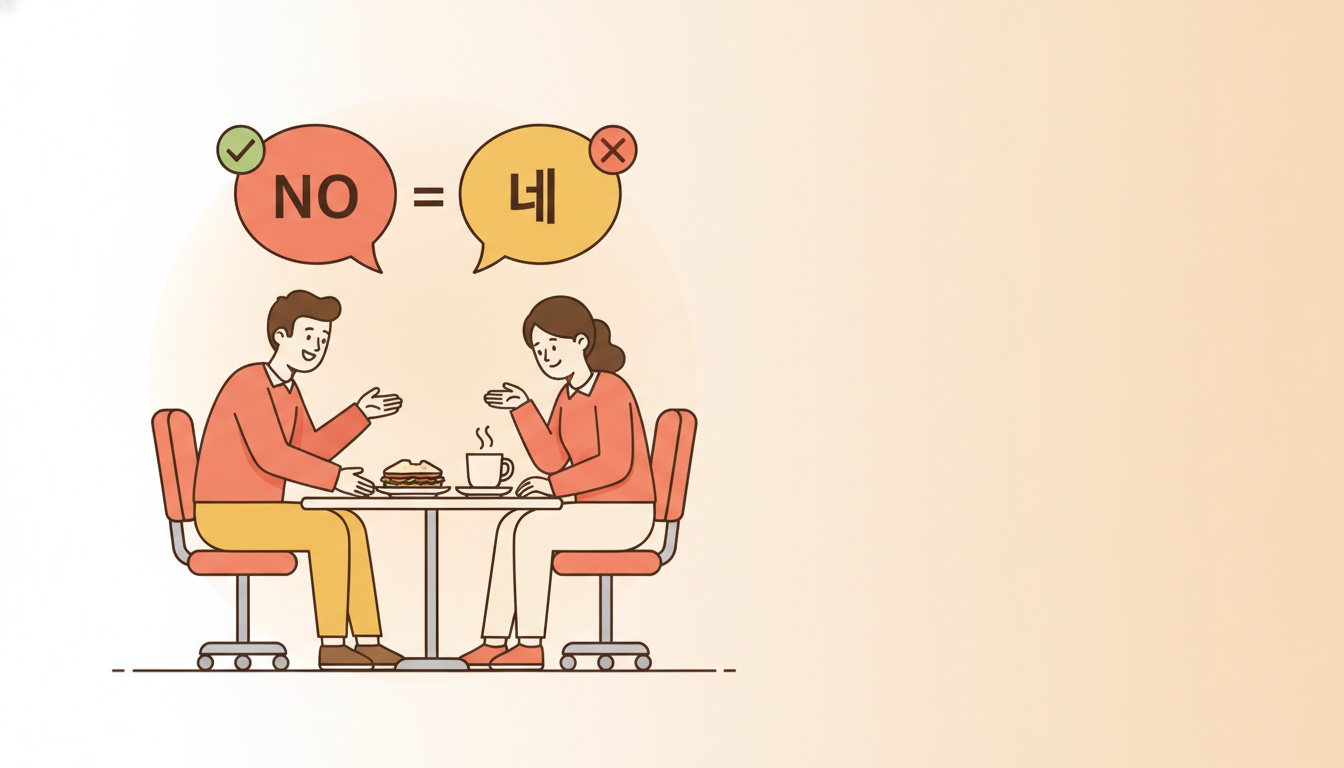
Your coworker sees you at your desk at noon and asks, "You're not coming to lunch?" You're not going. So you say "Yes." They nod and walk off. Ten minutes later they text: "Where are you? We're holding a seat." You answered honestly, in perfect grammar, and still sent the exact opposite message you meant.
This isn't a vocabulary gap or an accent problem. It comes down to one small rule about answering negative questions in English: the word "yes" works one way in Korean and the opposite way in English. Once you see it, you can't unsee it, and it fixes a whole category of mix-ups: RSVPs, confirmations, plans, "did you send the email?" at work.
Why negative questions flip your yes and no
In Korean, 네 means "you're right" and 아니요 means "you're wrong." Your yes/no agrees with the question. So when someone asks 출근 안 했어요? ("You didn't go to work?") and you really didn't go, you say 네, 안 했어요 — "Yes (correct), I didn't go" (UBC Korean Program).
English does the opposite. "Yes" and "No" agree with the fact, and they ignore how the question was framed. "Yes" always points to something positive (I am, I did, I do). "No" always points to something negative (I'm not, I didn't, I don't). The question can be positive or negative and it changes nothing.
So that same exchange in English goes: "You didn't go to work?" → "No, I didn't." The fact is negative, so the word is "No." Your Korean instinct reaches for 네, and 네 comes out as "Yes." That's the whole bug.
Why "Yes, I'm not coming" sounds broken to English ears
Try saying it out loud: "Yes, I'm not coming." An English speaker's brain snags on it, because "Yes" and "not" are fighting each other in the same breath. In English those two don't belong together. "Yes" has to be followed by the positive version: "Yes, I am coming."
There's a second problem, and it's the one that actually ruins the message. In practice, an English listener often keys on that first word: they hear "Yes," lean toward "he's coming," and half-tune the rest. By the time "I'm not" arrives, the wrong idea is already in their head. This is why "Don't you like it?" answered with "Yes, I don't like it" lands as pure confusion. The "Yes" already told them the wrong thing.
Answer the fact, not the question
"No, I'm not coming." That sentence is correct no matter how the question was framed, and it holds the whole fix inside it: ignore whether the question is positive or negative, look only at your own reality, and answer that.
- If the true fact is positive (you are, you did, you do), say "Yes."
- If the true fact is negative (you're not, you didn't, you don't), say "No."
There's a trick that makes this automatic while the habit is still forming: say the full sentence first, then let the yes/no fall out of it. Don't start with the word. Start with "I'm not coming," and now "No" is the only thing that fits in front of it: "No, I'm not coming." Korean learning materials give the same advice from the other direction, telling students to skip 네/아니요 entirely and just state the clause when a negative question could cause confusion (Eggbun Education). Full clause first, yes/no second. It works every time.
The same scenarios, side by side
"You're not coming?" when you're genuinely not coming: your reflex reaches for 네, which surfaces as "Yes," and English needs "No." Here's that gap across five everyday questions. Read the "wrong" column out loud once so you can hear how off it sounds, then cover it up.
| The question | Your situation | Korean reflex → wrong English | Correct English |
|---|---|---|---|
| You're not coming? | You're not | 네 → "Yes" | No, I'm not |
| You didn't eat? | You didn't | 네 → "Yes, I didn't" | No, I didn't |
| Don't you like it? | You do like it | 아니요 → "No, I like it" | Yes, I do |
| Aren't you cold? | You are cold | 아니요 → "No" | Yes, I am |
| Isn't he American? | He's not | 네 → "Yes, he's not" | No, he's not |
Notice the pattern in every row: the correct English word matches the fact in the middle column, and completely ignores the "not" in the question. Cold person says "Yes." Not-coming person says "No." That's all of it.
Try it in Conversa
Practice with AI characters who adapt to your level and give real-time feedback.
Try Conversa FreePractice: five questions you'll actually hear
"You didn't call her back?" You didn't. Is your answer "Yes" or "No"? Work through these five the same way: decide before you look, then say the full sentence, not just the word.
- "You didn't call her back?" (You didn't.) → No, I didn't.
- "Don't you have a charger?" (You do.) → Yes, I do.
- "You're not hungry?" (You're not.) → No, I'm not.
- "Isn't this seat taken?" (It's free.) → No, it's not. Go ahead.
- "Didn't you already send it?" (You did.) → Yes, I did.
If you got even two of these backwards, that's normal and it's the point. The reflex is fast, faster than thinking, so getting it right on paper isn't the same as getting it right when a real person is looking at you.
Two traps even advanced speakers miss
"Do you mind if I sit here?" You're happy to share, your instinct says "Yes, sure," and you've just told the person not to sit down. Two situations bend the answer-the-fact rule, and they catch people who have been speaking English for years.
"Do you mind if…?"
"Do you mind?" is really asking "is this a problem for you?" To say it's fine, you have to say "No, not at all," meaning "no, I don't mind" (British Council). Saying "Yes" technically refuses. Most native speakers will read your friendly tone and let it slide, but the clean answer is "No, go ahead."
Tag questions
"You're coming, aren't you?" and "You didn't call, did you?" tack a little question onto the end. Ignore the tag completely. It's the same rule: answer the fact. Coming? "Yes, I am." Didn't call? "No, I didn't." The tag is just the speaker checking their guess; it doesn't change your answer at all.
You fix this with your mouth, not your head
"You're not done yet?" from a coworker gets an answer out of your mouth before any grammar rule can load. That's why understanding this won't fix it. You already understand it now, and understanding runs at reading speed while conversation runs faster than that.
The only thing that actually rewires the reflex is hearing negative questions and answering them out loud, over and over, until "No, I'm not" beats 네 to the front of your mouth. Ten real exchanges do more than an hour of reading. Practicing with Conversa, an AI conversation partner that will ask you these questions on purpose and let you get them wrong without a coworker waiting on a held seat, is one way to run those reps. The same out-loud practice cleans up the other things Korean speakers carry into English, from Konglish words that quietly shift meaning to the f, v, and z sounds Korean doesn't have. However you drill it, drill it out loud. That's the part that sticks.