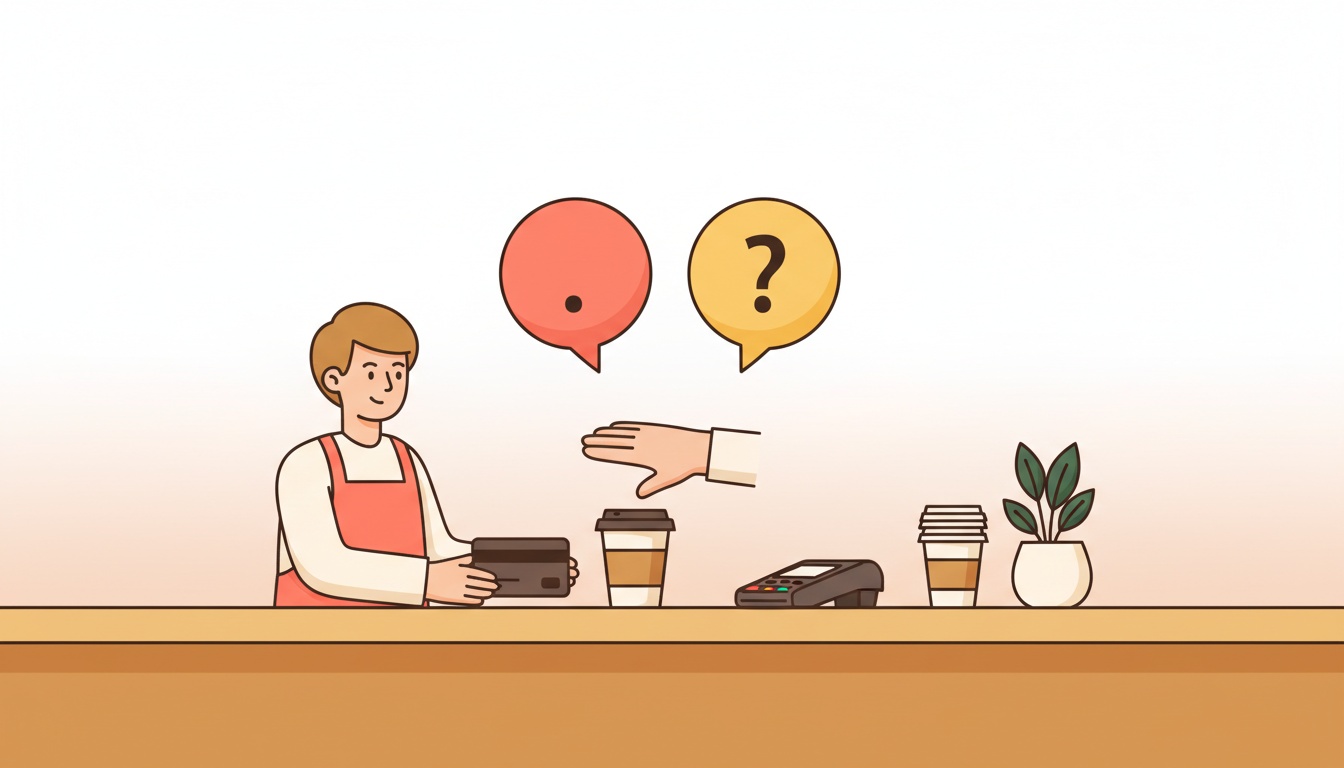
The cashier hands your card back, taps the screen twice, and says, "You're all set." You stay where you are. There must be a total, or a signature, or a receipt, or something. She is already looking past your shoulder at the next person in line.
Nothing else was coming. That was the end.
Your English is not what failed there. American service counters run on a small set of fixed phrases that do not mean what their words mean, and almost every guide to restaurant English teaches the customer's half of the script and leaves the staff's half untranslated. You can order a coffee in four ways. You still cannot always tell what the person handing it to you just said.
Here is the flip between "you're all set" and "all set?", and what "I'm good" commits you to when a bartender points at your glass. Then the two sentences that decide whether your plate gets taken, and why "mhm" is a complete and polite reply to thank you.
"You're all set" means the transaction is over
MIT's International Students Office keeps a page for exactly this sentence, and the scene it picks is the RMV counter: you have handed over your paperwork, you have your driver's license, and the clerk says you're all set. MIT's gloss: "everything is 'OK' or 'ready' or 'finished.'" Nothing further to pay, nothing to sign, nothing to wait for.
The reply is "Thank you." That is the whole reply. Often the staff member closes with "Have a nice day" or "Have a good one," and you are out.
If that phrase has stopped you before, it is worth knowing who else it stops. The same MIT page records the author's parents visiting from South Carolina, hearing a Boston bus driver tell them they were all set, and having to ask what he meant. They had spoken English their entire lives.
New Englanders claim the phrase, and WBUR's Boston glossary lists it among Massachusetts expressions. Do not file it as a regional curiosity you can skip, though. You will hear it at counters nationwide.
You're all set closes the transaction. It is not an offer, and nothing follows it.
But "All set?" is a question, and it flips the meaning
Wiktionary's entry for all set prints a waiter's line with its own stage direction attached: "Are you all set with that?" [a waiter offering to take an empty plate at a restaurant]. Two entries down, a retail version: "Can I help you with anything?" "Nah, I'm all set."
Same two words, opposite jobs. Said about you, "you're all set" means finished, go. Asked of you, "all set?" means do you need anything else. The tell is the rising tone and the question, not the vocabulary, which is identical.
Stated about you, all set means finished. Asked of you, it means do you want more.
Look all set up and you will probably get "ready," which is why the counter version never matched. Dictionary.com, the American Heritage Dictionary and The Free Dictionary all stop at the "prepared" sense. Wiktionary's all set entry is the one that spells out the American service sense: "not requiring initial or further assistance."
At a bar or a counter you will often hear "You're good" instead, closing the transaction the same way. "You're good" also has a second life as the standard American answer to an apology.
"I'm good" is a refusal, not a health report
The bartender points at your empty glass. You say "I'm good." You have just said no.
Writing on the Oxford University Press blog, the linguist Edwin Battistella describes the scene precisely: a server brings more coffee around, or the bartender points at the glass, and you hold up a palm and say "I'm good." It works as an indirect "no, thanks." Wiktionary tags the phrase chiefly US, informal, and defines it as "No, thank you: used when asked whether one wants or needs something."
During a DEA bus search described in Battistella's post, a woman answered a request to search her with "I'm good." The agent treated that as consent, searched her, found drugs, and arrested her. She contested the search, and the linguist John Rickford submitted a long deposition on what "I'm good" means when someone says it. The case ended in a plea deal.
The learner error runs the other direction. A server asks if you want another, you hear a question about your wellbeing, and you answer "I am fine too, thank you." It is a perfectly formed sentence answering a question nobody asked.
Grammatically both work. I'm good is what an American ear expects at a counter, and it will not be heard as a comment on your health.
"Are you still working on that?" is a question about your plate
A server stops at your table, looks at your half-finished food and asks, "Still working on that?" She is asking whether she can take the plate. Nothing about the phrase is a comment on how slowly you eat.
Two answers, with opposite results:
- "I'm good, thank you." She takes it.
- "Still going, thanks." She leaves it.
A nod decides nothing. It reads as agreement, and the plate often goes.
Search this phrase and the first thing you find is a fork-position code, a scheme of clock positions for your knife and fork that is supposed to tell the server whether you are finished or resting. The etiquette consultant Arden Clise teaches those signals, then concedes in a reply to a commenter under her own post that casual restaurants do not train staff to read them. Learn the sentence. The fork will not save your plate.
Servers say it because it does a job: it asks about the plate without making you announce that you are finished.
How to ask for what you want: "can I get", not "I want"
In a study of 820 requests recorded at a single American Starbucks, Jenna Taylor coded every order by its grammatical frame:
- Can I get, could I get, may I have: 46%. "Could I get a venti americano, light cream?"
- No verb at all: 20%. "Tall cinnamon dolce latte."
- I'll have, let me have: 16%. "Let me have a grande vanilla rooibos tea."
- I want, I would like: 13%. "I want a grande white chocolate mocha, nonfat, no whip."
- I need: 4%. "I need a grande coffee."
- Give me: 1%.
That is one store in one state, and Taylor counted what people said rather than asking baristas what they thought of it. Treat the ranking as a map of the room, not as a politeness rule. "I want a large coffee" is grammatically flawless and will get you a large coffee. It also lands flatter than almost anything else you could have said, because bare want states a desire where the room expects a request.
Can I get is the unmarked American order frame. I want is correct English that nobody else at the counter is using.
Try it in Conversa
Practice with AI characters who adapt to your level and give real-time feedback.
Try Conversa FreeThe questions that come with the order
"Is that for here or to go?" is printed as an example sentence in Cambridge's entry for to go, which defines it as food "wrapped up so that you can take it away with you." If you learned British English, your instinct is to answer "takeaway." You will be understood, and you will also be marked instantly. The American answer is "To go, please," or "For here, thanks."
Three more you will meet at a café counter:
- "Room for cream?" or "Leave room?" Should I stop short of the top so you can add milk. Yes or no is a complete answer.
- "What can I get started for you?" What would you like. The started is filler from the barista's workflow.
- "Anything else for you today?" Are you finished ordering. "That's it, thanks" closes it.
On the way out, one word swaps: Americans ask for the check, not the bill. That one belongs to a bigger list of the American and British words that actually cost you something.
At the card reader: "credit or debit", "tap or insert"
"Credit or debit?" is not asking which card is in your hand. As NBC News explained it, the cashier is asking which way to route the same debit transaction: PIN-based, or signature-based. Say "debit" and you type your PIN. Say "credit" and you sign or just approve. "Tap or insert" is simpler than it sounds: tap means hold the card over the reader, insert means push it chip-end first into the slot and leave it until the machine tells you to pull it out.
Then: "Do you want the receipt?" Then: "You're all set." And you are back where this post started, except now you know you can go.
"Mhm" and "you bet" both mean "you're welcome"
"All right, Lonnie, thank you very much." "You bet."
That is spoken American English, out of the Corpus of Contemporary American English. The linguist Laurel Brinton, who traced the history of these replies, found that you bet as a response to thanks is the majority usage in the spoken section of that corpus, and is rarely found in British English.
Then there are the replies so short they sound like nothing. Aaron Dinkin's fieldwork, published in the Journal of Sociolinguistics, transcribes what people actually said back: mhmm, uh-huh, yep, yup, sure, okay, of course, sure thing. His data comes from Toronto rather than the US, so read it for the shape of the thing. Every one of those is a complete and polite answer to thank you. None of them is a brush-off.
Do not conclude that "you're welcome" has died. Dinkin's own survey of earlier work reports studies that found the opposite: zero instances of no problem in one set of Los Angeles restaurant data, and you're welcome as the most common response in New York street interactions. "You're welcome" has competition. It has not been replaced.
The two sentences to leave with
Most of this post is comprehension, and comprehension is the easy half. The production half comes down to two lines that work in almost every scene above. "I'm good, thanks" is how you say no to an offer of anything. "Still going, thanks" is how you keep your plate.
Knowing them and saying them at speed, with a line behind you and a server already half-turned toward the next table, are different skills. The phrase arrives faster than you can retrieve it. That is a rehearsal gap, and rehearsal closes it. The fix is boring: say the answers out loud somewhere with no stakes until they come out without a search. An AI conversation partner like Conversa is one place to run the counter script a few times before you are standing in it.