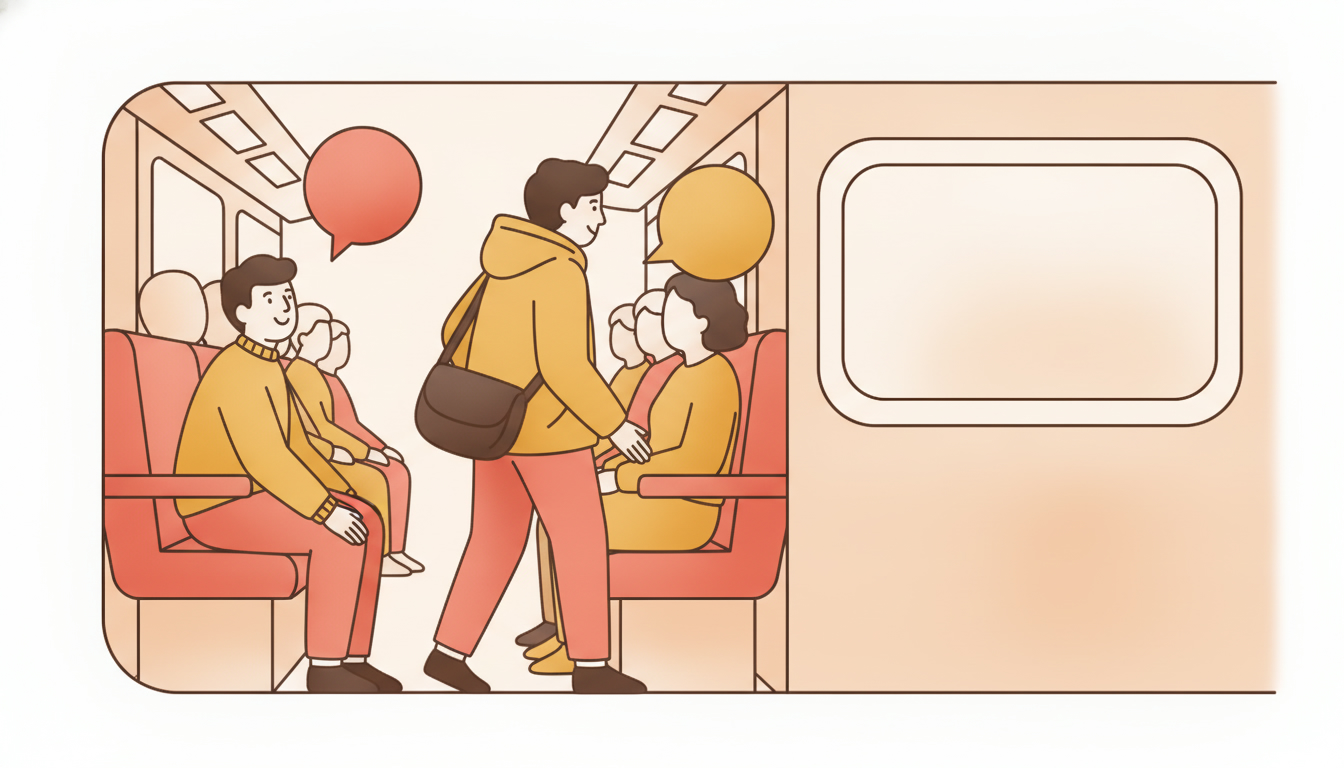
You are edging down the aisle of a packed train, bag first. "Excuse me. Sorry. Excuse me." The guy in the aisle seat pulls his knees in. Your bag clips his shoulder anyway.
"Oh — sorry."
"You're good."
Four seconds, two of the words this post is about, and one reply you were never taught. He did not say you were a good person. He did not forgive you. He said something much more specific than that. And the next time somebody apologizes to you, it is the thing you should say back.
Here is the rule that puts excuse me and sorry in the right order, the grammar test that tells you whether you just admitted fault, the ladder from my bad up to I apologize, and the two-word reply no dictionary has caught up with.
Excuse me goes before, sorry goes after
Both words came out in that train aisle, in that order, and the order was not a coin flip. Excuse me buys something you are about to need. Sorry pays for something already spent.
Look at the senses Cambridge leads with. Every one of them is pre-emptive. Attracting attention: "Excuse me, does this bus go to Oxford Street?" Asking someone to move: "Excuse me, can I just get past?" Announcing you are about to leave: "Excuse me — I'll be right back." Nothing has gone wrong yet in any of the three. You are clearing a path. (Cambridge does list other senses further down: one for apologizing after a small collision, one for asking someone to repeat, one for picking a fight. Those come later in this post.)
Now sorry, the one-word exclamation. Cambridge gives it as an exchange: "That's my foot you're stepping on." "Sorry!" The foot is already stepped on. You are paying.
Excuse me clears the path, sorry pays the bill.
Ask for the space; apologize for the shoulder. It also explains something I am asked about a lot: you will hear "excuse me" in a store aisle when you are not actually blocking anyone. Read as an apology, it makes no sense. They are buying a path they have not needed yet.
The grammar that decides whether you just admitted fault
"I'm sorry you had to wait" and "I'm sorry I kept you waiting" are four words apart. One of them admits fault. The other does not, and if your first language treats an apology as a confession, that difference is worth more to you than any phrase list.
Merriam-Webster splits sorry into two senses that live side by side. Sense 1a is sympathy: "I'm so sorry for your loss." Sense 1b is regret or penitence: "He was sorry about what he had said." Cambridge makes the same cut independently, filing one sense under expressing sympathy with the example "I'm sorry (that) you had such a difficult trip."
What decides which one you just said is the grammar after the word.
A clause about them is sympathy; a clause about you is an apology.
A coworker tells you she is out Thursday because her grandmother died. You say "Oh, I'm so sorry." Nobody in the room believes you killed the grandmother. The sentence does not work that way.
So when you dodge an apology in English because saying sorry feels like signing something, you are usually being careful about the sympathy half, where the risk is not there. The fault-admitting half is a real choice, and in a US office it is usually the right one. Which pieces of an apology feel obligatory turns out to be a first-language habit. Bar On and Meir found in 2022, testing Hebrew- and English-dominant bilinguals, that people carry their dominant language's apology strategies into their weaker one, and that what varies is which components you include: the apology word itself, accepting responsibility, offering to fix it. If your English apologies land flat, that is the piece to check first. The same transfer happens with politeness habits Japanese keigo hides.
"Excuse me?" is two different sentences
Merriam-Webster gives excuse me eight numbered senses, and two of them are the same three syllables doing opposite jobs.
Sense 7, labeled chiefly US: "Excuse me? I didn't hear the last part of what you were saying." You missed something.
Sense 8, labeled informal, is the other one. "You were supposed to be home an hour ago." "Well, excuse me! I had to fix a flat tire." You are annoyed and about to argue.
Written down they are identical. Said out loud they are not.
"Excuse me?" Same stress, but flat, quiet, over almost before it starts. You missed a word.
"ExCUSE me?!" Louder, the middle syllable pulled long and high. You are about to have a conversation you did not want.
Treat that as a rule of thumb rather than a measurement. Conversation-analysis work does find that pitch, loudness and contour shape can indicate whether a repair initiation sounds normal or astonished, though the study behind that claim (Selting, reported in a 2025 paper on detecting repair requests) worked on German conversation, not English. Short and quiet is the safe default in a checkout line.
"Excuse you," on the other hand, I have never once heard used neutrally. You cut a line, or you let a door swing back on someone, and you hear it from behind you: "Excuse you." That is not a request. It is a verdict.
To ask someone to repeat themselves, there is a separate set of repair phrases.
Pardon me is American. Bare "Pardon?" is not.
Cambridge's American dictionary lists "Pardon me, does this train go to Oakland?" as ordinary US English. So much for pardon being the British one. The entry for pardon me runs to four American senses: getting someone's attention, asking for a repeat, covering a burp or a bump, and softening a disagreement before you make it.
What the labels actually split is the short form. For the repeat-request sense, Cambridge tags excuse me? as US and gives pardon? as the UK equivalent. Merriam-Webster independently marks excuse me? for repeats as chiefly US. So bare "Pardon?" is the British habit, while "Pardon me" is at home on either side.
Two dictionaries agreeing on a regional label is the whole evidence base here. I could not find a frequency count, so treat it as a label, not a measurement.
Which rung: my bad, sorry, or I apologize
Say "I apologize" to a friend whose shoulder you just bumped and you sound like a letter from a lawyer. Say "my bad" after missing a client deadline and you sound like you do not care. Same ladder, opposite failures, and the rung is not chosen by how bad you feel. It is chosen by what the mistake cost the other person.
Late to work, nothing lost:
You (sliding in): Sorry, sorry — train was a mess. Manager: No worries, you didn't miss anything.
Late to work, and it cost someone:
You: Hey, I'm really sorry. That was on me, I should've left earlier. Where are we? Manager: It's fine. We pushed the demo to eleven.
Late with a file, on the record:
"I apologize for the delay. Resending the corrected version below."
My bad means "that was my fault". It accepts the blame and skips the apology word entirely, which is exactly why it sits at the bottom of the ladder. And it is newer than most people think. Cambridge labels it informal. The lexicographer Ben Zimmer, tracing its actual history, reports the OED's earliest citation from the Gainesville Sun in November 1985: "Oops, my bad, I forgot." It works with friends and it works for spilled coffee. It does not work in writing to anyone who outranks you.
Try it in Conversa
Practice with AI characters who adapt to your level and give real-time feedback.
Try Conversa FreeWhat to say when someone apologizes to you
Someone clips your cart in a grocery aisle, says sorry, and you have about half a second to answer. Here is what you will actually hear at a US counter, on a sidewalk, in an office:
"No worries." · "You're good." · "You're fine." · "All good." · "Don't worry about it." · "No problem." · "It's fine."
What "you're good" means
It means nothing happened, there is nothing here to forgive. Not "you are a good person," which is how it lands the first time and why people ask about it on forums for years.
Straight up: "you're good" in this sense has no entry in Cambridge. I went looking, and what comes back instead is forum threads and crowd-written glossaries. It is ordinary spoken American English that the dictionaries have not caught up with yet, which happens more than you would think with the short spoken stuff.
If you have read about why "how are you?" from a cashier is not really a question, this is the same machine one speech act over. A ritual phrase wants a ritual answer.
Why "it's okay" says more than you mean
"It's okay" is the reply most learners reach for, and it is the one that quietly does something extra. It grants forgiveness. Granting forgiveness concedes that there was an offense worth forgiving.
After a real one, that is exactly right. Someone forgot your birthday, someone dropped a commitment, and "it's okay" is warm and generous. After a bumped elbow, it sounds like you noticed, you weighed it, and you have decided to let it go this time. "You're good" does not weigh anything. It says the scale never came out.
Then there is no worries, which comes with a surprise. Merriam-Webster labels it "chiefly Australia + British, informal." Wiktionary agrees it is not American. Americans say it constantly anyway, several times a day in some offices. That last part is my ear, not a source.
What I can point at is the direction of travel. The sociolinguist Aaron Dinkin tracked a real shift toward "no problem" and "no worries" at the expense of "you're welcome" among younger speakers. Toronto, though, and replies to thank you rather than to apologies. Read it as the current moving, not as an American statistic.
For work, "no problem" and "don't worry about it" are safe everywhere, and "no worries" is fine in speech and in chat, just not in a message to a client, where the dictionaries' Australian label is a hint that it reads as very casual. "My bad" is a confession, not a reply. It never goes here.
The "sorry" that isn't an apology at all
"Sorry to bother you, do you have two minutes?" Nothing has gone wrong. Nobody is apologizing. You will hear this sorry in an American office all day, and it is not an apology at all, it is a way of asking for something.
There is a number on this. Danescu-Niculescu-Mizil and colleagues at Stanford scored a large annotated corpus of real written requests for politeness. Their table's example for that strategy is literally "Sorry to bother you…", and requests using it landed in the politest quarter 53% of the time. Their corpus was Wikipedia and Stack Exchange rather than office speech, so read it as evidence that the move works, not as a count of how often Americans say it. Drop it and the same question turns into an instruction.
"Sorry to jump in" does the same job in a meeting. So does "sorry, quick thing" before you interrupt.
One habit I would break, and this is craft advice rather than anything I can cite: opening every email with "Sorry for the late reply." It puts you at fault before the reader has decided whether they minded. "Thanks for your patience" carries the same message and hands them the compliment instead. I switched years ago and nobody has ever asked me why I stopped apologizing.
The one change worth making tomorrow
Next time someone apologizes to you for something trivial, a bumped cart or a held door, answer "you're good" and watch what happens next. Nothing happens next. That is the point. The exchange closes in two words because you declined to open a file on it.
None of this will make you more polite. Over-apologizing is its own problem in a US office. An engineer who starts every message with an apology reads as unsure, not as considerate. What you get instead is narrower: you stop sounding like you are reading from a script written for a different country.