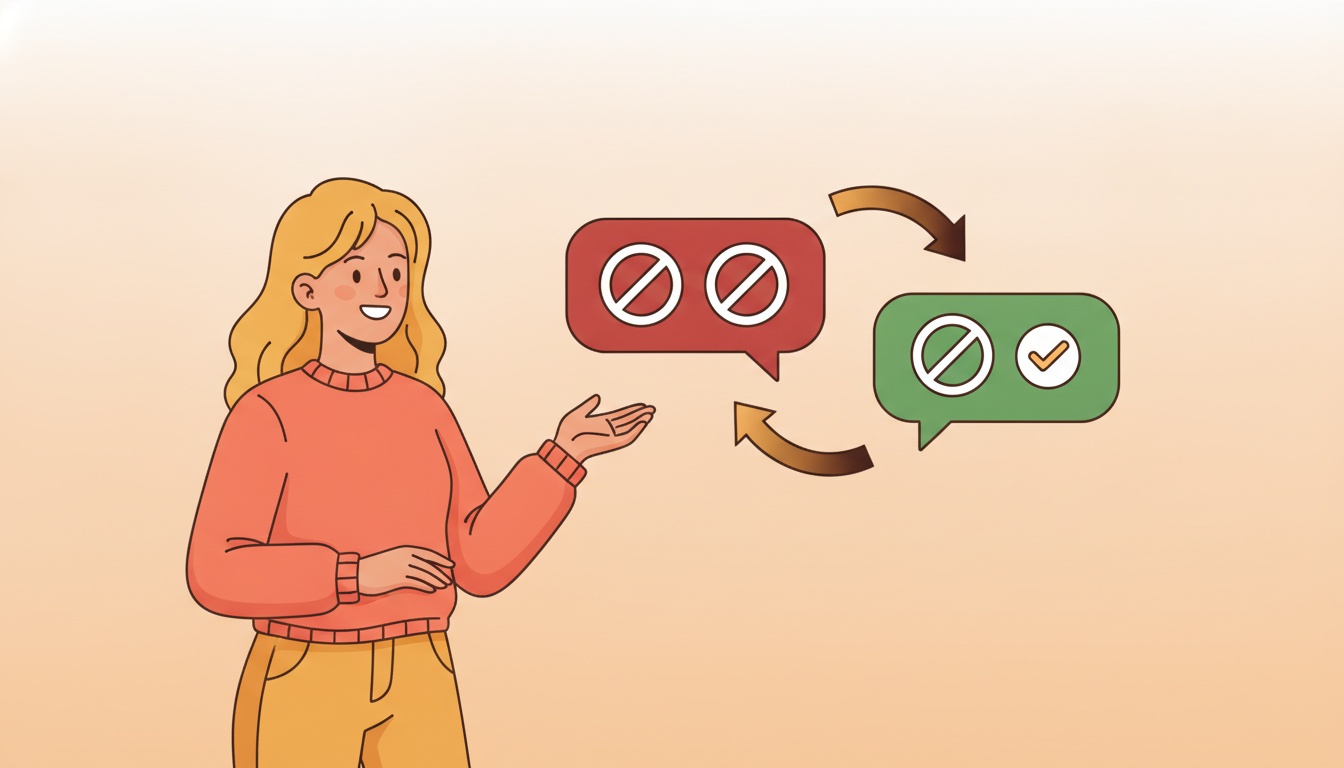
You say "I don't know nothing about it" in a work meeting, and someone gives you a small, confused look. The sentence felt completely right in your mouth. That's the problem: in Spanish, it is right. "No sé nada de eso" needs both negatives, and your brain just translated a correct Spanish sentence word for word.
Every Spanish speaker does this, and it has a fix that fits on an index card. It isn't carelessness or a gap in your vocabulary; it's your first language doing exactly what it's supposed to do, in the wrong place. Here's what's actually happening.
Your brain isn't being lazy: Spanish requires the second negative
Say "No vi a nadie" out loud. Word for word, that's "I didn't see nobody." Now try to say it the "English" way in Spanish: "No vi a alguien." It's broken. No native speaker would say it. Spanish demands a negative word after the verb once you've put no in front of it, and the two negatives don't fight each other. They team up. Linguists call this negative concord, and Spanish runs on it.
The rule is mechanical in Spanish: one negative goes before the verb and another goes after it. "No tengo nada" (I don't have nothing). "No conozco a nadie aquí" (I don't know nobody here). "Nunca dice nada" (He never says nothing). You've said sentences like these tens of thousands of times, correctly, for your whole life. Of course they leak into English.
What English does instead, and why it feels backwards
In 1762, a bishop named Robert Lowth wrote a grammar declaring that two negatives cancel each other into a positive, borrowing the logic from arithmetic, and that rule stuck to formal English like glue. So to a listener trained on standard English, "I don't know nothing" technically parses as "I know something."
Nobody actually hears it that way in the moment. What they hear is that the sentence is off. And here's the part that matters for the fix.
After a negative verb, English swaps the negative word for a different family of words entirely. "Nothing" becomes "anything." "Nobody" becomes "anybody." These "any" words have a name too, negative polarity items, and they exist precisely to carry the second half of a negative idea without adding a second negative.
The swap table: nada becomes anything
Here's the whole fix. When you've already made the verb negative (don't, doesn't, didn't, won't, never), switch the Spanish-style negative word to its "any" partner:
| After a negative verb, this... | ...becomes this |
|---|---|
| nothing | anything |
| nobody / no one | anybody / anyone |
| never | ever |
| nowhere | anywhere |
| none / no + noun | any |
| neither | either |
Run your usual sentences through it. "I don't have nothing to say" turns into "I don't have anything to say." "We don't go nowhere on Sundays" becomes "We don't go anywhere on Sundays." "She doesn't want nothing to drink" becomes "She doesn't want anything to drink."
The rule of thumb underneath the table is even shorter: keep one negative per idea. Spanish spreads the negative across two words; English concentrates it in one and lets an "any" word finish the thought. You don't have to decide which word gets the negative. It's almost always the verb, so make the verb negative and let everything after it go "any."
"But I hear native speakers say 'I ain't got no money'"
You do, and you're not imagining it. Double negatives are everywhere in English songs, in casual speech, and in whole dialects that are every bit as rule-governed as standard English. African American Vernacular English and Appalachian English both use negative concord systematically, the same way Spanish does. "I ain't got no money" isn't a mistake in those varieties. It's the grammar.
So the honest picture is not "double negatives are wrong." It's that they're a marked, non-standard style: perfect in a Rolling Stones lyric, fine when you're joking around with friends, and expensive in a job interview or an email to your manager. A native speaker who says "I ain't got no money" is making a stylistic choice. A learner who produces it by accident reads as someone still learning standard English. Same words, very different signal. Learn the standard form first, then break the rule on purpose if you ever want to.
Try it in Conversa
Practice with AI characters who adapt to your level and give real-time feedback.
Try Conversa FreeThe "me neither" trap
Your friend says "I don't like horror movies," and you want to agree with the negative: "yo tampoco." The instinct is to reach for a negative word, so it comes out "me neither" if you're lucky and something stranger if you're not. "Me neither" is the safe, standard answer for "yo tampoco." Watch the tail end of your own sentences too: "I don't like coffee either," not "I don't like coffee neither," because the "don't" already carried the negative and a second one has nowhere to go. ("Me either" turns up in casual American speech, but "me neither" is the version that's never wrong.)
A five-minute drill that makes the swap automatic
Grab ten Spanish sentences you'd actually say, each with nada, nadie, nunca, or tampoco in it. Translate each one twice. First do it the wrong way, word for word, and say it out loud: "I don't have nothing," "I didn't see nobody." Then translate it the right way with the swap table: "I don't have anything," "I didn't see anybody." Saying the broken version first sounds silly, and that's the point. Hearing the mistake in your own voice is what trains your ear to catch it before it leaves your mouth next time.
Do this for a week and something shifts. You stop translating "nada" as "nothing" by default and start reaching for "anything" on reflex. The place this really locks in is live conversation, where you don't get to pause and consult a table. Conversa is an AI conversation partner you can practice with, and running the same negative sentences past it until the "any" version comes out without thinking is exactly the kind of low-stakes reps that make the habit stick.
If you want to keep going, the same word-for-word-translation problem shows up in other corners of your English. Phrasal verbs bite Spanish speakers for a related reason, and the phantom e on words like school and Spain is the pronunciation version of the same "my first language ported a rule over" story.
The one thing to remember
You're not trying to think about Bishop Lowth mid-sentence. You're training yourself to hear "I don't know nothing" as a literal translation of "No sé nada," catch it, and reach for "anything" instead. One negative per idea. That's the entire move, and it's small enough to fix this week.