Tell an English speaker "I'm so excited" and you sound normal. Tell them "this jam has no preservatives" when you're thinking of the French préservatif, and you've just told them your jam contains no condoms. The word you wanted was conservateur. English "preservative" is the additive; French préservatif is the birth control.
That gap is the whole problem with faux amis. French and English share thousands of Latinate words, and most of the time the resemblance is a gift: table, animal, impossible, nation all mean what you'd guess. The instinct to trust a cognate is right often enough that you stop checking. Then you reach for a word that looks 100% safe and it has quietly drifted to mean something else. Nobody double-checks a word that looks familiar, which is exactly why the familiar ones are the dangerous ones.
Here are the faux amis that actually cost you something, grouped by where they ambush you.
The two that can embarrass you
Préservatif means condom, not preservative, and The Local France lists it among the most notorious faux amis for a reason. If you're reading a food label out loud, the English word you want is "preservative," the additive. Keep the two apart and you dodge one of the most notorious faux-ami mix-ups there is.
Excité is the other landmine. In French it leans toward aroused or worked up, so translating "Je suis excité" straight to "I'm excited" can carry a charge you didn't intend (Languagehat has the full story). For plain enthusiasm, say "I'm looking forward to it" or "I can't wait." It isn't an absolute rule, an excited child is fine, but for your own feelings in a work email, play it safe.
Déception rounds out the trio: it means disappointment, not deception. "What a deception" when the concert gets cancelled makes an English speaker picture a con artist, not a sad evening. You wanted "disappointment." English "deception" is tromperie.
The office faux amis
Actuellement is one of the most common faux amis of all, and it means currently, not actually. "I'm actually working on the report" tells your boss you weren't before; "I'm currently working on the report" is what you meant. WordReference lists "currently / at the moment" for it and no "actually" anywhere. English "actually" is en fait.
Its cousin éventuellement means possibly, not eventually. "I could possibly help you Thursday" keeps the door open; "I could eventually help you" promises help at some vague future point. English "eventually" is finalement.
Three more fire in the same meeting, all confirmed by FrenchToday and HelloFrench:
- Assister à is "to attend," not "to assist." You attended the conference; you didn't assist it.
- Demander is "to ask," not "to demand." "He asked me for the file" is neutral; "he demanded the file" sounds like a threat.
- Sensible is "sensitive," not "sensible." "He's very sensitive" describes a soft heart; the English "sensible," meaning level-headed, is raisonnable.
The verbs that betray you
Attendre means to wait, not to attend, and it cross-wires with assister from the last section. Assister is the one that means attend. Attendre is the one that means wait. "I'm waiting for the bus," never "I'm attending the bus."
Passer un examen is the sneakiest of all, because it produces a sentence that's true in French logic and self-contradictory in English. Passer means to sit or take the exam, not to succeed at it. So "I took my exam yesterday, but I don't know if I passed" is a perfectly normal thing to say. Translate passer as "pass" and you've claimed success and doubt in the same breath.
Two of these verbs are only half-traps, and it's worth being honest about that:
- Supporter mostly means to tolerate or put up with. "I can't stand the noise" is je ne supporte pas le bruit. The exception is sports: supporter une équipe really does mean to support a team.
- Introduire means to insert. "Insert the card in the slot" is introduisez la carte. It works for introducing a topic or a law, but for introducing a person you want présenter, which maps to "introduce."
Try it in Conversa
Practice with AI characters who adapt to your level and give real-time feedback.
Try Conversa FreeThe everyday and travel traps
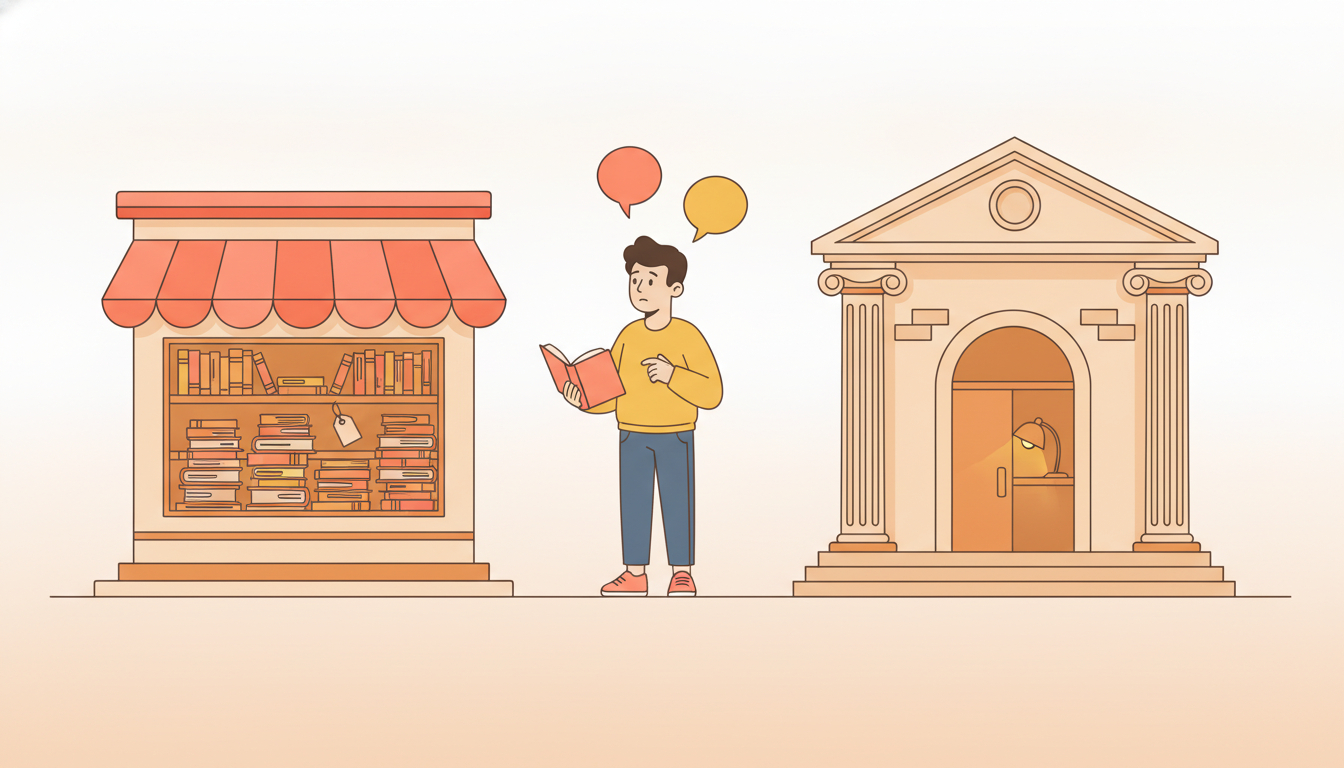
Librairie is a bookshop, not a library. If you want the quiet building full of borrowable books, that's a bibliothèque, which maps to "library." Ask for the librairie and you'll be sent somewhere that expects you to pay for the book.
Location means rental. "A holiday rental" is une location de vacances; the English "location," meaning place or spot, is emplacement or lieu. French Moments wrote a whole article untangling this one. "I booked a nice location for the summer" leaves an English speaker wondering what exactly you booked.
Car is a coach or an intercity bus, not a car. "We took the coach to Lyon" is on prend le car; the thing in your driveway is a voiture. Transparent Language sorts out bus versus car versus voiture if you want the full breakdown.
Journée is a day, not a journey. Bonne journée is "have a nice day," not "have a nice journey." English "journey" is voyage or trajet.
Every one of these runs backwards too: English speakers learning French walk into the same words from the other side, reaching for librairie when they want a library. Same drift, opposite direction.
How to make these stick
Reading a list once does almost nothing, which is why actuellement keeps slipping back into "actually" a week later. What works is a two-column trust check. Take twenty French-English lookalikes and write two columns: the French meaning on the left, the true English meaning on the right. The rows where the two columns disagree are your real flashcard deck. Table and animal drop out immediately; actuellement, sensible, and librairie stay in. You end up drilling only the words that can actually hurt you, not the hundreds that behave.
Then review the deck by scenario, not alphabetically. You want préservatif to surface when you're reading a food label and actuellement to surface when you're writing a status update, so group them the way this post does: pharmacy words together, office words together, travel words together. A word learned in the situation where you'll use it comes back faster than a word learned in a list.
Last, say the correct English sentence out loud. Read the wrong version first ("I assisted the conference"), then the right one ("I attended the conference"), so your ear hears the contrast. This is where an AI conversation partner like Conversa earns its keep, because the faux amis that survive flashcards are the ones you only catch when you're actually talking and one slips out.
The faux amis that trip fluent French speakers aren't the obscure ones. They're actually, eventually, sensible, and library, the words that look so safe you'd never think to check. Check those four first. Then keep talking until the real meanings are the ones your mouth reaches for without asking.