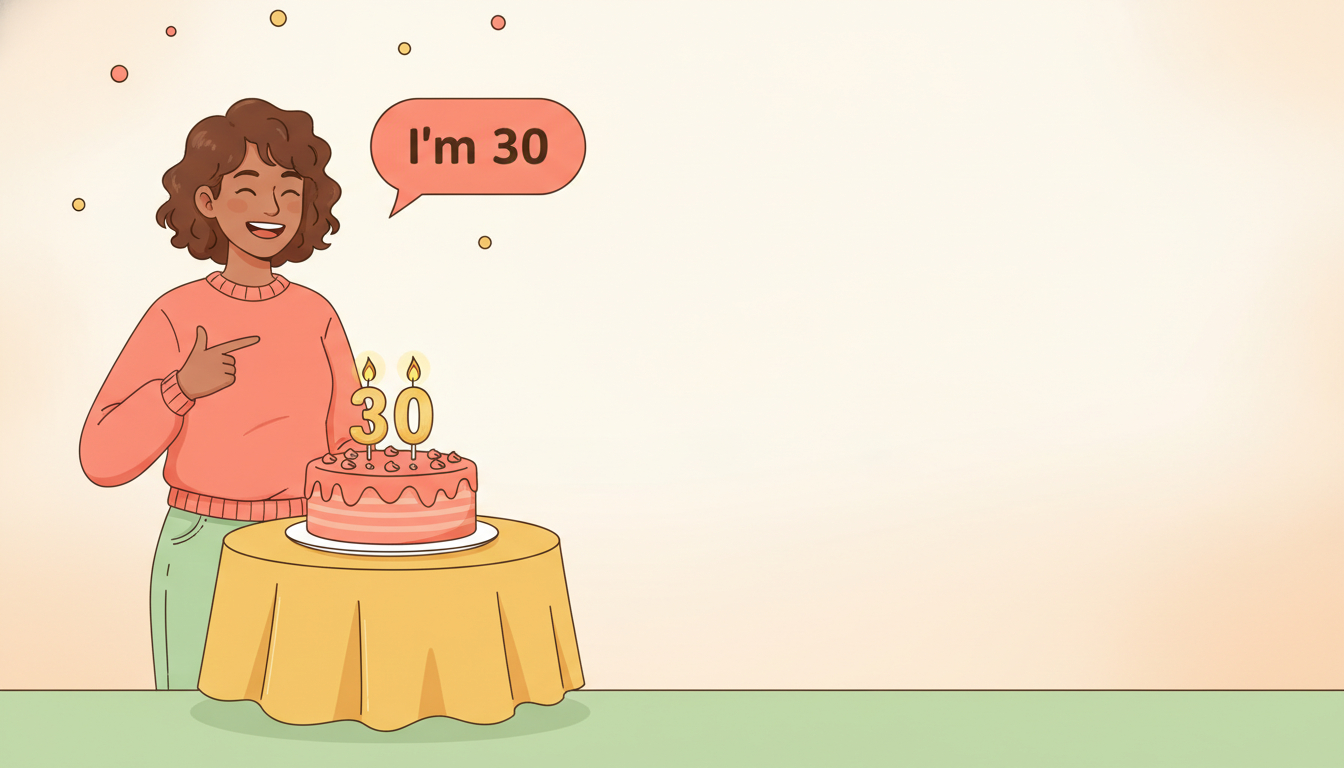
Someone at a party asks how old you are, and you answer "I have 30 years." You watch a tiny flicker cross their face. You said something grammatically strange, and you have no idea what, because in your head the sentence was perfect. It was perfect. In Portuguese. Tenho 30 anos is exactly how you say it, and ter means "to have," so "I have 30 years" is a clean, correct translation of a clean, correct thought.
That's the whole problem in one sentence: it's a good translation of the wrong verb. English doesn't count your years as something you own. It treats your age as something you are. And once you see that one swap, a whole pile of sentences you've been getting wrong falls into place at once.
Why "I have 30 years" feels correct
Portuguese hands age to the verb ter. Tenho 30 anos, ela tem cinco anos, meu pai tem sessenta. The years are a possession, like a car or a headache. So when you reach for English, your brain grabs "have" because that's the slot the verb lives in.
You're in good company, and it's not a Brazilian quirk. Spanish does the same thing (tengo 30 años), and so does French with avoir (j'ai 30 ans). English is the odd one out. It uses "be": I am 30. Portuguese teachers in the UK even list "I have 22 years" as one of the most common mistakes their Portuguese-speaking students make, precisely because the Portuguese logic is so solid that nobody stops to check it.
The fix is one word. Drop "have," use "am":
- Tenho 30 anos → I'm 30. (or "I'm 30 years old," where the "years old" is optional, and most people drop it)
- Ela tem cinco anos → She's five.
- Meu pai tem sessenta → My dad's sixty.
The reframe that makes it stick: in English, your age is not a thing you carry around. It's a thing you are. You don't have thirty years the way you have thirty reais. You simply are thirty.
The question trips you too
In Portuguese you ask Quantos anos você tem?, which is literally "How many years do you have?" Word for word, that's a perfectly natural English sentence, so it's the first thing out of your mouth. But it's not only the answer that changes when you switch to English. The whole question changes shape.
"How many years do you have?" "Uh… at this company?"
English has no "how many years" age question at all. It asks with a completely different frame: How old are you? There's no "years," no "have," nothing to translate across. You have to memorize the English question as a fixed chunk, because taking it apart and rebuilding it from Portuguese gives you the wrong sentence every time.
"How old are you?" "I'm 30."
Two short questions, two short answers, zero "have."
The same trap hits hunger, cold, and fear
Estou com fome, tenho frio, estou com medo: age turns out to be the famous member of a much bigger family, and once you fix the pattern you fix all of them at once. Portuguese uses ter or estar com plus a noun for a whole set of bodily and internal states. Estou com fome is literally "I'm with hunger." Tenho frio is "I have cold." Estou com medo is "I'm with fear." English throws all of that out and uses "be" plus an adjective instead. Here's the field, with the trap in the middle column so you can feel where your brain wants to go:
| Portuguese | The literal trap | Real English |
|---|---|---|
| Estou com fome | I have / I'm with hunger | I'm hungry |
| Estou com sede | I have thirst | I'm thirsty |
| Estou com frio | I have cold | I'm cold |
| Estou com calor | I have heat | I'm hot |
| Estou com medo | I have fear | I'm afraid / I'm scared |
| Estou com sono | I have sleep | I'm sleepy |
| Estou com pressa | I have hurry | I'm in a hurry |
Every row on the right is "be" plus a describing word. Hungry, not hunger. Cold the adjective, not cold the noun. That's the shift English wants: Portuguese names the thing you have, English names the way you are.
One nuance worth knowing, so you don't overthink it: in Portuguese, estou com fome (hungry right now) and tenho fome (hunger in general) carry a slightly different flavor, the same kind of estar-versus-ter split that runs through ser, estar, and ficar. In Brazil, estou com fome is what you'll hear most. In English that distinction vanishes. Both are just "I'm hungry." You don't have to choose. One less thing to track.
The one that hides in plain sight
When you agree with someone in Portuguese, you say você tem razão, literally "you have reason." Watch this one, because it uses ter too and you might slip without noticing. It's the same instinct as the others: a state you "have."
English doesn't say "you have reason." It just calls that being right: você tem razão becomes "you're right." Same family, same fix, swapping the "have" construction for "be" plus an adjective.
I'll be honest about this one. It's less of a banana peel than the age sentence, because a lot of Brazilians already learn "you're right" as a set phrase early on. But it's worth seeing that it belongs to the same pattern, because that's what makes the pattern feel like a rule instead of a list of exceptions to memorize.
Two rules that fix the whole cluster
One swap fixes all seven: I'm 30, I'm hungry, I'm cold, I'm scared, I'm sleepy, I'm right, I'm in a hurry. You need two rules, not seven translations.
Rule one: for age and bodily states, English uses "be" plus an adjective, never "I have." When you feel yourself reaching for "have," stop and ask what you are, not what you have.
Rule two: the age question is "How old are you?" It's a fixed chunk. Never build it from "how many years."
Try it in Conversa
Practice with AI characters who adapt to your level and give real-time feedback.
Try Conversa FreeDrill it out loud
Say "I have 25 years" out loud, then say "I'm 25." Saying the wrong version first, on purpose, makes the correct swap louder in your ear, because this is a spoken reflex and not a spelling rule. The fix has to happen in your mouth, at conversation speed, before you have time to translate.
Run the same two-pass drill through ten sentences:
- "I have 25 years." → I'm 25.
- "How many years do you have?" → How old are you?
- "I have much hunger." → I'm really hungry.
- "My son has three years." → My son is three.
- "I am with cold." → I'm cold.
- "I have fear of dogs." → I'm scared of dogs.
Do it a few times a week and the "have" reflex quietly dies. It's the same live-practice fix that clears the sounds that give Brazilians away, like the English R in "red" and "car": both are habits that only surface at conversation speed, because the error only shows up under real-time pressure. Practicing with a patient conversation partner, whether a person or an AI one like Conversa that won't get bored correcting the same swap, puts you in exactly the spot where the mistake happens. That's the only place you can actually unlearn it.
The honest summary
Next time someone asks your age, remember you're not reporting an inventory. You don't have thirty years sitting in a drawer somewhere. You are thirty. That single swap from "have" to "be" clears age, hunger, cold, fear, and half a dozen other sentences in one move. Learn the pattern once, and you stop translating it word by word forever.