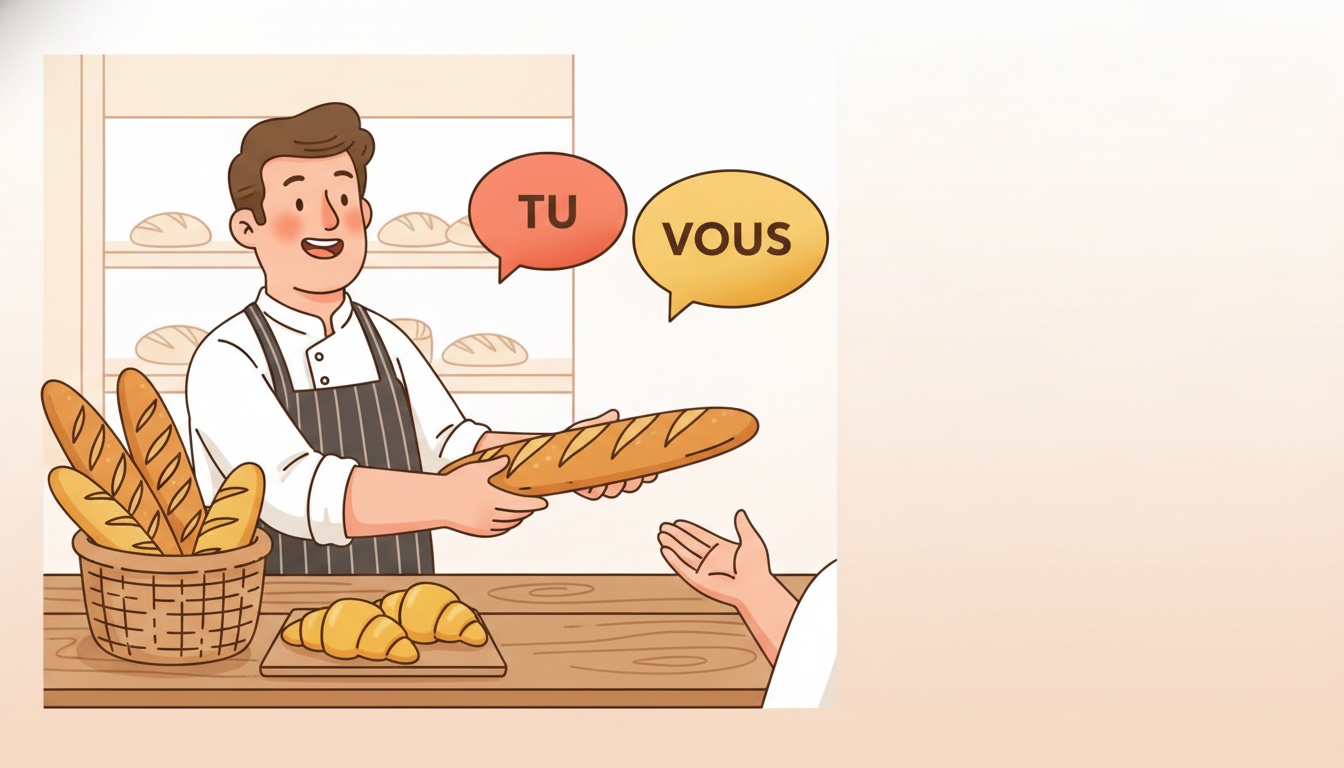
French Catholics say tu to God. The Lord's Prayer in French opens « Notre Père, qui es aux cieux », and that es is the tu form of être. It wasn't always. Before the post-Vatican II translation of the Mass French Catholics prayed « Notre Père, qui êtes aux cieux », and the switch to tu was deliberate, chosen to make God sound close rather than distant.
Meanwhile the man who sells you a baguette gets vous.
So tu vs vous is not a respect dial. If it were, God would be pinned at maximum, and he isn't. What vous actually measures is distance, and distance between two people is something they negotiate, sometimes out loud, in a specific sentence with a specific answer. Here's the default that keeps you safe, who is allowed to offer you the tu, and what to say when you guess wrong.
One scope note before you build a habit on any of this: what follows describes France. Quebec runs looser, and I'll come back to it.
Tu vs vous: start with vous, because the two mistakes cost different amounts
Walk into a boulangerie and say « Vous avez des croissants ? » Not « Tu as des croissants ? » Both are grammatical, both mean "do you have croissants," and only one of them makes the person behind the counter reassess you.
The reason the default is vous is that the two errors aren't priced the same. Say vous to someone who expected tu and you sound a bit stiff, maybe a little formal for the room. Say tu to someone who expected vous and you sound presumptuous, like you've assumed a closeness that wasn't offered.
FrenchEntrée gives the list of people to keep on vous: your boss, work colleagues, neighbors, strangers, teachers, doctors, local officials, and anyone older than you by half a generation or more. And even Quebec's language authority, the OQLF, which describes one of the loosest norms in the francophone world, calls vous the expected form with people you don't know. If it's the default there, it's the default everywhere.
So the short answer to when to use tu or vous in French is that one error is a shrug and the other is a small wince. You start at vous and let people move you. This holds for anyone serving you, no matter how relaxed the room feels. The waiter in a loud bar gets vous. So does the guy renting you a bike. A casual atmosphere is not an invitation.
Vous is doing two jobs, and the verb won't tell you which
You're at a dinner table with four other people and the host says « Vous voulez du vin ? » Is that a polite question to you, or is she offering wine to the table? The verb is no help. Vous voulez is the form whether vous is one person addressed politely or five people addressed at once. Same with vous êtes and vous avez. French merged its polite singular and its plain plural into one word and one conjugation.
There is a tell, and it's the thing most guides on this topic leave out. Adjectives and past participles do not follow the verb into the plural. With a polite vous aimed at one person, the adjective stays singular and agrees with that person's gender.
The OQLF spells this out in its usage guide. Two of its examples are addressed to a woman: « Vous voici rassurée, Madame » and « Vous êtes revenue de ce voyage en pleine forme ». One is addressed to a man: « Je vous ai aperçu hier soir au théâtre », which is why that participle has no -e. Singular endings in all three, gendered to match whoever is being spoken to.
So one sentence splits four ways:
- Vous êtes prêt. One man, politely.
- Vous êtes prête. One woman, politely.
- Vous êtes prêts. A group with at least one man in it.
- Vous êtes prêtes. A group of women.
Now the catch, because this is only half a superpower. Gender you can hear: prête has an audible final /t/ and prêt doesn't. Number you can't. Prêt and prêts are pronounced identically, and so are prête and prêtes. Swap the host's line for « Vous êtes prête ? » and you'll know she's addressing a woman while still having no idea whether she means one of them. That's why French speakers reach for vous deux and vous tous when it actually matters, and it's the same machinery behind liaison and silent letters.
This particular ambiguity is a French problem. Spanish keeps usted and ustedes apart, and German keeps Sie and ihr apart. French merged them, which is why you have to read the adjective.
Tutoyer vs vouvoyer: who gets to offer the tu
The sentence you're waiting to hear is « Voulez-vous qu'on se tutoie ? », which the OQLF prints as a model phrasing. It's also the smartest one to borrow, because it stays in vous while it asks. You haven't presumed anything by the time you reach the question mark. Another from the same page, for stiffer rooms: « Nous pourrions nous tutoyer si vous le voulez bien… »
French has verbs for both modes, which tells you how much of a thing this is. Tutoyer means to address someone with tu; Larousse defines it as using the second-person singular with someone. Vouvoyer is its opposite. An older variant, voussoyer, still turns up, but the Académie française's dictionary marks it vieilli and defines it with the single word "vouvoyer," so vouvoyer is the one to use. The nouns are le tutoiement and le vouvoiement. English has no word for "to call someone by the informal you," and that gap is roughly the size of the problem.
Who's allowed to make the offer? The OQLF names three people, and as the newcomer you're probably none of them: « En général, c'est la personne la plus âgée, ou celle qui se trouve dans une position hiérarchique supérieure, ou encore celle qui reçoit, qui en décide. » The oldest person, the senior one, or the host. So you wait. Casually, the offer lands as « On se tutoie ? » or « On peut se tutoyer ? », and once someone has decided for both of you, as « Tu peux me tutoyer », which is the example sentence Wiktionnaire prints under the verb.
You can also decline, and declining isn't rude if you give it a reason. The Institut Saussure offers a usable line: « Si ça ne vous dérange pas, je préfère qu'on se vouvoie dans un cadre professionnel. » If you don't mind, I'd rather we use vous in a work setting. It names a context. That's what makes it land as a preference the other person can work around.
Picking one rewires the rest of the sentence
« Tu t'appelles comment ? » and « Comment vous appelez-vous ? » both ask your name. Same verb, and past that, nothing lines up: the pronoun changes, the reflexive changes shape, the word order inverts, and comment jumps from the end of the sentence to the front.
Here's the asymmetry that costs you the most. Vous covers four grammatical jobs with one word, and tu needs three different words to cover the same four.
| Job | tu | vous |
|---|---|---|
| Subject | Tu parles vite. | Vous parlez vite. |
| Object | Je te téléphone demain. | Je vous téléphone demain. |
| Reflexive | Tu te lèves tôt. | Vous vous levez tôt. |
| After a preposition | C'est pour toi. | C'est pour vous. |
So tu, te, te, toi on one side, and vous four times on the other. « Vous vous levez » looks like a typo to English eyes and isn't. Possessives collapse the same way: ton, ta, and tes all flatten into votre and vos. « Tu as oublié tes clés. » becomes « Vous avez oublié vos clés. » Imperatives move twice on the same verb: « Assieds-toi. » becomes « Asseyez-vous. », then go negative and the toi goes back to te, « Ne t'assieds pas. » against « Ne vous asseyez pas. »
None of this is hard on paper. It's hard because you commit at the pronoun, three words in, and the rest of the sentence is then locked. English lets you stay vague about how close you are to someone for a whole conversation. French makes you declare it before you've finished your first clause, then holds you to it. That's also why y and en take so long to feel automatic: French keeps more pronoun slots than English does, and all of them have to agree with the choice you already made.
What actually happens when you get it wrong
In Les Souvenirs, Michel Blanc plays a man reporting his mother's disappearance from a nursing home, and the commissioner needles him by asking whether his mother is even old enough to qualify for a child-abduction alert. Somewhere in the panic he starts to tutoyer the commissioner, who stops the conversation to name it: « Non mais vous me tutoyez, là, monsieur ? » The answer comes back « Oui, je vous tutoie ! Laisse-moi, toi ! », which is funnier than he intends: he concedes the point in vous and slips straight back into tu in the same breath. The French teaching blog Je dis, tu dis, il dit, nous disons transcribes the whole exchange and reads that concession as the moment he climbs back down.
Your repair is the same one, minus the shouting. Switch back and keep talking. Don't deliver a paragraph of apology, because the apology draws far more attention to the slip than the slip did.
Two things keep this in proportion. From the panic side: Quebec's police ethics commissioner refuses complaints where the tu is the only grievance, and notes that most complaints that raise it also cite other markers of discourtesy, like wording and tone. The pronoun is rarely the offense on its own. From the too-relaxed side: French teacher Géraldine Lepère points out that foreigners get more slack on this than French people do, which is true and does not mean nobody notices.
It should be some comfort that French people argue about this constantly. Frédéric Vitoux of the Académie française wrote a 2013 column, Éloge du vouvoiement (ou du voussoiement), deploring « le recul progressif du vous, dans la conversation courante ». His verdict on people who push tu on everyone: « le tutoielitarisme est un totalitarisme. » You are not failing to learn a settled rule. You're stepping into a live argument.
Try it in Conversa
Practice with AI characters who adapt to your level and give real-time feedback.
Try Conversa FreeThe version that lands hardest is asymmetry: one person using tu while the other stays on vous. French Wikipedia says non-reciprocal address can be « très mal ressenti », very badly received, especially when it's a superior using tu with a subordinate who has to keep saying vous back. That reads as a status claim, and everyone in the room hears it.
Quebec, Belgium, and the places the rule bends
The OQLF puts it plainly: « Dans certaines aires francophones, au Québec notamment, dire tu dès la première rencontre est beaucoup plus fréquent que dans d'autres, où le tutoiement spontané peut être ressenti comme une familiarité déplacée ». Quebec reaches for tu on a first meeting; elsewhere the same opening move reads as misplaced familiarity. The useful framing is that Quebec tu is a weaker signal. Same pronoun, smaller claim about the relationship.
Quebec also hands you a fix for the ambiguity problem from earlier. Vous autres and nous autres are everyday French, and Quebec reaches for them even when there's no contrast to draw. The OQLF's example is « Vous autres, les garçons, vous pourrez partir avant le reste du groupe. » You lot, the boys, can leave ahead of the group. Nobody at that table is wondering who's being addressed. It's everyday register, not formal writing, so keep it out of your cover letters.
Belgium adds a piece of trivia worth knowing if you work there. The fixed phrase se faire tutoyer means to get a serious dressing-down, and Wiktionnaire gives « Je me suis fait tutoyer par le patron », the boss tore a strip off me. It ties the sense to the Walloon dialects, where people don't use tu at all because it comes across as excessively familiar.
At work, the thing to understand is what tu is signaling. The OQLF describes workplace tutoiement as having the effect of reinforcing « le sentiment d'égalité et d'appartenance au groupe », the feeling of equality and belonging to the group, and notes that spontaneous tu is normal in workplaces and clubs. It's a membership marker. Which gives you a rule that beats any list of industries: mirror what's used on you, and when a group already uses tu among themselves, being brought into it is an invitation.
The one drill worth doing
« Tu peux m'aider ? » « Vous pouvez m'aider ? » Say both, out loud, back to back, until the second one doesn't need a run-up. You already know which is which. What you're drilling away is the two-second stall while you re-conjugate, because that stall is the actual tell, more than the wrong pronoun ever was. Rehearsing it with an AI conversation partner like Conversa helps here for a dull reason: you can run the same sentence both ways twenty times without wasting a real person's afternoon.
And when you have to guess cold, remember what the prayer is doing. Tu for God, vous for the baker. It was never a respect dial.
Quick answers
Is it rude to use tu in French? Only with the wrong person, and the cost is smaller than learners fear. A tu aimed at a shopkeeper, a stranger or a senior colleague reads as presumptuous rather than offensive. Quebec's police ethics commissioner won't even treat it as discourtesy on its own. With friends, children and peers it's the normal form. Start on vous and let people move you.
Can I just use vous with everyone to be safe? Mostly, yes, and it's the right default as a learner. The one place it gets odd is with close friends, or a group that has already brought you into their tu, where staying on vous starts to read as keeping your distance on purpose.
Who is allowed to offer the tu? The OQLF names three: the oldest person present, the one higher up the hierarchy, or whoever is hosting. As the newcomer you are usually none of them, so you wait. If you do want to propose it, « Voulez-vous qu'on se tutoie ? » keeps you in vous right up to the question mark.
Is vous always plural? The verb is always the plural form, but the pronoun might be aimed at one person. Adjectives and past participles give it away in writing: « Vous êtes prêt » is one man, « Vous êtes prêts » is a group.
Do people in Quebec use tu differently? Yes. First-meeting tu is far more common there, and it carries less weight than the same choice would in France. Quebec also uses vous autres to mark an unambiguous plural.
Can I switch back to vous after using tu? After a slip, yes, and quietly is best. What French Wikipedia does flag as badly received is asymmetry: one person on tu while the other stays on vous. So if you switch back, don't leave the other person stranded on tu.