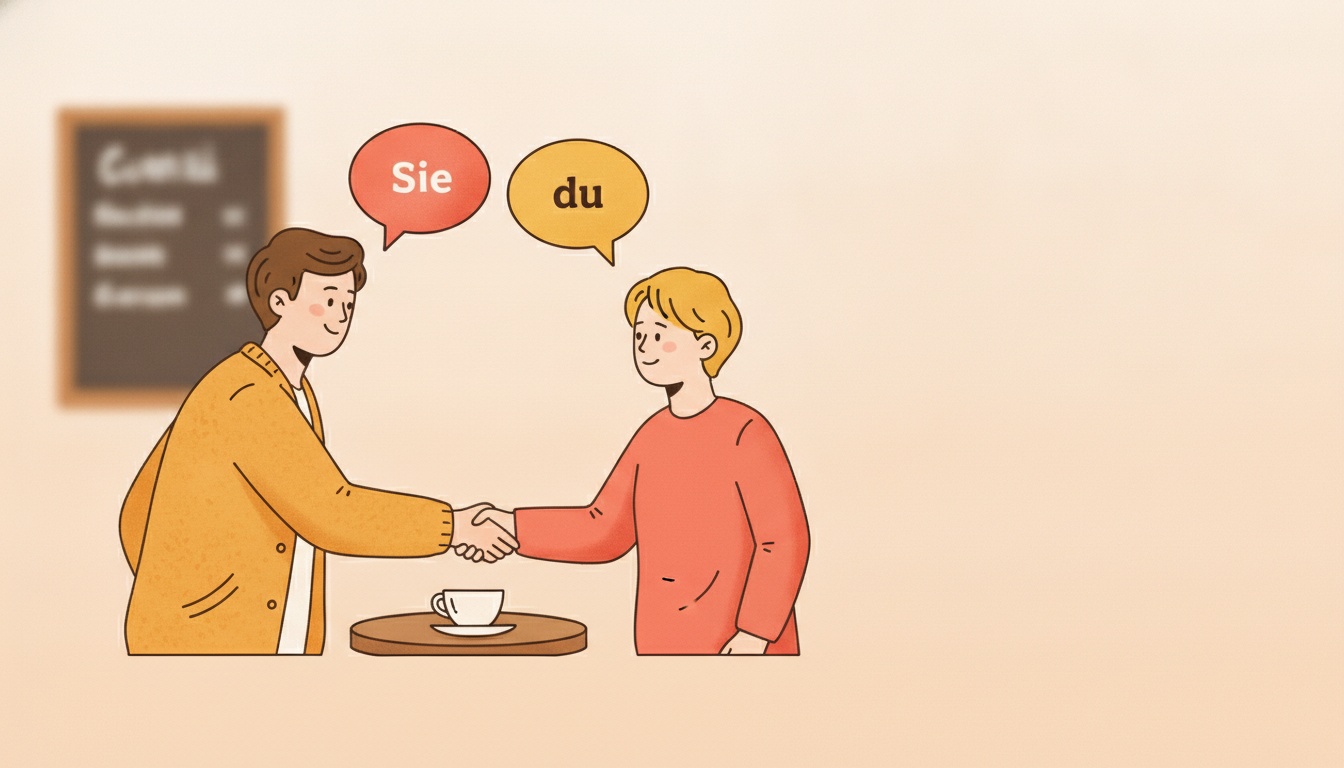
You're at a bakery counter in Berlin and the woman asks what you'd like. In your head, two sentences fight: "Haben Sie noch Brötchen?" or "Hast du noch Brötchen?" Same question, "Do you still have rolls?", but one of them is correct and the other makes you sound like you're hitting on the baker. Your textbook told you Sie is formal and du is informal, then left you alone at exactly this moment.
The formal-versus-informal line is true and almost useless. The part that actually trips up English speakers is everything the textbook skipped: who is allowed to switch first, when switching lands as friendly and when it lands as rude, and the fact that saying "du" to the wrong person is a real social stumble, not a rounding error. Here's how Germans actually decide, and what changes in your sentence the second you pick one.
The safe default that never gets you in trouble
Say Sie to any adult you don't know. The stranger on the train, the cashier, the clerk at the Bürgeramt, the new colleague three desks over whose name you just learned: all Sie. This is the rule that saves you, because the two mistakes are not equal. Using Sie with someone who expected du feels a little stiff and formal. Using du with someone who expected Sie can read as presumptuous or even disrespectful. Babbel and Charlingua both land on the same advice: when unsure, Sie.
So to the baker you say "Haben Sie noch Brötchen?" To your flatmate you say "Hast du noch Brötchen?" The difference isn't politeness in the abstract. It's the specific social distance German expects you to keep with someone you've known for four seconds.
Who gets to offer the du, and why it probably isn't you
The phrase to listen for is "Wollen wir uns duzen?", literally "shall we use du with each other?" Whoever says that sentence is doing something with real social weight, and it is almost never the new foreigner in the room. There's a rule about who's allowed to extend it.
Privately, the older person offers the du to the younger one. At work, the senior person offers it down the hierarchy, never the other way. Your boss can say "Sagen wir doch 'du'"; you cannot. German even has a name for this act, das Du anbieten, offering the du, and etiquette guides treat it as a small ceremony with a clear direction (kniggebenefit.de). As a newcomer you usually rank lowest on both the age and the seniority axis, so the move is simple: wait to be offered, don't offer it yourself.
You'll also read the traditional Knigge rule that a woman offers the du to a man. That one is genuinely old-fashioned. It still shows up in etiquette books, but in practice age and rank do most of the deciding now, so treat it as history, not a rule to act on. When someone does offer, a warm way to take it is "Gerne, ich bin Anna." You give your first name, because first names and du travel together.
Switching back to Sie is a slap
Once two people are on du, going back to Sie is not a neutral reset. It's a message, and the message is cold. Imagine a friend who has called you by your first name for a year suddenly addressing you as "Mr. Rodriguez" across a dinner table. That's the temperature of pointed re-Siezen. One German learning guide puts it flatly: "From 'du' there is no way back to 'Sie'" (Charlingua).
Two caveats keep you out of trouble. First, the offer of du can be politely declined, and a decline isn't an insult; some people simply prefer distance at work, and that's their call to make. Second, the snub reading is social, not legal. There's a much-repeated bit of internet folklore about a German court treating "du" as a punishable insult, but the cases people cite involved other insults piled on top, so don't believe a stray "du" is a crime. It's a faux pas, not an offense.
Where the rule bends: IKEA, startups, Bavaria
Walk into a German IKEA and the signs address you as du: "Hast du Fragen?" instead of "Haben Sie Fragen?" This isn't sloppiness. IKEA was the first company in Germany to deliberately duzen its customers, back in 2003 (The Local). It imported the flat Swedish habit of du for everyone, and once you know that, the du feels like branding rather than a question about your relationship.
IKEA is one corner of a bigger shift. Tech companies and startups often run entirely on du across the whole office. People under about thirty tend to duzen each other by default. Sports clubs and gyms tend to reach for du fast. On the other side, the Sie holdouts are exactly where you'd guess: banks, doctors' offices, courtrooms, government desks, and the older neighbor you pass on the stairs. Treat these as strong tendencies rather than a survey. A startup can have a formal older manager; a bank can have a du-friendly team.
Geography adds another layer. Southern Germany and Austria reach for du sooner, and Bavaria has a reputation for the fast du. Northern Germany, Hamburg especially, holds Sie longer (Lingoda). It's a tendency, not a border you can trust: plenty of Viennese institutions are as formal as anything in Hamburg. Read the room over the map.
The pronoun rewrites the whole sentence
"Wie heißen Sie?" becomes "Wie heißt du?", and three things move at once: the verb ending, the command form, and the word for "your." This is the part the etiquette articles skip, because switching pronoun quietly rewrites the sentence around it.
The verb ending is the loudest. Sie always takes the same form as "they", the infinitive-looking one, and it's capitalized wherever it appears: Sie kommen, Sie haben, Sie heißen. Du takes a -st ending: du kommst, du hast, du heißt. So "Woher kommen Sie?" and "Woher kommst du?" both mean "where are you from?", but every word after the question word is different.
Commands shift too. The Sie imperative is just the verb plus Sie: "Kommen Sie!", "Warten Sie!" The du imperative strips the verb down to its stem: "Komm!", "Warte!" Both put the verb first, one of the few places German word order lets it lead. And "your" splits: dein Auto to a friend, Ihr Auto to a stranger. Note the capital I, because Ihr meaning "your" (formal) is capitalized, while ihr meaning "you all" is not. That capital letter is doing real work.
Try it in Conversa
Practice with AI characters who adapt to your level and give real-time feedback.
Try Conversa FreeYour du/Sie playbook for this week
Start every cold interaction with Sie. That's move one, and you don't need to memorize a chart beyond it. Move two is to mirror: listen to which pronoun the other person uses on you and copy it back, because they've usually already made the decision for both of you. Move three: wait to be offered du rather than reaching for it, especially with anyone older or more senior. Move four: when the offer comes, accept it warmly and hand over your first name, "Gerne, ich bin Anna."
That's the whole system. The one thing reading can't give you is the reflex of hearing "Hast du kurz Zeit?" and answering in du without a two-second stall while you re-conjugate everything. That comes from actually doing it, ideally somewhere low-stakes where getting it wrong costs nothing. An AI conversation partner like Conversa is one place to rehearse the switch out loud, and to get comfortable with the casual flavoring words like doch and mal that come with on-du German, so the first time a real colleague offers you the du, your "Gerne" comes out smooth instead of startled.
Get the default right, mirror what you hear, and let Germans offer the du on their schedule. Do that and you'll never be the person who duzed the judge.
Quick answers
Is it rude to use du in German? It can be, with the wrong person. Using du with a stranger, an official, or a senior colleague who expected Sie reads as too familiar. With friends, kids, and peers it's completely normal. When unsure, start with Sie.
Who is allowed to offer the du? The older person in private settings, the higher-ranking person at work. As a newcomer you usually wait to be offered rather than offering it yourself.
Can I say no to a du offer? Yes, politely. Some people prefer Sie at work, and declining isn't an insult. But once you've accepted du, don't drift back to Sie without a reason.
What happens if I switch back to Sie? With someone you're on du with, switching back to Sie reads as a deliberate cold shoulder. It's a strong social signal, so don't do it by accident.
Du or Sie at work? It depends on the company. Startups and tech firms often use du across the board; banks, law firms, and traditional companies stay on Sie until it's offered. Follow whatever your colleagues use with you.