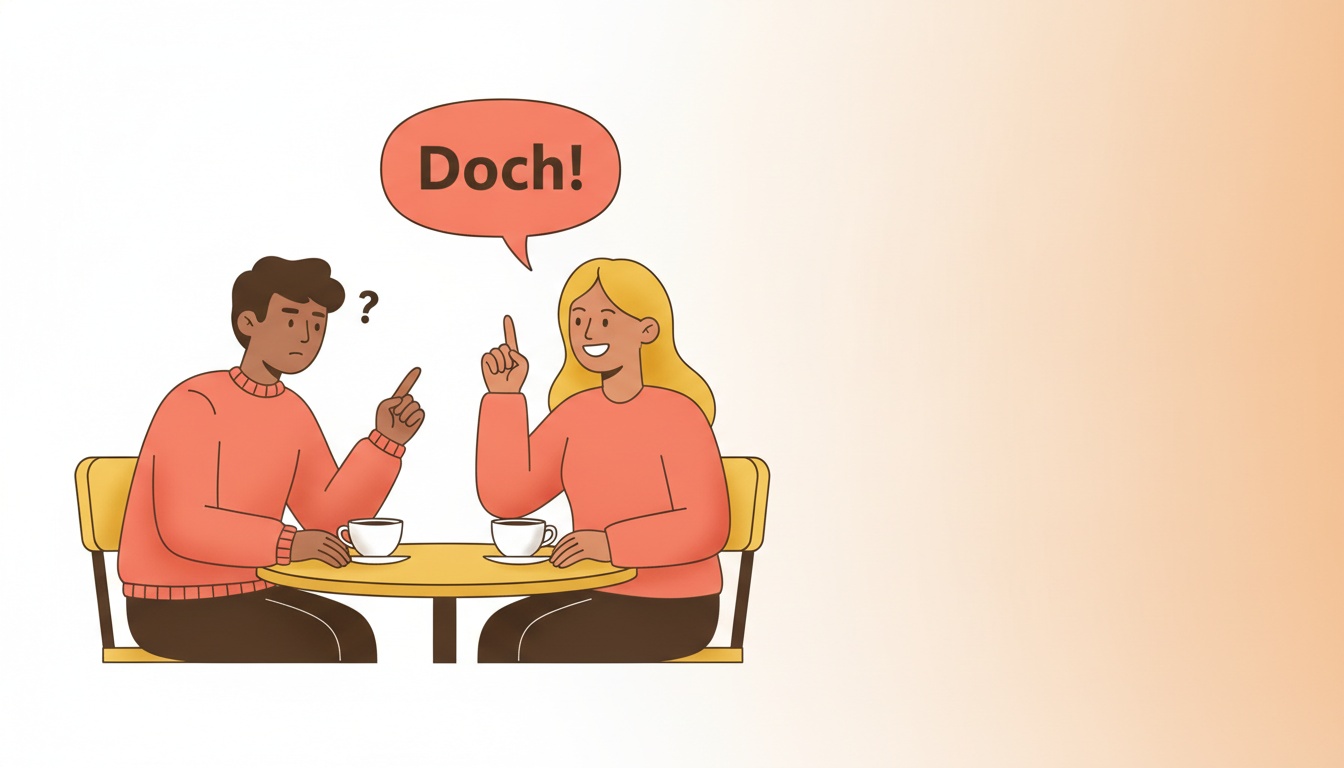
A German friend asks, "Magst du keinen Kaffee?" (You don't like coffee?). You do like coffee. In English you'd say "No, I do like it," and then spend three seconds untangling whether "no" means "no I don't" or "no, you're wrong." German fixes this with one word: "Doch!" Yes I do. You're wrong. Done.
That word is a modal particle, and it's one of about seven little words Germans drop into nearly every spoken sentence. Your textbook skipped them because they "don't translate." That's the wrong reason to skip them. They don't translate the way "Tisch" translates to "table," but each one does a specific, learnable job. Leave them out and your grammar can be flawless while you still sound like a voice from a train-station announcement.
Why your perfect German still sounds robotic
"Komm her" is grammatically correct. It also sounds like an order barked across a parking lot. "Komm mal her" means the same thing and sounds like a friend waving you over. The only difference is one unstressed syllable dropped into the middle.
That's what modal particles do: they carry tone, not dictionary meaning. Wikipedia notes they have no real English equivalent and live "mainly in the spontaneous spoken language in colloquial registers." Two consequences fall out of that. First, you say them flat and fast, never stressed. Second, you keep them out of your B2 essay. They belong in conversation, not formal writing.
One more structural fact worth knowing: these words sit in the middle of the sentence, after the conjugated verb, in the zone German grammar calls the Mittelfeld, the same middle ground that German word order builds its whole sentence bracket around. Linguists have shown this isn't a stylistic preference but a hard syntactic rule for these particles (the middle-field restriction). You don't need the terminology. You just need to know they slot in after the verb, not at the front. Here are the seven that matter most, each with the job it does and a frame you can copy.
Doch: the "yes I am!" English doesn't have
"Du hast keine Zeit" (you don't have time), a friend says, and you do have time. One word flips it: "Doch!" This is the particle to learn first, because English genuinely lacks it. When someone makes a negative statement or asks a negative question, "doch" fires back "yes, actually" and overturns it.
- "Magst du keinen Kaffee?" "Doch! Ich mag Kaffee." (Don't you like coffee? Yes I do!)
- "Du kommst nie pünktlich." "Doch!" (You're never on time. Yes I am!)
Notice the second one answers a statement, not a question (deutale walks through both cases). The template is dead simple: anyone says something negative about you or the world, you disagree, you say "Doch!" One word.
"Doch" has a second job inside sentences, where it leans on something you both already know. "Komm doch her!" is a warmer, more coaxing version of "come here." "Ich hab dir doch gesagt, dass es nicht so ist" means "I did tell you it isn't like that" with a built-in "as you'll recall." Same word, same flavor of "we both know this," just not used as a one-word reply.
Mal: turn an order into a casual ask
"Hör mal zu!" (Listen for a sec) lands softer than a bare "Hör zu." That's the whole job of "mal": it takes the edge off an imperative and makes it sound offhand, like adding "real quick" or "why don't you" in English.
- "Hör mal zu!" (Listen for a sec.)
- "Sag mal, möchtest du noch was zu essen?" (Say, do you want anything more to eat?)
- "Probier mal die Knödel." (Give the dumplings a try.)
Those last two come straight from UT Austin's Grimm Grammar, which also points out that "mal" is never stressed inside the sentence. The frame: take any command, drop "mal" in after the verb, and it stops sounding bossy. "Warte" (wait) becomes "Warte mal" (hang on a second). Note that "Hör zu" is itself a separable verb, zuhören, with its prefix flung to the end, and "mal" tucks in right before it. It's the cheapest politeness upgrade in the language.
Ja: "as you know" and "well, would you look at that"
"Das ist ja toll!" (Well, that's great!) doesn't mean "yes, that's great." The "ja" buried in the middle of that sentence isn't the "ja" that means yes. It does something else entirely, and it splits into two jobs.
The first flags shared knowledge, like a spoken "as you know." "Du weißt ja, wie er ist" (You know how he is, after all). The second marks mild surprise, as in "Das ist ja toll!" or, from Grimm Grammar, "Ihr müsst ja verhungert sein!" (You two must be starving!). Both readings drop "ja" right after the verb. If you're stating something the other person clearly already knows, or reacting to something you didn't expect, "ja" is the particle that signals it.
Halt and eben: German for "it is what it is"
"Das ist halt so." That's just how it is, nothing to be done. Some things can't be fixed, and German hands you a one-syllable shrug for them.
- "Der ist halt so, immer skeptisch." (He's just like that, always skeptical.)
- "Gute Kleider sind eben teuer." (Good clothes just are expensive.)
"Halt" and "eben" both deliver this resignation. "Eben" carries one extra trick: as a one-word reply it means "exactly." Someone lays out the problem, you nod and say "Eben." That's just it. The two aren't perfectly interchangeable in register. "Halt" sounds more colloquial and is often heard as southern-flavored, while "eben" reads as more neutral. Be careful with the popular claim that it's a clean north/south split, though: a recent sociolinguistic study found "halt" is actually spreading north and "eben" leans formal, so the geography is messier than the internet says. For your purposes: both mean "that's just how it is," and "halt" is the more casual pick.
Schon: the reassurance particle
"Das wird schon." (It'll work out.) When a German friend is anxious about something, the particle you reach for is "schon," meaning roughly "don't worry, it'll be fine."
- "Das wird schon." (It'll work out.)
- "Du schaffst das schon." (You'll manage it, trust me.)
Your Daily German treats this reassuring use as one of "schon"'s core particle jobs, separate from its everyday meaning. It can also carry impatience: "Jetzt komm schon!" (Come on already!).
Watch out for the trap here. "Schon" is also a plain adverb meaning "already," as in "Ich habe schon gegessen" (I've already eaten). Same spelling, completely different job. The particle reassures or prods; the adverb marks time. Context tells them apart, but don't assume every "schon" is the comforting one.
Try it in Conversa
Practice with AI characters who adapt to your level and give real-time feedback.
Try Conversa FreeDenn: make a question sound like you care
"Was machst du denn?" (So what are you up to?) feels warm and curious. Strip the "denn" and "Was machst du?" can land flat, even suspicious, depending on your tone. As a particle, "denn" turns a bare question into genuine interest.
It lives only in questions (Grimm Grammar). "Was meinst du denn?" (So what do you reckon?). "Was machst du denn mit dem Einhorn?" (What on earth are you doing with that unicorn?), an example Lingoda uses to show the curious, friendly flavor.
One confusion to clear up: "denn" is also a conjunction meaning "because." "Ich bleibe zu Hause, denn ich bin müde" (I'm staying home, because I'm tired). That's a different word doing a different job. The particle goes inside a question; the conjunction joins two statements. They won't collide if you remember the particle only ever shows up in questions.
Stack modal particles like a native
"Komm doch mal her!" stacks "doch" and "mal" on one short command, and it sounds completely natural. This is the part textbooks bury: Germans pile these particles up. Wikipedia lists real combinations like "doch mal" and even the four-particle "ja doch nun mal."
You don't need to engineer your own stacks yet. Keep it to two while you're finding your feet, and copy combinations you actually hear rather than inventing them. "Komm doch mal her" and "Das ist halt so" are safe, common, and will make you sound like you've spent time around real speakers instead of flashcards.
A few common questions
What's the difference between doch and ja? "Doch" contradicts a negative ("yes I do, you're wrong"). "Ja" confirms something you both already know or reacts with surprise. They're not interchangeable.
Is the particle denn the same as denn meaning "because"? No. The particle only appears in questions ("Was machst du denn?"). The "because" version joins two statements ("…, denn ich bin müde").
Where do they go in the sentence? After the conjugated verb, in the middle, never at the front. And never stressed.
Can I use two at once? Yes. "Komm doch mal her" is normal. Stick to two while learning.
Are they okay in formal writing? No. These are spoken German. Keep them out of essays and official emails.
Where to actually practice this
Reading about "doch" won't install the reflex. The only thing that does is being asked a negative question and having half a second to fire back "Doch!" before your brain reaches for "no." That comes from back-and-forth, from someone talking to you and reacting when your particle lands wrong or goes missing. An AI conversation partner like Conversa is one place to drill exactly that: real exchanges where you try "Komm mal her" and "Das ist halt so" out loud and find out whether they sound natural. Start with "doch." Catch one negative question with it this week, and the rest will start slotting in on their own.